

Test Yourself
Q1: Multiple Choice Type:
a. The amount of ₹ 1,000 in 2 years and at 20% compound interest compounded per year is:
Step 1: Identify the given values from the problem statement.
Step 2: Principal \( (P) = \text{₹ } 1,000 \), Rate \( (r) = 20\% \) p.a., Time \( (n) = 2 \) years.
Step 3: Apply the standard compound interest amount formula:
\[
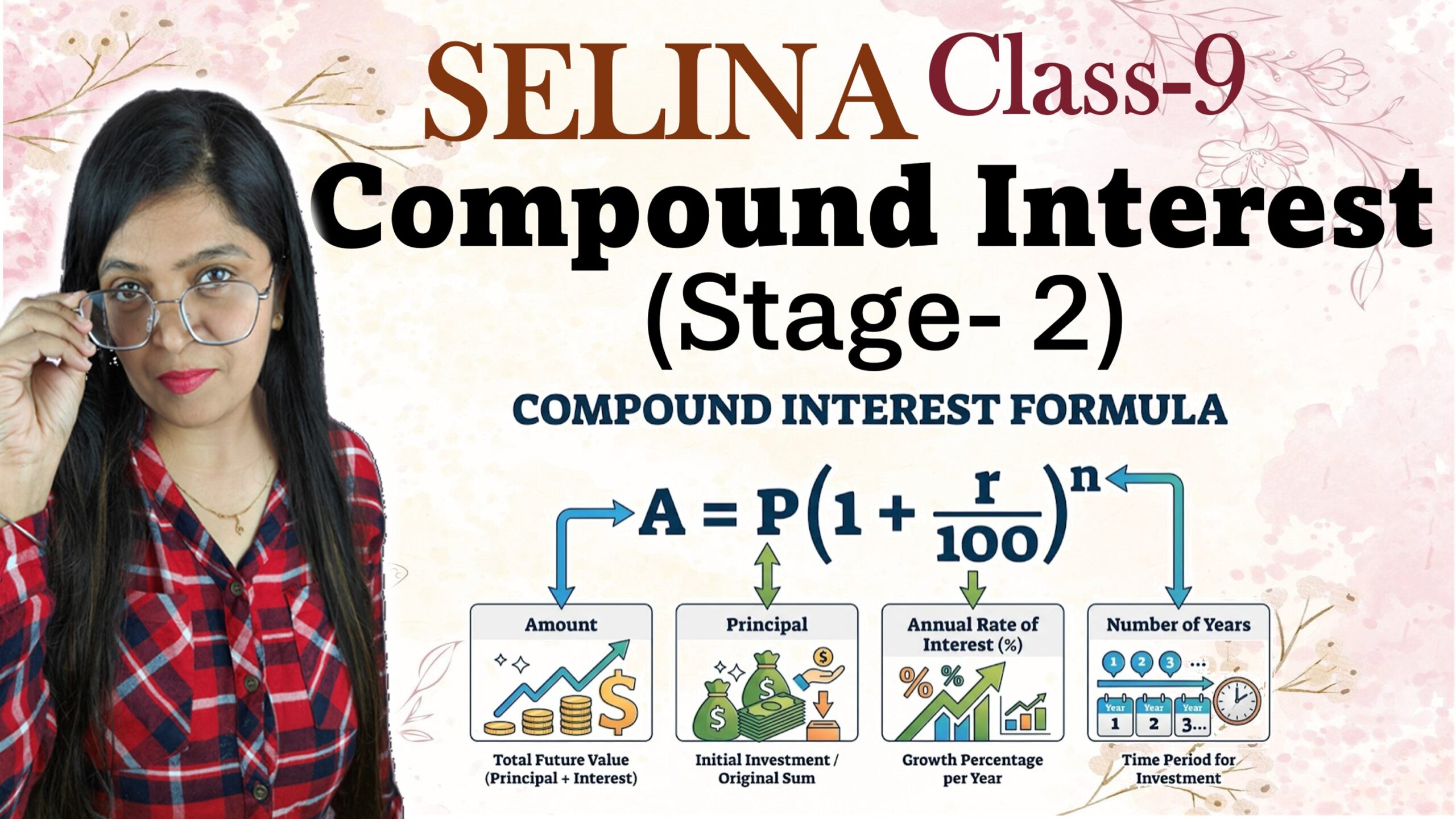
A = P \left(1 + \frac{r}{100}\right)^n
\]
Step 4: Substitute the known variables into the expression:
\[
A = 1000 \left(1 + \frac{20}{100}\right)^2 \\
A = 1000 \left(1 + \frac{1}{5}\right)^2 = 1000 \left(\frac{6}{5}\right)^2
\]
Step 5: Expand the squared term to calculate the accumulated amount:
\[
A = 1000 \times \frac{36}{25} = 40 \times 36 = \text{₹ } 1,440
\]
Answer: iv. ₹ 1,440
b. The difference between C.I. and S.I. at 10% in 2 years on ₹ 100 is:
Step 1: Identify the given values: Principal \( (P) = \text{₹ } 100 \), Rate \( (r) = 10\% \) p.a., Time \( = 2 \) years.
Step 2: Calculate the Simple Interest (S.I.):
\[
\text{S.I.} = \frac{P \times r \times t}{100} = \frac{100 \times 10 \times 2}{100} = \text{₹ } 20
\]
Step 3: Calculate the Amount (A) for Compound Interest:
\[
A = P \left(1 + \frac{r}{100}\right)^n = 100 \left(1 + \frac{10}{100}\right)^2 = 100 \left(\frac{11}{10}\right)^2 = 100 \times \frac{121}{100} = \text{₹ } 121
\]
Step 4: Determine Compound Interest (C.I.):
\[
\text{C.I.} = A – P = 121 – 100 = \text{₹ } 21
\]
Step 5: Compute the difference between C.I. and S.I.:
\[
\text{Difference} = \text{C.I.} – \text{S.I.} = 21 – 20 = \text{₹ } 1
\]
Answer: i. ₹ 1
c. A certain sum of money (₹ P) is lent for \(3\frac{1}{2}\) years at r% C.I. compounded half yearly. The interest accrued will be:
Step 1: Note that under half-yearly compounding, the annual rate is halved to \( \frac{r}{2}\% \).
Step 2: Adjust the conversion factor for the rate expression inside the bracket: \( \left(1 + \frac{r}{2 \times 100}\right) \).
Step 3: Convert the time period into total half-years: \( 3\frac{1}{2} \text{ years} = \frac{7}{2} \times 2 = 7 \text{ half-years} \).
Step 4: Set up the total compound interest layout by subtracting the principal: \( \text{C.I.} = \text{Amount} – P \).
\[
\text{C.I.} = P \left(1 + \frac{r}{2 \times 100}\right)^7 – P
\]
Answer: iv. \(P\left(1+\frac{\operatorname{r}}{2\times100}\right)^7-P\)
d. A certain sum of money (₹ P) is lent for \(3\frac{1}{2}\) years at r% C.I. compounded yearly. The interest accrued will be:
Step 1: For a broken timeline under yearly compounding, interest builds fully for 3 years and at half-rate for the remaining \(\frac{1}{2}\) year.
Step 2: Formulate the compounding factor for the first 3 full years: \( \left(1 + \frac{r}{100}\right)^3 \).
Step 3: Formulate the multiplier component for the remaining fractional year: \( \left(1 + \frac{r}{2 \times 100}\right)^1 \).
Step 4: Subtract principal \(P\) from the compound amount formula expression to determine net interest:
\[
\text{C.I.} = P \left(1 + \frac{r}{100}\right)^3 \times \left(1 + \frac{r}{2 \times 100}\right)^1 – P
\]
Answer: ii. \(P\left(1+\frac{\operatorname{r}}{100}\right)^3\times\left(1+\frac{\operatorname{r}}{2\times100}\right)^1-P\)
e. Statement 1: \(P\left(1+\frac{\operatorname{r}}{100}\right)^7-P\left(1+\frac{\operatorname{r}}{100}\right)^6\) = Interest accrued in 7th year
Statement 2: C.I. accrued in 7 years = \(P+P\left(1+\frac{\operatorname{r}}{100}\right)^7\) and C.I. accrued in 6 years = \(P+P\left(1+\frac{\operatorname{r}}{100}\right)^6\)
Step 1: Evaluate Statement 1. Interest for a specific year is the difference between total amounts at the end of that year and the preceding year: \( A_7 – A_6 \).
Step 2: Substituting the formulas gives \( P\left(1+\frac{r}{100}\right)^7 – P\left(1+\frac{r}{100}\right)^6 \). Thus, Statement 1 is true.
Step 3: Evaluate Statement 2. The formula for compound interest earned over \(n\) years is \( \text{C.I.} = A_n – P = P\left(1+\frac{r}{100}\right)^n – P \).
Step 4: The expressions given in Statement 2 add the principal instead of subtracting it, making them mathematically incorrect. Thus, Statement 2 is false.
Answer: iii. Statement 1 is true, and statement 2 is false
f. Statement 1: The population of a town was x in the year 2024 which increased by 10% every year. The population in the year 2021 was equal to \(x\left(1-\frac{10}{100}\right)^3\)
Statement 2: If the population increases from year 2021 to year 2024 at the rate of 10%, then corresponding decrease from 2024 to 2021 is 10 × 3%.
Step 1: Evaluate Statement 1. Let population in 2021 be \(P\). Growth for 3 years means \( x = P\left(1+\frac{10}{100}\right)^3 \), so \( P = \frac{x}{(1+10/100)^3} \).
Step 2: The expression \( x\left(1-\frac{10}{100}\right)^3 \) is incorrect because backward compounding is division, not subtraction. Thus, Statement 1 is false.
Step 3: Evaluate Statement 2. Compound growth changes the baseline value every year recursively.
Step 4: Percentage changes cannot be calculated backward by simply multiplying the annual rate by the number of years. Thus, Statement 2 is false.
Answer: ii. Both the statements are false.
g. Assertion (A): A certain sum of money (P) lent out at r% C.I., increased for first five years and then decreased for next five years at the same rate is same as decrease on the same sum at the same rate (r%) during the first five years and then increase for next five years at the same rate.
Reason (R): \(P\left(1+\frac{\operatorname{r}}{100}\right)^5\times\left(1-\frac{\operatorname{r}}{100}\right)^5\) is same as \(P\left(1-\frac{\operatorname{r}}{100}\right)^5\times\left(1+\frac{\operatorname{r}}{100}\right)^5\).
Step 1: Analyze the Assertion (A). Under the compound interest growth model, consecutive adjustments function as multiplier terms.
Step 2: Increasing for 5 years then decreasing for 5 years yields the mathematical expression: \[ P\left(1+\frac{r}{100}\right)^5 \times \left(1-\frac{r}{100}\right)^5 \]
Step 3: Reversing the order to decrease for 5 years then increase for 5 years yields: \[ P\left(1-\frac{r}{100}\right)^5 \times \left(1+\frac{r}{100}\right)^5 \]
Step 4: Multiplication satisfies the commutative property, meaning changing the order of the items does not change the final product. Thus, Assertion (A) is true.
Step 5: Analyze the Reason (R). It directly demonstrates that both operations result in the exact same algebraic product due to this commutative property.
Step 6: Since Reason (R) is true and perfectly justifies the equality claimed in Assertion (A), it is the correct explanation.
Answer: iii. Both A and R are true and R is the correct reason for A.
h. Assertion (A): \(A=P\left(1+\frac{10}{100}\right)^2=1.21P\)
Reason (R): \(\left(1+\frac{10}{100}\right)^2=\left(1.1\right)^2=1.21\)
Step 1: Evaluate the expression within the brackets in Assertion (A): \[ 1 + \frac{10}{100} = 1 + 0.1 = 1.1 \]
Step 2: Square the decimal multiplier to find the final scale value: \[ (1.1)^2 = 1.1 \times 1.1 = 1.21 \]
Step 3: Multiply the expanded decimal back by the principal variable to get \( 1.21P \). Thus, Assertion (A) is true.
Step 4: Evaluate Reason (R). It provides the exact step-by-step arithmetic computation for evaluating the fractional bracket expression squared.
Step 5: Reason (R) is correct, and it serves as the underlying mathematical proof for the assertion statement.
Answer: iii. Both A and R are true and R is the correct reason for A.
Q2: Simple interest on a sum of money for 2 years at 4% growth rate is ₹ 450. Find compound interest on same sum at the same rate for 1 year, if the interest is reckoned half-yearly.
Step 1: Let the initial sum of money (principal) be ₹ x.
Step 2: Identify the parameters for the simple interest calculation: Simple Interest \( (\text{S.I.}) = \text{₹ } 450 \), Rate \( (r) = 4\% \) p.a., Time \( (t) = 2 \) years.
Step 3: Write out the standard simple interest formula to solve for x:
\[
\text{S.I.} = \frac{x \times r \times t}{100}
\]
Step 4: Substitute the known parameters into the equation:
\[
450 = \frac{x \times 4 \times 2}{100} \\
450 = \frac{8x}{100}
\]
Step 5: Rearrange the terms to isolate and solve for the initial principal x:
\[
x = \frac{450 \times 100}{8} \\
x = \frac{45000}{8} \\
x = 5625
\]
Step 6: Identify the parameters for the compound interest calculation: Principal \( (P) = \text{₹ } 5,625 \), Rate \( (r) = 4\% \) p.a., Time \( = 1 \) year.
Step 7: Since the interest is reckoned half-yearly, adjust the compounding variables.
Step 8: Adjusted semi-annual interest rate \( (R) = \frac{4}{2}\% = 2\% \) per half-year.
Step 9: Total conversion periods in 1 year \( (n) = 1 \times 2 = 2 \) half-years.
Step 10: Set up the adjusted compound interest amount formula:
\[
A = P \left(1 + \frac{R}{100}\right)^n
\]
Step 11: Substitute the known values into the equation layout:
\[
A = 5625 \left(1 + \frac{2}{100}\right)^2 \\
A = 5625 \left(1 + \frac{1}{50}\right)^2 \\
A = 5625 \left(\frac{51}{50}\right)^2
\]
Step 12: Expand the squared term to calculate the accumulated amount:
\[
A = 5625 \times \frac{2601}{2500}
\]
Step 13: Simplify the multiplication and division steps:
\[
A = \frac{5625}{2500} \times 2601 \\
A = 2.25 \times 2601 \\
A = 5852.25
\]
Step 14: Calculate the Compound Interest (C.I.) using the relation \( \text{C.I.} = A – P \):
\[
\text{C.I.} = 5852.25 – 5625 \\
\text{C.I.} = 227.25
\]
Answer: Compound Interest = ₹ 227.25
Q3: Find the compound interest to the nearest rupee on ₹ 10,800 for \(2\frac{1}{2}\) years at 10% per annum.
Step 1: Identify the given values from the problem statement.
Step 2: Principal \( (P) = \text{₹ } 10,800 \), Time \( = 2\frac{1}{2} \text{ years} \), and Rate \( (r) = 10\% \) per annum.
Step 3: For a broken timeline under yearly compounding, interest builds fully for 2 years and at half-rate for the remaining \(\frac{1}{2}\) year.
Step 4: Apply the compound interest amount formula for a fractional time period:
\[
A = P \left(1 + \frac{r}{100}\right)^2 \times \left(1 + \frac{r}{2 \times 100}\right)^1
\]
Step 5: Substitute the known parameters into the formula expression:
\[
A = 10800 \left(1 + \frac{10}{100}\right)^2 \times \left(1 + \frac{10}{200}\right)^1
\]
Step 6: Simplify the fraction terms inside each bracket component:
\[
A = 10800 \left(1 + \frac{1}{10}\right)^2 \times \left(1 + \frac{1}{20}\right)^1 \\
A = 10800 \left(\frac{11}{10}\right)^2 \times \left(\frac{21}{20}\right)
\]
Step 7: Expand the squared term block component inside the expression:
\[
A = 10800 \times \frac{121}{100} \times \frac{21}{20}
\]
Step 8: Reduce the numbers by canceling out the common zeros:
\[
A = \frac{108 \times 121 \times 21}{20} \\
A = \frac{54 \times 121 \times 21}{10}
\]
Step 9: Perform the step-by-step multiplication for the numerator:
\[
A = \frac{6534 \times 21}{10} \\
A = \frac{137214}{10} \\
A = \text{₹ } 13,721.40
\]
Step 10: Calculate the Compound Interest (C.I.) using the formula \( \text{C.I.} = A – P \):
\[
\text{C.I.} = 13721.40 – 10800 \\
\text{C.I.} = \text{₹ } 2,921.40
\]
Step 11: Round off the calculated value to the nearest integer rupee:
\[
\text{C.I.} \approx \text{₹ } 2,921
\]
Answer: Compound Interest = ₹ 2,921
Q4: The value of a machine, purchased two years ago, depreciates at the annual rate of 10%. If its present value is ₹ 97,200, find:
i. its value after 2 years:
Step 1: Identify the present value of the machine to use as the initial baseline amount.
Step 2: Present Value \( (P) = \text{₹ } 97,200 \), Rate of depreciation \( (r) = 10\% \) per annum, Time \( (n) = 2 \) years.
Step 3: Apply the standard formula for asset value depreciation over time:
\[
A = P \left(1 – \frac{r}{100}\right)^n
\]
Step 4: Substitute the known parameters directly into the equation:
\[
A = 97200 \left(1 – \frac{10}{100}\right)^2
\]
Step 5: Simplify the fraction value within the brackets:
\[
A = 97200 \left(1 – \frac{1}{10}\right)^2 \\
A = 97200 \left(\frac{9}{10}\right)^2
\]
Step 6: Expand the squared fractional term component expression:
\[
A = 97200 \times \frac{81}{100}
\]
Step 7: Simplify by canceling common zeros and multiplying:
\[
A = 972 \times 81 \\
A = \text{₹ } 78,732
\]
Answer: Value after 2 years = ₹ 78,732
ii. its value when it was purchased:
Step 8: Let the initial cost when it was purchased (2 years ago) be ₹ x.
Step 9: The time duration from the purchase date to the present day is exactly \( 2 \) years.
Step 10: Set up the backward depreciation equation matching the present value:
\[
\text{Present Value} = x \left(1 – \frac{10}{100}\right)^2
\]
Step 11: Substitute the known present value parameter layout:
\[
97200 = x \left(\frac{9}{10}\right)^2 \\
97200 = x \left(\frac{81}{100}\right)
\]
Step 12: Isolate the variable x to calculate the original purchase price:
\[
x = \frac{97200 \times 100}{81}
\]
Step 13: Perform the final division step where \( 97200 \div 81 = 1200 \):
\[
x = 1200 \times 100 \\
x = 120000
\]
Answer: Value when it was purchased = ₹ 1,20,000
Q5: Anuj and Rajesh each lent the same sum of money for 2 years at 8% simple interest and compound interest respectively. Rajesh received ₹ 64 more than Anuj. Find the money lent by each and interest received.
Step 1: Let the initial sum of money lent by each be ₹ x.
Step 2: Identify the given values from the problem statement: Rate \( (r) = 8\% \) p.a., Time \( (n \text{ or } t) = 2 \) years.
Step 3: Calculate the Simple Interest (S.I.) received by Anuj in terms of x:
\[
\text{S.I.} = \frac{x \times r \times t}{100} \\
\text{S.I.} = \frac{x \times 8 \times 2}{100} = \frac{16x}{100}
\]
Step 4: Write out the formula for the Compound Interest (C.I.) received by Rajesh in terms of x:
\[
\text{C.I.} = x \left[\left(1 + \frac{r}{100}\right)^n – 1\right]
\]
Step 5: Substitute the values into the compound interest expression:
\[
\text{C.I.} = x \left[\left(1 + \frac{8}{100}\right)^2 – 1\right] \\
\text{C.I.} = x \left[\left(\frac{108}{100}\right)^2 – 1\right] \\
\text{C.I.} = x \left[\frac{11664}{10000} – 1\right] \\
\text{C.I.} = x \left[\frac{11664 – 10000}{10000}\right] = \frac{1664x}{10000}
\]
Step 6: Rajesh received ₹ 64 more than Anuj, which means the difference between C.I. and S.I. is ₹ 64:
\[
\text{C.I.} – \text{S.I.} = 64 \\
\frac{1664x}{10000} – \frac{16x}{100} = 64
\]
Step 7: Equate the denominators to solve the algebraic equation:
\[
\frac{1664x – 1600x}{10000} = 64 \\
\frac{64x}{10000} = 64
\]
Step 8: Rearrange the terms to solve for x:
\[
64x = 64 \times 10000 \\
x = 10000
\]
Step 9: Calculate the interest received by Anuj (Simple Interest):
\[
\text{S.I.} = \frac{16 \times 10000}{100} = 16 \times 100 = \text{₹ } 1,600
\]
Step 10: Calculate the interest received by Rajesh (Compound Interest):
\[
\text{C.I.} = \text{S.I.} + 64 = 1600 + 64 = \text{₹ } 1,664
\]
Answer: Sum lent by each = ₹ 10,000; Interest received by Anuj = ₹ 1,600; Interest received by Rajesh = ₹ 1,664.
Q6: Calculate the sum of money on which the compound interest (payable annually) for 2 years is four times the simple interest on ₹ 4,715 for 5 years, both at the rate of 5 per cent per annum.
Step 1: Identify the given values for calculating the Simple Interest (S.I.).
Step 2: Principal for simple interest \( (P_1) = \text{₹ } 4,715 \), Rate \( (r) = 5\% \) p.a., and Time \( (t) = 5 \) years.
Step 3: Calculate the Simple Interest using the formula:
\[
\text{S.I.} = \frac{P_1 \times r \times t}{100} \\
\text{S.I.} = \frac{4715 \times 5 \times 5}{100} \\
\text{S.I.} = \frac{4715 \times 25}{100} = \frac{4715}{4} = \text{₹ } 1,178.75
\]
Step 4: According to the problem statement, the compound interest is four times this simple interest:
\[
\text{Compound Interest (C.I.)} = 4 \times \text{S.I.} \\
\text{C.I.} = 4 \times 1178.75 = \text{₹ } 4,715
\]
Step 5: Let the required sum of money for compound interest be ₹ x.
Step 6: Identify the parameters for the compound interest part: Rate \( (r) = 5\% \) p.a., Time \( (n) = 2 \) years.
Step 7: Write down the compound interest formula in terms of principal:
\[
\text{C.I.} = x \left[\left(1 + \frac{r}{100}\right)^n – 1\right]
\]
Step 8: Substitute the known parameters into the equation:
\[
4715 = x \left[\left(1 + \frac{5}{100}\right)^2 – 1\right]
\]
Step 9: Simplify the fraction value inside the bracket term:
\[
4715 = x \left[\left(1 + \frac{1}{20}\right)^2 – 1\right] \\
4715 = x \left[\left(\frac{21}{20}\right)^2 – 1\right]
\]
Step 10: Expand the squared fraction expression:
\[
4715 = x \left[\frac{441}{400} – 1\right]
\]
Step 11: Perform the subtraction step inside the brackets:
\[
4715 = x \left[\frac{441 – 400}{400}\right] \\
4715 = x \left[\frac{41}{400}\right]
\]
Step 12: Rearrange the expression terms to isolate and solve for x:
\[
x = \frac{4715 \times 400}{41}
\]
Step 13: Perform the division step where \( 4715 \div 41 = 115 \):
\[
x = 115 \times 400 \\
x = 46000
\]
Answer: The required sum of money is ₹ 46,000.
Q7: A sum of money was invested for 3 years, interest being compounded annually. The rates for successive years were 10%, 15% and 18% respectively. If the compound interest for the second year amounted to ₹ 4,950, find the sum invested.
Step 1: Let the initial sum invested be ₹ x.
Step 2: Identify the given values from the problem statement.
Step 3: Rate for the 1st year \( (r_1) = 10\% \), Rate for the 2nd year \( (r_2) = 15\% \), and Rate for the 3rd year \( (r_3) = 18\% \).
Step 4: Calculate the amount at the end of the 1st year \( (A_1) \), which serves as the principal for the 2nd year:
\[
A_1 = x \left(1 + \frac{r_1}{100}\right) \\
A_1 = x \left(1 + \frac{10}{100}\right) = x \left(\frac{110}{100}\right) = \frac{11x}{10}
\]
Step 5: Formulate the compound interest for the 2nd year by applying the second year’s rate directly to \( A_1 \):
\[
\text{C.I. for 2nd year} = A_1 \times \frac{r_2}{100} \\
\text{C.I. for 2nd year} = \frac{11x}{10} \times \frac{15}{100} \\
\text{C.I. for 2nd year} = \frac{165x}{1000}
\]
Step 6: According to the problem statement, the compound interest for the second year is ₹ 4,950:
\[
\frac{165x}{1000} = 4950
\]
Step 7: Rearrange the terms to isolate and solve for the initial sum x:
\[
165x = 4950 \times 1000 \\
x = \frac{4950 \times 1000}{165}
\]
Step 8: Perform the division step where \( 4950 \div 165 = 30 \):
\[
x = 30 \times 1000 \\
x = 30000
\]
Answer: The sum invested was ₹ 30,000.
Q8: A sum of money is invested at 10% per annum compounded half-yearly. If the difference of amounts at the end of 6 months and 12 months is ₹ 189, find the sum of money invested.
Step 1: Let the initial sum of money invested be ₹ x.
Step 2: Identify the given values from the problem statement: Annual Rate \( (r) = 10\% \) p.a. compounded half-yearly.
Step 3: Adjust the interest parameters for semi-annual cycles: Half-yearly rate \( (R) = \frac{10}{2}\% = 5\% \) per half-year.
Step 4: Calculate the amount at the end of 6 months, which corresponds to \( n = 1 \) half-year cycle:
\[
A_1 = x \left(1 + \frac{5}{100}\right)^1 = x \left(1 + \frac{1}{20}\right) = \frac{21x}{20}
\]
Step 5: Calculate the amount at the end of 12 months, which corresponds to \( n = 2 \) half-year cycles:
\[
A_2 = x \left(1 + \frac{5}{100}\right)^2 = x \left(\frac{21}{20}\right)^2 = \frac{441x}{400}
\]
Step 6: According to the problem statement, the difference between these two amounts is ₹ 189:
\[
A_2 – A_1 = 189 \\
\frac{441x}{400} – \frac{21x}{20} = 189
\]
Step 7: Make the denominators common by multiplying the second fraction by \( \frac{20}{20} \):
\[
\frac{441x}{400} – \frac{21x \times 20}{20 \times 20} = 189 \\
\frac{441x}{400} – \frac{420x}{400} = 189 \\
\frac{441x – 420x}{400} = 189 \\
\frac{21x}{400} = 189
\]
Step 8: Rearrange the expression to isolate and solve for the initial sum x:
\[
21x = 189 \times 400 \\
x = \frac{189 \times 400}{21}
\]
Step 9: Perform the final division step where \( 189 \div 21 = 9 \):
\[
x = 9 \times 400 \\
x = 3600
\]
Answer: The sum of money invested is ₹ 3,600.
Q9: Rohit borrows ₹ 86,000 from Arun for two years at 5% per annum simple interest. He immediately lends out this money to Akshay at 5% compound interest compounded annually for the same period. Calculate Rohit’s profit in the transaction at the end of two years.
Step 1: Identify the given values from the problem statement.
Step 2: Principal \( (P) = \text{₹ } 86,000 \), Rate \( (r) = 5\% \) per annum, and Time \( (t \text{ or } n) = 2 \) years.
Step 3: Calculate the Simple Interest (S.I.) that Rohit owes to Arun using the formula:
\[
\text{S.I.} = \frac{P \times r \times t}{100}
\]
Step 4: Substitute the given values into the simple interest formula:
\[
\text{S.I.} = \frac{86000 \times 5 \times 2}{100} \\
\text{S.I.} = 860 \times 10 = \text{₹ } 8,600
\]
Step 5: Calculate the compound interest amount (A) that Rohit receives from Akshay using the formula:
\[
A = P \left(1 + \frac{r}{100}\right)^n
\]
Step 6: Substitute the parameters into the compound interest amount equation:
\[
A = 86000 \left(1 + \frac{5}{100}\right)^2
\]
Step 7: Simplify the fraction values within the brackets:
\[
A = 86000 \left(1 + \frac{1}{20}\right)^2 \\
A = 86000 \left(\frac{21}{20}\right)^2
\]
Step 8: Expand the squared terms to calculate the final accumulated amount:
\[
A = 86000 \times \frac{441}{400} \\
A = \frac{860 \times 441}{4} = 215 \times 441 = \text{₹ } 94,815
\]
Step 9: Calculate the Compound Interest (C.I.) using the formula \( \text{C.I.} = A – P \):
\[
\text{C.I.} = 94815 – 86000 = \text{₹ } 8,815
\]
Step 10: Calculate Rohit’s net profit in the transaction, which is the difference between the compound interest earned and the simple interest paid:
\[
\text{Profit} = \text{C.I.} – \text{S.I.} \\
\text{Profit} = 8815 – 8600 = \text{₹ } 215
\]
Answer: Rohit’s profit in the transaction at the end of two years is ₹ 215.
Q10: The simple interest on a certain sum of money for 3 years at 5% per annum is ₹ 1,200. Find the amount due and the interest on this sum of money at the same rate and after 2 years, interest is reckoned annually.
Step 1: Let the initial sum of money (principal) be ₹ x.
Step 2: Identify the parameters for the simple interest calculation: Simple Interest \( (\text{S.I.}) = \text{₹ } 1,200 \), Rate \( (r) = 5\% \) p.a., Time \( (t) = 3 \) years.
Step 3: Write down the simple interest formula to calculate x:
\[
\text{S.I.} = \frac{x \times r \times t}{100}
\]
Step 4: Substitute the known parameters into the equation:
\[
1200 = \frac{x \times 5 \times 3}{100} \\
1200 = \frac{15x}{100}
\]
Step 5: Isolate x to find the initial principal sum:
\[
x = \frac{1200 \times 100}{15} \\
x = 80 \times 100 = 8000
\]
Step 6: Identify the parameters for the compound interest calculation: Principal \( (P) = \text{₹ } 8,000 \), Rate \( (r) = 5\% \) p.a., Time \( (n) = 2 \) years.
Step 7: Apply the standard compound interest amount formula:
\[
A = P \left(1 + \frac{r}{100}\right)^n
\]
Step 8: Substitute the parameter values into the formula expression:
\[
A = 8000 \left(1 + \frac{5}{100}\right)^2
\]
Step 9: Simplify the fraction value within the brackets:
\[
A = 8000 \left(1 + \frac{1}{20}\right)^2 = 8000 \left(\frac{21}{20}\right)^2
\]
Step 10: Expand the squared term to calculate the accumulated amount due:
\[
A = 8000 \times \frac{441}{400} \\
A = 20 \times 441 = 8820
\]
Step 11: Calculate the Compound Interest (C.I.) using the relationship \( \text{C.I.} = A – P \):
\[
\text{C.I.} = 8820 – 8000 = 820
\]
Answer: Amount due = ₹ 8,820 and Compound Interest = ₹ 820
Q11: Nikita invests ₹ 6,000 for two years at a certain rate of interest compounded annually. At the end of first year it amounts to ₹ 6,720. Calculate:
a. the rate percent (i.e. rate of growth):
Step 1: Identify the given values from the problem statement for the first year.
Step 2: Principal \( (P) = \text{₹ } 6,000 \) and Amount at the end of the first year \( (A_1) = \text{₹ } 6,720 \).
Step 3: Calculate the interest earned during the first year:
\[
\text{Interest for 1st year} = A_1 – P \\
\text{Interest for 1st year} = 6720 – 6000 = \text{₹ } 720
\]
Step 4: Let the required rate of interest per annum be \( r \% \).
Step 5: Use the basic interest equation for the first single year cycle:
\[
\text{Interest} = \frac{P \times r \times 1}{100} \\
720 = \frac{6000 \times r}{100}
\]
Step 6: Simplify the algebraic expression to solve for percentage rate r:
\[
720 = 60r \\
r = \frac{720}{60} \\
r = 12\%
\]
Answer: Rate percent = 12% per annum
b. the amount at the end of the second year:
Step 7: Use the amount at the end of the first year as the initial principal for the second year.
Step 8: New Principal for the 2nd year \( (P_2) = \text{₹ } 6,720 \), Rate \( (r) = 12\% \), and Time \( = 1 \) year.
Step 9: Formulate the equation for the amount at the end of the second year \( (A_2) \):
\[
A_2 = P_2 \left(1 + \frac{r}{100}\right)
\]
Step 10: Substitute the known parameters into our formula:
\[
A_2 = 6720 \left(1 + \frac{12}{100}\right) \\
A_2 = 6720 \left(\frac{112}{100}\right)
\]
Step 11: Perform the final step-by-step decimal multiplication:
\[
A_2 = 6720 \times 1.12 \\
A_2 = \text{₹ } 7,526.40
\]
Answer: Amount at the end of the second year = ₹ 7,526.40
Q12: A certain sum of money invested at C.I. triples itself in 8 years interest being payable annually. In how many years will it be 81 times?
Step 1: Let the initial sum of money invested (principal) be ₹ x.
Step 2: According to the first condition, the money becomes 3 times itself: Amount \( (A_1) = 3x \) in Time \( (n_1) = 8 \) years.
Step 3: Let the rate of interest per annum be \( r \% \).
Step 4: Write down the standard compound interest amount formula:
\[
A = P \left(1 + \frac{r}{100}\right)^n
\]
Step 5: Substitute the parameters of the first condition into the formula:
\[
3x = x \left(1 + \frac{r}{100}\right)^8
\]
Step 6: Divide both sides by x to simplify the expression:
\[
3 = \left(1 + \frac{r}{100}\right)^8 \quad \text{— (Equation 1)}
\]
Step 7: According to the second condition, we want the money to become 81 times itself: Amount \( (A_2) = 81x \).
Step 8: Let the required time period for this expansion be \( n_2 \) years.
Step 9: Set up the equation for the second condition:
\[
81x = x \left(1 + \frac{r}{100}\right)^{n_2}
\]
Step 10: Divide both sides by x to eliminate the variable:
\[
81 = \left(1 + \frac{r}{100}\right)^{n_2} \quad \text{— (Equation 2)}
\]
Step 11: Express the number 81 as a power with base 3 to connect it to Equation 1:
\[
3^4 = \left(1 + \frac{r}{100}\right)^{n_2}
\]
Step 12: Substitute the value of 3 from Equation 1 into this expression:
\[
\left[\left(1 + \frac{r}{100}\right)^8\right]^4 = \left(1 + \frac{r}{100}\right)^{n_2}
\]
Step 13: Use the laws of exponents to multiply the powers on the left-hand side:
\[
\left(1 + \frac{r}{100}\right)^{8 \times 4} = \left(1 + \frac{r}{100}\right)^{n_2} \\
\left(1 + \frac{r}{100}\right)^{32} = \left(1 + \frac{r}{100}\right)^{n_2}
\]
Step 14: Compare exponents on both sides since the geometric bases match exactly:
\[
n_2 = 32
\]
Answer: Time period = 32 years
Q13: A certain sum of money doubles itself at a given rate in 8 years compounded yearly. In how many years will it be four times at the same rate compounded yearly?
Step 1: Let the initial sum of money (principal) be ₹ x.
Step 2: According to the first condition, the money doubles itself: Amount \( (A_1) = 2x \) in Time \( (n_1) = 8 \) years.
Step 3: Let the rate of interest per annum be \( r \% \).
Step 4: Write down the standard compound interest amount formula:
\[
A = P \left(1 + \frac{r}{100}\right)^n
\]
Step 5: Substitute the parameters of the first condition into the formula:
\[
2x = x \left(1 + \frac{r}{100}\right)^8
\]
Step 6: Divide both sides by x to simplify the expression:
\[
2 = \left(1 + \frac{r}{100}\right)^8 \quad \text{— (Equation 1)}
\]
Step 7: According to the second condition, we want the money to become 4 times itself: Amount \( (A_2) = 4x \).
Step 8: Let the required time period for this expansion be \( n_2 \) years.
Step 9: Set up the equation for the second condition:
\[
4x = x \left(1 + \frac{r}{100}\right)^{n_2}
\]
Step 10: Divide both sides by x to eliminate the variable:
\[
4 = \left(1 + \frac{r}{100}\right)^{n_2} \quad \text{— (Equation 2)}
\]
Step 11: Express the number 4 as a power with base 2 to connect it to Equation 1:
\[
2^2 = \left(1 + \frac{r}{100}\right)^{n_2}
\]
Step 12: Substitute the value of 2 from Equation 1 into this expression:
\[
\left[\left(1 + \frac{r}{100}\right)^8\right]^2 = \left(1 + \frac{r}{100}\right)^{n_2}
\]
Step 13: Use laws of exponents to multiply the powers on the left-hand side:
\[
\left(1 + \frac{r}{100}\right)^{8 \times 2} = \left(1 + \frac{r}{100}\right)^{n_2} \\
\left(1 + \frac{r}{100}\right)^{16} = \left(1 + \frac{r}{100}\right)^{n_2}
\]
Step 14: Compare exponents on both sides since the geometric bases match exactly:
\[
n_2 = 16
\]
Answer: Time period = 16 years
Q14: Mr. Sharma wants to divide ₹ 1,68,200 between his two sons who are 16 years and 18 years old respectively, in such a way that the sum invested at the rate of 5% p.a. compound interest annually will give the same amount to each when they attain the age of 21 years. How much should he divide the sum?
Step 1: Identify the given values from the problem statement.
Step 2: Total sum to be divided = ₹ 1,68,200, Rate of interest \( (r) = 5\% \) p.a.
Step 3: Calculate the investment time period for each son up to the age of 21 years.
Step 4: Time period for the younger son (16 years old) \( (n_1) = 21 – 16 = 5 \) years.
Step 5: Time period for the elder son (18 years old) \( (n_2) = 21 – 18 = 3 \) years.
Step 6: Let the share of the younger son be ₹ x.
Step 7: Then, the share of the elder son will be \( \text{₹ } (168200 – x) \).
Step 8: Write down the standard compound interest amount formula:
\[
A = P \left(1 + \frac{r}{100}\right)^n
\]
Step 9: Formulate the equation for the younger son’s final accumulated amount:
\[
\text{Younger Son’s Amount} = x \left(1 + \frac{5}{100}\right)^5
\]
Step 10: Formulate the equation for the elder son’s final accumulated amount:
\[
\text{Elder Son’s Amount} = (168200 – x) \left(1 + \frac{5}{100}\right)^3
\]
Step 11: Since they receive equal amounts at age 21, equate both expressions:
\[
x \left(1 + \frac{5}{100}\right)^5 = (168200 – x) \left(1 + \frac{5}{100}\right)^3
\]
Step 12: Divide both sides by \( \left(1 + \frac{5}{100}\right)^3 \) to simplify the powers:
\[
x \left(1 + \frac{5}{100}\right)^{5 – 3} = 168200 – x \\
x \left(1 + \frac{5}{100}\right)^2 = 168200 – x
\]
Step 13: Simplify the fraction value inside the bracket term:
\[
x \left(1 + \frac{1}{20}\right)^2 = 168200 – x \\
x \left(\frac{21}{20}\right)^2 = 168200 – x
\]
Step 14: Expand the squared term fraction block component:
\[
x \left(\frac{441}{400}\right) = 168200 – x \\
\frac{441x}{400} = 168200 – x
\]
Step 15: Transpose the variable term to isolate the x terms together:
\[
\frac{441x}{400} + x = 168200 \\
\frac{441x + 400x}{400} = 168200 \\
\frac{841x}{400} = 168200
\]
Step 16: Rearrange the terms to isolate and solve for x:
\[
841x = 168200 \times 400 \\
x = \frac{168200 \times 400}{841}
\]
Step 17: Perform the division step where \( 168200 \div 841 = 200 \):
\[
x = 200 \times 400 \\
x = 80000
\]
Step 18: Calculate the elder son’s share by substituting the value of x:
\[
\text{Elder Son’s Share} = 168200 – 80000 = 88200
\]
Answer: Younger son’s share = ₹ 80,000 and Elder son’s share = ₹ 88,200
Leave a Comment