

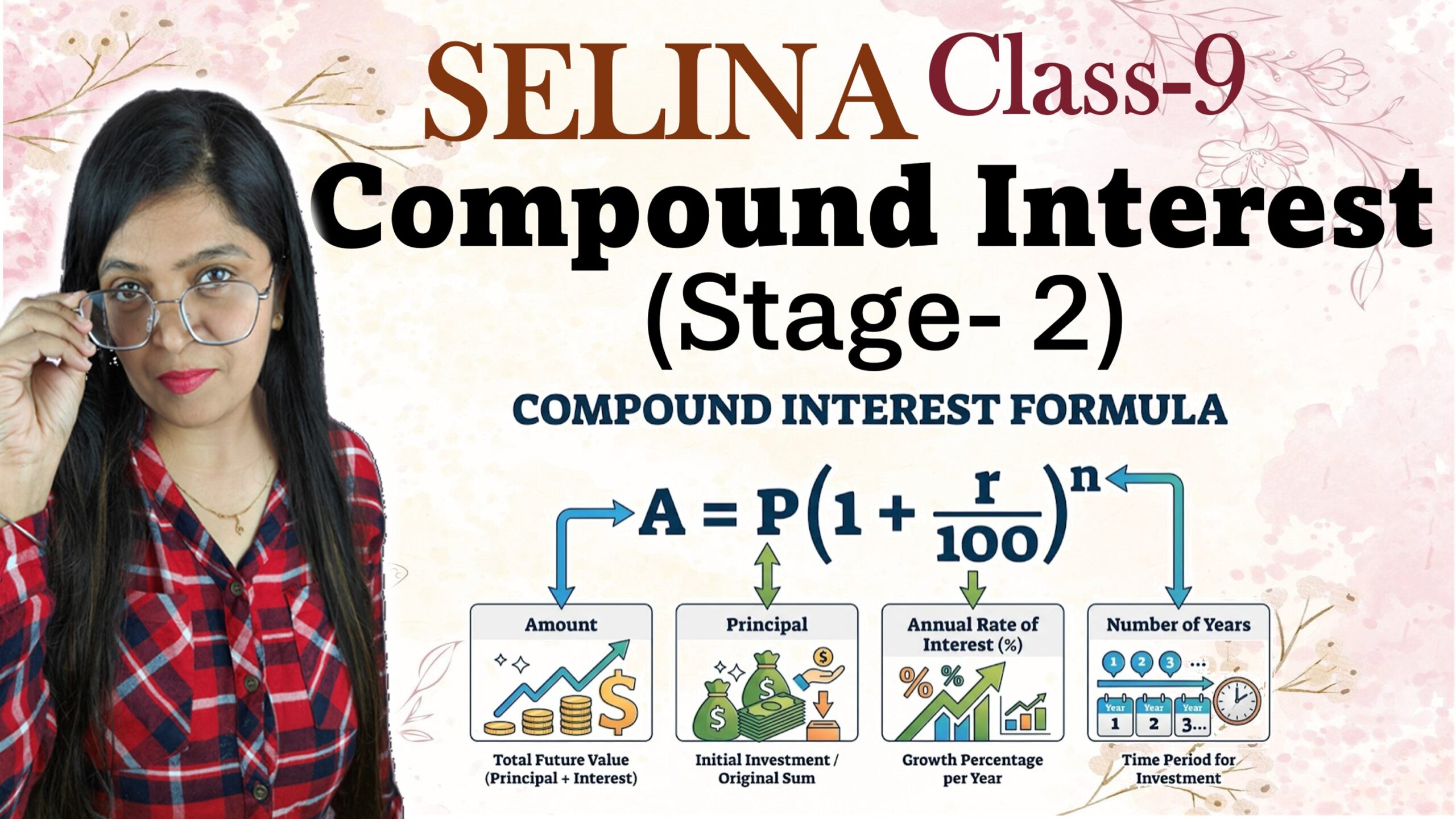
Exercise: 3B
Q1: Multiple Choice Type:
a. On ₹ 6,000, the difference between C.I. and S.I. in 2 years and at 10% interest, compounded per year, is:
Step 1: Identify the given values from the statement: Principal \( (P) = \text{₹ } 6,000 \), Time \( (n) = 2 \) years, Rate \( (r) = 10\% \) p.a.
Step 2: Calculate Simple Interest (S.I.):
\[
\text{S.I.} = \frac{P \times r \times t}{100} = \frac{6000 \times 10 \times 2}{100} = \text{₹ } 1,200
\]
Step 3: Calculate Amount (A) for Compound Interest:
\[
A = P \left(1 + \frac{r}{100}\right)^n = 6000 \left(1 + \frac{10}{100}\right)^2 = 6000 \left(\frac{11}{10}\right)^2 \\
A = 6000 \times \frac{121}{100} = 60 \times 121 = \text{₹ } 7,260
\]
Step 4: Calculate Compound Interest (C.I.):
\[
\text{C.I.} = A – P = 7260 – 6000 = \text{₹ } 1,260
\]
Step 5: Find the difference between C.I. and S.I.:
\[
\text{Difference} = \text{C.I.} – \text{S.I.} = 1260 – 1200 = \text{₹ } 60
\]
Answer: iii. ₹ 60
b. ₹ 10,000 amounts to ₹ 12,500 in one year. The rate of interest per year is:
Step 1: Extract given values: Principal \( (P) = \text{₹ } 10,000 \), Amount \( (A) = \text{₹ } 12,500 \), Time \( (n) = 1 \) year.
Step 2: For a single year period, use the formula:
\[
A = P \left(1 + \frac{r}{100}\right)
\]
Step 3: Insert the values and isolate the rate term:
\[
12500 = 10000 \left(1 + \frac{r}{100}\right) \\
\frac{12500}{10000} = 1 + \frac{r}{100} \\
1.25 = 1 + \frac{r}{100}
\]
Step 4: Subtract 1 and multiply by 100:
\[
\frac{r}{100} = 0.25 \\
r = 25\%
\]
Answer: iv. 25%
c. The C.I. on ₹ 16,000 in 2 years at the rate of 20% per annum is:
Step 1: Identify values: Principal \( (P) = \text{₹ } 16,000 \), Time \( (n) = 2 \) years, Rate \( (r) = 20\% \) p.a.
Step 2: Set up the compound amount formula:
\[
A = P \left(1 + \frac{r}{100}\right)^n
\]
Step 3: Substitute values and simplify:
\[
A = 16000 \left(1 + \frac{20}{100}\right)^2 = 16000 \left(1 + \frac{1}{5}\right)^2 = 16000 \left(\frac{6}{5}\right)^2 \\
A = 16000 \times \frac{36}{25} = 640 \times 36 = \text{₹ } 23,040
\]
Step 4: Determine Compound Interest:
\[
\text{C.I.} = A – P = 23040 – 16000 = \text{₹ } 7,040
\]
Answer: ii. ₹ 7,040
d. Simple interest, at the same rate for the same period as given above in part (c) is:
Step 1: Use the same parameters: Principal \( (P) = \text{₹ } 16,000 \), Rate \( (r) = 20\% \) p.a., Time \( (t) = 2 \) years.
Step 2: Apply the standard Simple Interest formula:
\[
\text{S.I.} = \frac{P \times r \times t}{100}
\]
Step 3: Calculate the final simple interest amount:
\[
\text{S.I.} = \frac{16000 \times 20 \times 2}{100} = 160 \times 40 = \text{₹ } 6,400
\]
Answer: ii. ₹ 6,400
e. The difference between C.I. and S.I. in 2 years as given above for parts (c) and (d) is:
Step 1: Fetch values calculated in previous parts: \( \text{C.I.} = \text{₹ } 7,040 \) and \( \text{S.I.} = \text{₹ } 6,400 \).
Step 2: Write down the variation relation formula:
\[
\text{Difference} = \text{C.I.} – \text{S.I.}
\]
Step 3: Perform the subtraction to find the solution:
\[
\text{Difference} = 7040 – 6400 = \text{₹ } 640
\]
Answer: i. ₹ 640
Q2: The difference between simple interest and compound interest on a certain sum is ₹ 54.40 for 2 years at 8 percent per annum. Find the sum.
Step 1: Let the initial cost or sum of money be ₹ x.
Step 2: Identify the given parameters from the problem: Rate \( (r) = 8\% \) p.a., Time \( (n \text{ or } t) = 2 \) years, and Difference \( (\text{C.I.} – \text{S.I.}) = \text{₹ } 54.40 \).
Step 3: Write out the formula for Simple Interest (S.I.) in terms of x:
\[
\text{S.I.} = \frac{x \times r \times t}{100} \\
\text{S.I.} = \frac{x \times 8 \times 2}{100} = \frac{16x}{100}
\]
Step 4: Write out the formula for Compound Interest (C.I.) in terms of x:
\[
\text{C.I.} = x \left[\left(1 + \frac{r}{100}\right)^n – 1\right]
\]
Step 5: Substitute the parameters into the compound interest expression:
\[
\text{C.I.} = x \left[\left(1 + \frac{8}{100}\right)^2 – 1\right] \\
\text{C.I.} = x \left[\left(\frac{108}{100}\right)^2 – 1\right] \\
\text{C.I.} = x \left[\frac{11664}{10000} – 1\right] \\
\text{C.I.} = x \left[\frac{11664 – 10000}{10000}\right] = \frac{1664x}{10000}
\]
Step 6: Formulate the difference equation between C.I. and S.I.:
\[
\text{C.I.} – \text{S.I.} = 54.40 \\
\frac{1664x}{10000} – \frac{16x}{100} = 54.40
\]
Step 7: Make the denominators common to solve the algebraic expression:
\[
\frac{1664x – 1600x}{10000} = 54.40 \\
\frac{64x}{10000} = 54.40
\]
Step 8: Rearrange the terms to isolate and solve for x:
\[
64x = 54.40 \times 10000 \\
64x = 544000 \\
x = \frac{544000}{64} \\
x = 8500
\]
Answer: The sum is ₹ 8,500.
Q3: Pramod and anand each lent the same sum of money for 2 years at 5% at simple interest and compound interest respectively. Anand received ₹ 15 more than Pramod. Find the amount of money lent by each and the interest received.
Step 1: Let the initial sum of money lent by each be ₹ x.
Step 2: Identify the given values from the problem: Rate \( (r) = 5\% \) p.a., Time \( (n \text{ or } t) = 2 \) years.
Step 3: Calculate the Simple Interest (S.I.) received by Pramod in terms of x:
\[
\text{S.I.} = \frac{x \times r \times t}{100} \\
\text{S.I.} = \frac{x \times 5 \times 2}{100} = \frac{10x}{100} = \frac{x}{10}
\]
Step 4: Write out the formula for the Compound Interest (C.I.) received by Anand in terms of x:
\[
\text{C.I.} = x \left[\left(1 + \frac{r}{100}\right)^n – 1\right]
\]
Step 5: Substitute the values into the compound interest expression:
\[
\text{C.I.} = x \left[\left(1 + \frac{5}{100}\right)^2 – 1\right] \\
\text{C.I.} = x \left[\left(1 + \frac{1}{20}\right)^2 – 1\right] \\
\text{C.I.} = x \left[\left(\frac{21}{20}\right)^2 – 1\right] \\
\text{C.I.} = x \left[\frac{441}{400} – 1\right] \\
\text{C.I.} = x \left[\frac{441 – 400}{400}\right] = \frac{41x}{400}
\]
Step 6: Anand received ₹ 15 more than Pramod, so the difference between C.I. and S.I. is ₹ 15:
\[
\text{C.I.} – \text{S.I.} = 15 \\
\frac{41x}{400} – \frac{x}{10} = 15
\]
Step 7: Equate the denominators to solve the algebraic equation:
\[
\frac{41x – 40x}{400} = 15 \\
\frac{x}{400} = 15
\]
Step 8: Multiply to find the value of x:
\[
x = 15 \times 400 \\
x = 6000
\]
Step 9: Calculate the interest received by Pramod (Simple Interest):
\[
\text{S.I.} = \frac{6000}{10} = \text{₹ } 600
\]
Step 10: Calculate the interest received by Anand (Compound Interest):
\[
\text{C.I.} = \frac{41 \times 6000}{400} = 41 \times 15 = \text{₹ } 615
\]
Answer: Sum lent by each = ₹ 6,000; Interest received by Pramod = ₹ 600; Interest received by Anand = ₹ 615.
Q4: Simple interest on a sum of money for 2 years at 4% is ₹ 450. Find the compound interest on the same sum and at the same rate for 2 years.
Step 1: Let the initial sum of money (principal) be ₹ x.
Step 2: Identify the given values from the problem statement.
Step 3: Simple Interest \( (\text{S.I.}) = \text{₹ } 450 \), Rate \( (r) = 4\% \) p.a., Time \( (t \text{ or } n) = 2 \) years.
Step 4: Write down the simple interest formula to calculate x:
\[
\text{S.I.} = \frac{x \times r \times t}{100}
\]
Step 5: Substitute the known parameters into the equation:
\[
450 = \frac{x \times 4 \times 2}{100} \\
450 = \frac{8x}{100}
\]
Step 6: Isolate x to find the initial principal amount:
\[
x = \frac{450 \times 100}{8} \\
x = \frac{45000}{8} \\
x = 5625
\]
Step 7: Now, apply the standard compound interest formula on this principal:
\[
\text{C.I.} = P \left[\left(1 + \frac{r}{100}\right)^n – 1\right]
\]
Step 8: Substitute \( P = 5625 \), \( r = 4 \), and \( n = 2 \) into the expression:
\[
\text{C.I.} = 5625 \left[\left(1 + \frac{4}{100}\right)^2 – 1\right]
\]
Step 9: Simplify the fractional value inside the brackets:
\[
\text{C.I.} = 5625 \left[\left(1 + \frac{1}{25}\right)^2 – 1\right] \\
\text{C.I.} = 5625 \left[\left(\frac{26}{25}\right)^2 – 1\right]
\]
Step 10: Expand the squared term to execute subtraction:
\[
\text{C.I.} = 5625 \left[\frac{676}{625} – 1\right] \\
\text{C.I.} = 5625 \left[\frac{676 – 625}{625}\right] \\
\text{C.I.} = 5625 \left[\frac{51}{625}\right]
\]
Step 11: Perform the final division and multiplication step where \( 5625 \div 625 = 9 \):
\[
\text{C.I.} = 9 \times 51 \\
\text{C.I.} = 459
\]
Answer: Compound Interest = ₹ 459
Q5: Compound interest on a certain sum of money at 5% per annum for two years is ₹ 246. Calculate simple interest on the same sum for 3 years at 6% per annum.
Step 1: Let the initial sum of money (principal) be ₹ x.
Step 2: Identify the given values from the first part of the problem statement.
Step 3: Compound Interest \( (\text{C.I.}) = \text{₹ } 246 \), Rate \( (r_1) = 5\% \) p.a., Time \( (n) = 2 \) years.
Step 4: Apply the standard formula connecting compound interest and principal:
\[
\text{C.I.} = x \left[\left(1 + \frac{r_1}{100}\right)^n – 1\right]
\]
Step 5: Substitute the known parameters into the equation:
\[
246 = x \left[\left(1 + \frac{5}{100}\right)^2 – 1\right]
\]
Step 6: Simplify the fraction within the brackets:
\[
246 = x \left[\left(1 + \frac{1}{20}\right)^2 – 1\right] \\
246 = x \left[\left(\frac{21}{20}\right)^2 – 1\right]
\]
Step 7: Expand the squared fraction term:
\[
246 = x \left[\frac{441}{400} – 1\right]
\]
Step 8: Simplify the subtraction inside the bracket:
\[
246 = x \left[\frac{441 – 400}{400}\right] \\
246 = x \left[\frac{41}{400}\right]
\]
Step 9: Rearrange the expression to isolate and solve for x:
\[
x = \frac{246 \times 400}{41}
\]
Step 10: Perform the division step where \( 246 \div 41 = 6 \):
\[
x = 6 \times 400 \\
x = 2400
\]
Step 11: Now, identify parameters for the second part of the problem statement.
Step 12: Principal \( (P) = \text{₹ } 2,400 \), New Rate \( (r_2) = 6\% \) p.a., New Time \( (t) = 3 \) years.
Step 13: Write down the standard simple interest formula:
\[
\text{S.I.} = \frac{P \times r_2 \times t}{100}
\]
Step 14: Substitute the parameters into the simple interest equation:
\[
\text{S.I.} = \frac{2400 \times 6 \times 3}{100}
\]
Step 15: Simplify the calculation by canceling out common zeros:
\[
\text{S.I.} = 24 \times 18 \\
\text{S.I.} = 432
\]
Answer: Simple Interest = ₹ 432
Q6: A sum of money, invested at compound interest, amount to ₹ 19,360 in 2 years and to ₹ 23,425.60 in 4 years. Find the rate percent and the original sum of money.
Step 1: Let the original sum of money (principal) be ₹ x.
Step 2: Identify the given values from the problem statement.
Step 3: Amount after 2 years \( (A_2) = \text{₹ } 19,360 \) and Amount after 4 years \( (A_4) = \text{₹ } 23,425.60 \).
Step 4: Let the rate of interest per annum be \( r \% \).
Step 5: Write down the compound interest amount formulas for both periods:
\[
A_2 = x \left(1 + \frac{r}{100}\right)^2 \\
A_4 = x \left(1 + \frac{r}{100}\right)^4
\]
Step 6: Substitute the known values into the respective equations:
\[
19360 = x \left(1 + \frac{r}{100}\right)^2 \quad \text{— (Equation 1)} \\
23425.60 = x \left(1 + \frac{r}{100}\right)^4 \quad \text{— (Equation 2)}
\]
Step 7: Divide Equation 2 by Equation 1 to eliminate the variable x:
\[
\frac{23425.60}{19360} = \frac{x \left(1 + \frac{r}{100}\right)^4}{x \left(1 + \frac{r}{100}\right)^2} \\
1.21 = \left(1 + \frac{r}{100}\right)^{4 – 2} \\
1.21 = \left(1 + \frac{r}{100}\right)^2
\]
Step 8: Express 1.21 as a fraction to simplify taking the square root:
\[
\frac{121}{100} = \left(1 + \frac{r}{100}\right)^2
\]
Step 9: Take the square root on both sides of the expression:
\[
\sqrt{\frac{121}{100}} = 1 + \frac{r}{100} \\
\frac{11}{10} = 1 + \frac{r}{100} \\
1.1 = 1 + \frac{r}{100}
\]
Step 10: Subtract 1 from both sides to isolate the rate fraction term:
\[
\frac{r}{100} = 1.1 – 1 \\
\frac{r}{100} = 0.1
\]
Step 11: Multiply by 100 to solve for the interest rate percentage value r:
\[
r = 0.1 \times 100 \\
r = 10\%
\]
Step 12: Substitute the value of \( r = 10 \) back into Equation 1 to find the original sum x:
\[
19360 = x \left(1 + \frac{10}{100}\right)^2
\]
Step 13: Simplify the terms inside the brackets:
\[
19360 = x \left(1 + \frac{1}{10}\right)^2 \\
19360 = x \left(\frac{11}{10}\right)^2
\]
Step 14: Expand the squared fractional term:
\[
19360 = x \left(\frac{121}{100}\right)
\]
Step 15: Rearrange the expression to solve directly for original sum x:
\[
x = \frac{19360 \times 100}{121}
\]
Step 16: Perform the division step where \( 19360 \div 121 = 160 \):
\[
x = 160 \times 100 \\
x = 16000
\]
Answer: Rate of interest = 10% per annum and Original sum of money = ₹ 16,000
Q7: A sum of money lent out at C.I. at a certain rate per annum becomes three times of itself in 8 years. Find in how many years will the money become twenty-seven times of itself at the same rate of interest p.a.
Step 1: Let the initial sum of money (principal) be ₹ x.
Step 2: According to the first condition, the money becomes 3 times itself: Amount \( (A_1) = 3x \) in Time \( (n_1) = 8 \) years.
Step 3: Let the rate of interest per annum be \( r \% \).
Step 4: Write down the standard compound interest amount formula:
\[
A = P \left(1 + \frac{r}{100}\right)^n
\]
Step 5: Substitute the parameters of the first condition into the formula:
\[
3x = x \left(1 + \frac{r}{100}\right)^8
\]
Step 6: Divide both sides by x to eliminate the variable:
\[
3 = \left(1 + \frac{r}{100}\right)^8 \quad \text{— (Equation 1)}
\]
Step 7: According to the second condition, we want the money to become 27 times itself: Amount \( (A_2) = 27x \).
Step 8: Let the required time period for this growth be \( n_2 \) years.
Step 9: Set up the equation for the second condition:
\[
27x = x \left(1 + \frac{r}{100}\right)^{n_2}
\]
Step 10: Divide both sides by x to simplify the expression:
\[
27 = \left(1 + \frac{r}{100}\right)^{n_2} \quad \text{— (Equation 2)}
\]
Step 11: Express the number 27 as a base of 3 to link it to Equation 1:
\[
3^3 = \left(1 + \frac{r}{100}\right)^{n_2}
\]
Step 12: Substitute the value of 3 from Equation 1 into this expression:
\[
\left[\left(1 + \frac{r}{100}\right)^8\right]^3 = \left(1 + \frac{r}{100}\right)^{n_2}
\]
Step 13: Use exponent rules to multiply the powers on the left-hand side:
\[
\left(1 + \frac{r}{100}\right)^{8 \times 3} = \left(1 + \frac{r}{100}\right)^{n_2} \\
\left(1 + \frac{r}{100}\right)^{24} = \left(1 + \frac{r}{100}\right)^{n_2}
\]
Step 14: Compare the exponents on both sides since the geometric bases match exactly:
\[
n_2 = 24
\]
Answer: Time period = 24 years
Q8: On what sum of money will compound interest (payable annually) for 2 years be the same as simple interest on ₹ 9,430 for 10 years, both at the rate of 5 percent per annum?
Step 1: Identify the given values for calculating the Simple Interest (S.I.).
Step 2: Principal for simple interest \( (P_1) = \text{₹ } 9,430 \), Rate \( (r) = 5\% \) p.a., and Time \( (t) = 10 \) years.
Step 3: Calculate the Simple Interest using the formula:
\[
\text{S.I.} = \frac{P_1 \times r \times t}{100} \\
\text{S.I.} = \frac{9430 \times 5 \times 10}{100} \\
\text{S.I.} = 943 \times 5 = \text{₹ } 4,715
\]
Step 4: According to the problem statement, this interest is equal to the compound interest: Compound Interest \( (\text{C.I.}) = \text{₹ } 4,715 \).
Step 5: Let the required sum of money for compound interest be ₹ x.
Step 6: Identify the parameters for the compound interest part: Rate \( (r) = 5\% \) p.a., Time \( (n) = 2 \) years.
Step 7: Write down the compound interest formula in terms of principal:
\[
\text{C.I.} = x \left[\left(1 + \frac{r}{100}\right)^n – 1\right]
\]
Step 8: Substitute the known parameters into the equation:
\[
4715 = x \left[\left(1 + \frac{5}{100}\right)^2 – 1\right]
\]
Step 9: Simplify the fractional value inside the bracket term:
\[
4715 = x \left[\left(1 + \frac{1}{20}\right)^2 – 1\right] \\
4715 = x \left[\left(\frac{21}{20}\right)^2 – 1\right]
\]
Step 10: Expand the squared fraction expression:
\[
4715 = x \left[\frac{441}{400} – 1\right]
\]
Step 11: Perform the subtraction step inside the brackets:
\[
4715 = x \left[\frac{441 – 400}{400}\right] \\
4715 = x \left[\frac{41}{400}\right]
\]
Step 12: Rearrange the expression terms to isolate and solve for x:
\[
x = \frac{4715 \times 400}{41}
\]
Step 13: Perform the division step where \( 4715 \div 41 = 115 \):
\[
x = 115 \times 400 \\
x = 46000
\]
Answer: The required sum of money is ₹ 46,000.
Q9: Simple interest on a certain sum of money for 4 years at 4% per annum exceeds the compound interest on the same sum for 3 years at 5 percent per annum by ₹ 228. Find the sum.
Step 1: Let the initial cost or sum of money be ₹ x.
Step 2: Identify the parameters for the simple interest calculation: Time \( (t) = 4 \) years, Rate \( (r_1) = 4\% \) p.a.
Step 3: Formulate the Simple Interest (S.I.) equation using the standard formula:
\[
\text{S.I.} = \frac{x \times r_1 \times t}{100} \\
\text{S.I.} = \frac{x \times 4 \times 4}{100} = \frac{16x}{100}
\]
Step 4: Identify the parameters for the compound interest calculation: Time \( (n) = 3 \) years, Rate \( (r_2) = 5\% \) p.a.
Step 5: Write out the formula for Compound Interest (C.I.) in terms of x:
\[
\text{C.I.} = x \left[\left(1 + \frac{r_2}{100}\right)^n – 1\right]
\]
Step 6: Substitute the known compound interest values into the equation:
\[
\text{C.I.} = x \left[\left(1 + \frac{5}{100}\right)^3 – 1\right] \\
\text{C.I.} = x \left[\left(1 + \frac{1}{20}\right)^3 – 1\right] \\
\text{C.I.} = x \left[\left(\frac{21}{20}\right)^3 – 1\right]
\]
Step 7: Expand the cubed fraction expression inside the bracket:
\[
\text{C.I.} = x \left[\frac{9261}{8000} – 1\right] \\
\text{C.I.} = x \left[\frac{9261 – 8000}{8000}\right] = \frac{1261x}{8000}
\]
Step 8: According to the problem statement, simple interest exceeds compound interest by ₹ 228:
\[
\text{S.I.} – \text{C.I.} = 228 \\
\frac{16x}{100} – \frac{1261x}{8000} = 228
\]
Step 9: Make the denominators common by multiplying the first fraction by \( \frac{80}{80} \):
\[
\frac{16x \times 80}{100 \times 80} – \frac{1261x}{8000} = 228 \\
\frac{1280x}{8000} – \frac{1261x}{8000} = 228 \\
\frac{1280x – 1261x}{8000} = 228 \\
\frac{19x}{8000} = 228
\]
Step 10: Rearrange the terms to isolate and solve for sum x:
\[
19x = 228 \times 8000 \\
x = \frac{228 \times 8000}{19}
\]
Step 11: Perform the final division step where \( 228 \div 19 = 12 \):
\[
x = 12 \times 8000 \\
x = 96000
\]
Answer: The sum of money is ₹ 96,000.
Q10: A certain sum of money amounts to ₹ 23,400 in 3 years at 10% per annum simple interest. Find the amount of the same sum in 2 years and at 10% p.a. compound interest.
Step 1: Let the initial sum of money (principal) be ₹ x.
Step 2: Identify the given values from the simple interest part: Amount \( (A_{\text{S.I.}}) = \text{₹ } 23,400 \), Time \( (t) = 3 \) years, and Rate \( (r) = 10\% \) p.a.
Step 3: Write down the simple interest amount formula:
\[
A_{\text{S.I.}} = x + \text{S.I.} = x + \frac{x \times r \times t}{100} \\
A_{\text{S.I.}} = x \left(1 + \frac{r \times t}{100}\right)
\]
Step 4: Substitute the known simple interest parameters into the equation:
\[
23400 = x \left(1 + \frac{10 \times 3}{100}\right) \\
23400 = x \left(1 + \frac{30}{100}\right) \\
23400 = x \left(\frac{130}{100}\right)
\]
Step 5: Rearrange the terms to solve for the principal sum x:
\[
x = \frac{23400 \times 100}{130} \\
x = \frac{234000}{13} \\
x = 18000
\]
Step 6: Now, identify parameters for the second part of the problem to calculate the compound interest amount.
Step 7: Principal \( (P) = \text{₹ } 18,000 \), Rate \( (r) = 10\% \) p.a., and Time \( (n) = 2 \) years.
Step 8: Apply the standard compound interest amount formula:
\[
A_{\text{C.I.}} = P \left(1 + \frac{r}{100}\right)^n
\]
Step 9: Substitute the values into the compound amount formula:
\[
A_{\text{C.I.}} = 18000 \left(1 + \frac{10}{100}\right)^2
\]
Step 10: Simplify the fraction value within the brackets:
\[
A_{\text{C.I.}} = 18000 \left(1 + \frac{1}{10}\right)^2 \\
A_{\text{C.I.}} = 18000 \left(\frac{11}{10}\right)^2
\]
Step 11: Expand the squared fraction expression:
\[
A_{\text{C.I.}} = 18000 \times \frac{121}{100}
\]
Step 12: Simplify by canceling out the zeros from the denominator:
\[
A_{\text{C.I.}} = 180 \times 121 \\
A_{\text{C.I.}} = 21780
\]
Answer: The required amount under compound interest is ₹ 21,780.
Q11: Mohit borrowed a certain sum at 5% per annum compound interest and cleared this loan by paying ₹ 12,600 at the end of the first year and ₹ 17,640 at the end of the second year. Find the sum borrowed.
Step 1: Let the initial sum borrowed by Mohit be ₹ x.
Step 2: Identify the given values from the problem statement: Rate of interest \( (r) = 5\% \) per annum.
Step 3: Calculate the total accumulated amount due at the end of the first year before payment:
\[
\text{Amount after 1 year} = x \left(1 + \frac{5}{100}\right) = x \left(1 + \frac{1}{20}\right) = \frac{21x}{20}
\]
Step 4: Subtract the first year repayment of ₹ 12,600 to find the remaining principal balance:
\[
\text{Remaining Principal balance} = \frac{21x}{20} – 12600
\]
Step 5: This balance acts as the principal for the second year. Compute the final amount due at the end of the second year:
\[
\text{Amount after 2 years} = \left(\frac{21x}{20} – 12600\right) \left(1 + \frac{5}{100}\right) \\
\text{Amount after 2 years} = \left(\frac{21x}{20} – 12600\right) \left(\frac{21}{20}\right)
\]
Step 6: According to the problem statement, this final amount is completely cleared by paying ₹ 17,640:
\[
\left(\frac{21x}{20} – 12600\right) \left(\frac{21}{20}\right) = 17640
\]
Step 7: Isolate the term inside the bracket by multiplying by \( \frac{20}{21} \) on the right side:
\[
\frac{21x}{20} – 12600 = \frac{17640 \times 20}{21}
\]
Step 8: Perform the division step where \( 17640 \div 21 = 840 \):
\[
\frac{21x}{20} – 12600 = 840 \times 20 \\
\frac{21x}{20} – 12600 = 16800
\]
Step 9: Transpose the numerical constant term to isolate the variable expression:
\[
\frac{21x}{20} = 16800 + 12600 \\
\frac{21x}{20} = 29400
\]
Step 10: Rearrange the remaining terms to find the initial sum borrowed x:
\[
x = \frac{29400 \times 20}{21}
\]
Step 11: Perform the final division and multiplication step where \( 29400 \div 21 = 1400 \):
\[
x = 1400 \times 20 \\
x = 28000
\]
Answer: The sum borrowed is ₹ 28,000.
Leave a Comment