

Case-Study Based Question
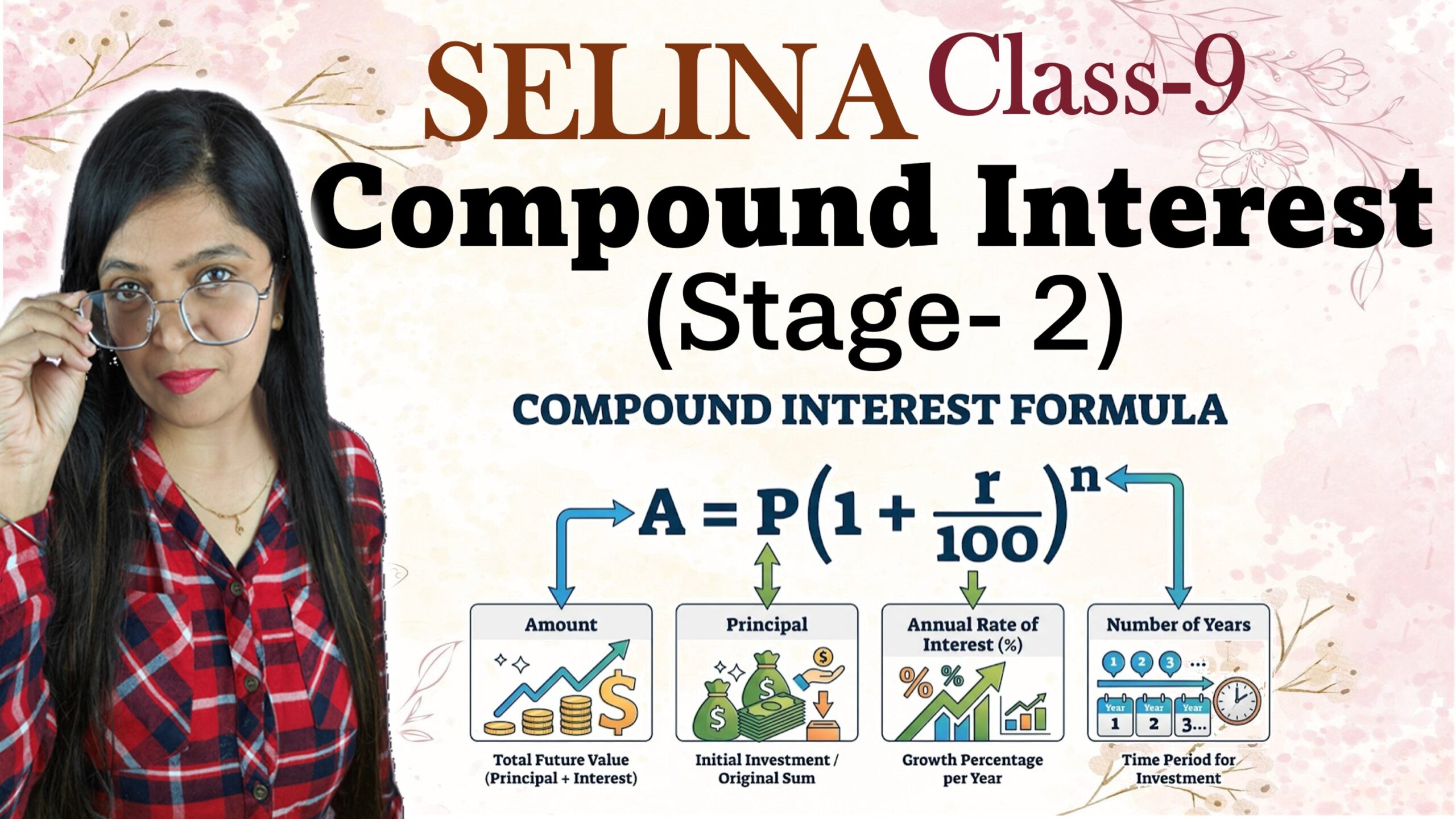
Q1: The compound interest formula is: \(A=P\left(1+\frac{\operatorname{r}}{100}\right)^n\), in which each letter A, P, r and n has the usual meaning. The same formula can be re-written as \(A=P\left(1+\frac{\operatorname{r}}{100\times N}\right)^{n\times N}\), where n is the time in years and N is the number of times the interest is compounded per year. For each of the following cases, take time (n) = 1 year, rate of interest per year (r) = 6% and sum invested (P) = ₹ 4,000.
a. Calculate the amount when the interest is compounded quarterly:
Step 1: Identify the given values: Principal \( (P) = \text{₹ } 4,000 \), Rate \( (r) = 6\% \) per annum, Time \( (n) = 1 \) year.
Step 2: Since interest is compounded quarterly, there are four compounding periods in one year, so \( N = 4 \).
Step 3: Write down the revised compound interest formula given in the problem statement:
\[
A = P \left(1 + \frac{r}{100 \times N}\right)^{n \times N}
\]
Step 4: Substitute the known parameters into the equation:
\[
A = 4000 \left(1 + \frac{6}{100 \times 4}\right)^{1 \times 4} \\
A = 4000 \left(1 + \frac{6}{400}\right)^4
\]
Step 5: Simplify the fraction within the brackets to a decimal component:
\[
A = 4000 \left(1 + \frac{3}{200}\right)^4 \\
A = 4000 \left(1 + 0.015\right)^4 \\
A = 4000 \left(1.015\right)^4
\]
Step 6: Calculate the exponential decimal value up to six decimal places:
\[
(1.015)^4 = 1.06136355
\]
Step 7: Perform the multiplication step to calculate the total amount:
\[
A = 4000 \times 1.06136355 \\
A = 4245.4542
\]
Step 8: Round the calculated accumulated sum to standard currency decimal places:
\[
A \approx \text{₹ } 4,245.45
\]
Answer: Amount = ₹ 4,245.45
b. Observation from the cases discussed:
Step 9: Note down the final amounts calculated under the different compounding frequencies:
• Compounded Half-Yearly (\(N = 2\)): \( A = \text{₹ } 4,243.60 \)
• Compounded Every Four Months (\(N = 3\)): \( A = \text{₹ } 4,244.83 \)
• Compounded Quarterly (\(N = 4\)): \( A = \text{₹ } 4,245.45 \)
Step 10: Compare the values and establish the numerical trend line inequality:
\[
4245.45 > 4244.83 > 4243.60
\]
Step 11: Conclude the trend concept as a general financial principle rule.
Answer: Observation: We observe that as the frequency of compounding per year (N) increases, the final accumulated amount (A) also increases for the same principal, rate, and time.
Q2: In the 2024-25 period, India collected approximately 1.46 crore (14.6 million) units of blood, which was about 15% more than the previous year. This volume is roughly equal to the estimated annual national requirement, indicating progress toward meeting demand. The Indian Red Cross Society (IRCS) typically collects around 30,000 units per year as per the report in 2024-25. Based on the above information, answer the following:
i. If the number of blood donors increases by 15% every year, then what will be the number of units to be collected by ICRS in the year 2026-27.
Step 1: Identify the baseline data given for the base year 2024-25.
Step 2: Initial value in 2024-25 \( (P) = 30,000 \text{ units} \), Rate of annual increase \( (r) = 15\% \).
Step 3: Calculate the time duration from 2024-25 to 2026-27, which is exactly \( n = 2 \) years.
Step 4: Apply the standard compounding formula for annual growth:
\[
A = P \left(1 + \frac{r}{100}\right)^n
\]
Step 5: Substitute the known values into the equation:
\[
A = 30000 \left(1 + \frac{15}{100}\right)^2
\]
Step 6: Simplify the fraction within the bracket term component:
\[
A = 30000 \left(1 + 0.15\right)^2 \\
A = 30000 \left(1.15\right)^2
\]
Step 7: Expand the squared decimal multiplier:
\[
A = 30000 \times 1.3225
\]
Step 8: Perform the final multiplication to find the population of units:
\[
A = 39675
\]
Answer: Number of units to be collected in 2026-27 = 39,675 units
ii. If 2024-25 is taken as a base year and it is predicted that the number of units to be collected by IRCS in 3 years will be 39,930, then what be rate of increase of donors?
Step 9: Identify the parameters for the projected scenario starting from 2024-25.
Step 10: Base value \( (P) = 30,000 \), Predicted value \( (A) = 39,930 \), and Time duration \( (n) = 3 \) years.
Step 11: Let the required rate of annual increase be \( r \% \).
Step 12: Set up the equation using the standard compounding expansion layout:
\[
39930 = 30000 \left(1 + \frac{r}{100}\right)^3
\]
Step 13: Isolate the cubed block component by dividing both sides by 30,000:
\[
\left(1 + \frac{r}{100}\right)^3 = \frac{39930}{30000}
\]
Step 14: Simplify the fraction by canceling out zeros and dividing by 3:
\[
\left(1 + \frac{r}{100}\right)^3 = \frac{3993}{3000} \\
\left(1 + \frac{r}{100}\right)^3 = \frac{1331}{1000}
\]
Step 15: Express the right-hand fraction block as a perfect mathematical cube:
\[
\left(1 + \frac{r}{100}\right)^3 = \left(\frac{11}{10}\right)^3
\]
Step 16: Take the cube root on both sides since the exponents match perfectly:
\[
1 + \frac{r}{100} = \frac{11}{10} \\
1 + \frac{r}{100} = 1.1
\]
Step 17: Subtract 1 from both sides to isolate the rate fraction:
\[
\frac{r}{100} = 1.1 – 1 \\
\frac{r}{100} = 0.1
\]
Step 18: Multiply by 100 to solve for the final annual growth percentage r:
\[
r = 0.1 \times 100 \\
r = 10\%
\]
Answer: Rate of increase of donors = 10% per annum.
Leave a Comment