

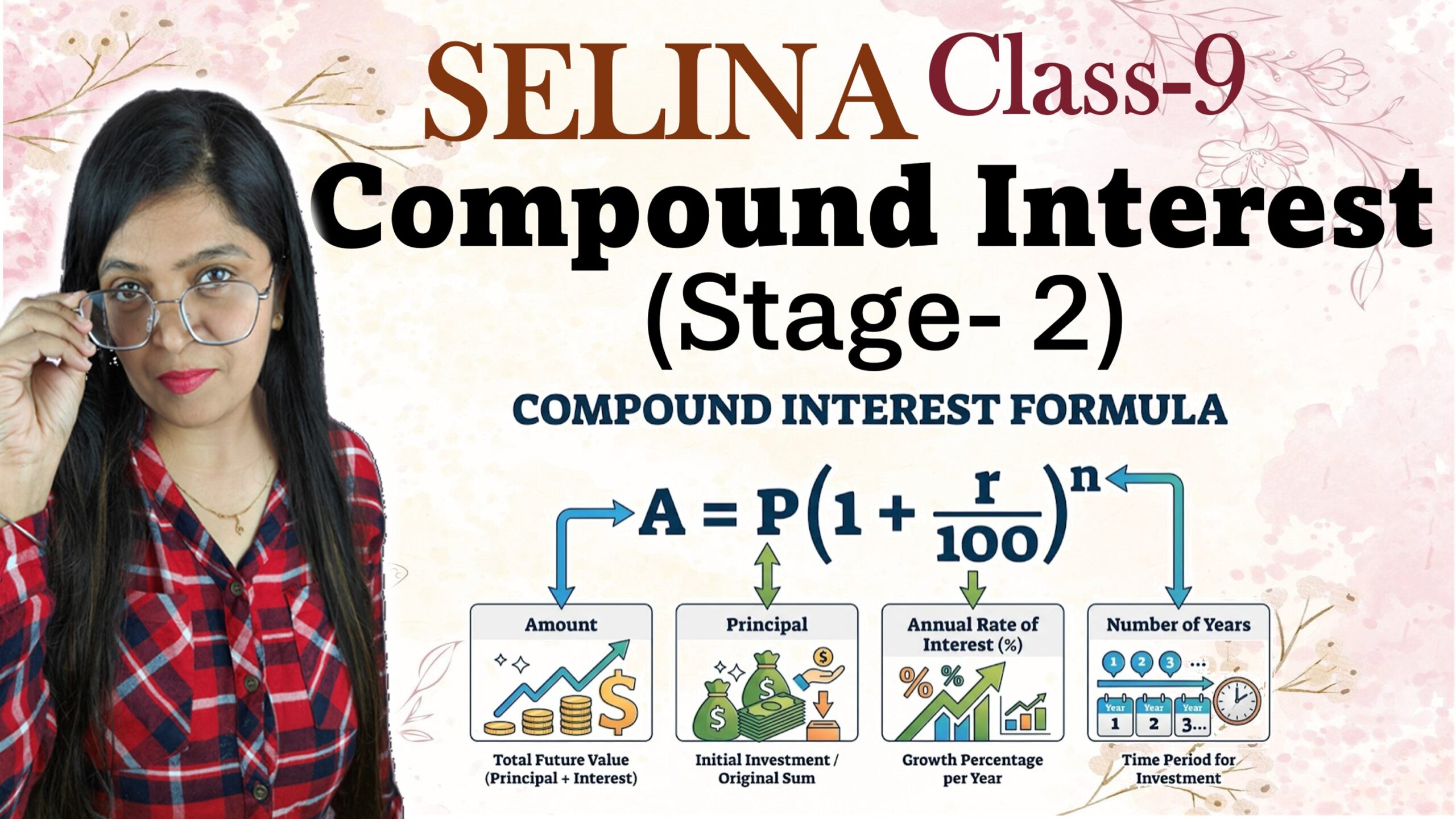
Exercise: 3C
Q1: Multiple Choice Type:
a. If the letters have usual meanings, the formula for finding compound interest, compounded yearly for the given time is:
i. \(1\frac{1}{2}\) years:
Step 1: For a broken time period of \(1\frac{1}{2}\) years under yearly compounding, the interest is calculated fully for 1 year and at half-rate for the remaining \(\frac{1}{2}\) year.
Step 2: The accumulated amount expression is written as:
\[
A = P \left(1 + \frac{r}{100}\right)^1 \left(1 + \frac{r}{200}\right)
\]
Step 3: Deduct the principal from the total amount to find compound interest: \(\text{C.I.} = A – P\).
Answer (i): 2. \(P\left(1+\frac{\operatorname{r}}{100}\right)\left(1+\frac{\operatorname{r}}{200}\right)-P\)
ii. \(1\) year:
Step 4: For a standard period of 1 year, the interest accumulates normally over a single cycle.
Step 5: Subtracting principal from the amount yields the simple compound interest formula:
\[
\text{C.I.} = P \left(1 + \frac{r}{100}\right)^1 – P
\]
Answer (ii): 1. \(P\left(1+\frac{\operatorname{r}}{100}\right)^1-P\)
iii. \(2\frac{1}{2}\) years:
Step 6: For a fractional period of \(2\frac{1}{2}\) years, interest compounds fully for 2 whole years, and at half-rate for the final \(\frac{1}{2}\) year.
Step 7: The corresponding accumulated amount expression equals:
\[
A = P \left(1 + \frac{r}{100}\right)^2 \left(1 + \frac{r}{200}\right)
\]
Step 8: Subtract the principal \(P\) to establish the final net interest expression:
\[
\text{C.I.} = P \left(1 + \frac{r}{100}\right)^2 \left(1 + \frac{r}{200}\right) – P
\]
Answer (iii): 4. \(P\left(1+\frac{\operatorname{r}}{100}\right)^2\left(1+\frac{\operatorname{r}}{200}\right)-P\)
b. When interest is compounded half-yearly then the formula for C.I. for the given time is:
i. \(1\) years:
Step 1: In semi-annual or half-yearly compounding, the annual interest rate is halved to \(\frac{r}{2}\%\) and the conversion period frequency doubles.
Step 2: In a 1-year timeline, there are exactly 2 compounding intervals:
\[
\text{C.I.} = P \left(1 + \frac{r}{200}\right)^2 – P
\]
Answer (i): 1. \(P\left(1+\frac{\operatorname{r}}{200}\right)^2-P\)
ii. \(1\frac{1}{2}\) years:
Step 3: In a \(1\frac{1}{2}\)-year timeline, there are exactly 3 half-year compounding intervals:
\[
\text{C.I.} = P \left(1 + \frac{r}{200}\right)^3 – P
\]
Answer (ii): 2. \(P\left(1+\frac{\operatorname{r}}{200}\right)^3-P\)
iii. \(2\) years:
Step 4: In a 2-year timeline, there are exactly 4 half-year compounding intervals:
\[
\text{C.I.} = P \left(1 + \frac{r}{200}\right)^4 – P
\]
Answer (iii): 3. \(P\left(1+\frac{\operatorname{r}}{200}\right)^4-P\)
c. If ₹ 6,000 earns C.I. = ₹ 1,200 in 6 months; then the rate of interest per year is:
Step 1: Identify the parameters: Principal \((P) = \text{₹ } 6,000\), \(\text{C.I.} = \text{₹ } 1,200\), and Time \((n) = 6 \text{ months} = 1 \text{ half-year interval}\).
Step 2: Since there is only one compounding cycle, calculate the 6-month period rate directly:
\[
\text{Rate for 6 months} = \frac{1200}{6000} \times 100 = 20\%
\]
Step 3: Multiply the 6-month rate by 2 to compute the standard full annual rate per year:
\[
\text{Annual Rate} = 20\% \times 2 = 40\%
\]
Answer: 1. 40%
d. On a certain sum, the S.I. for 2 years is ₹ 2,400. If the rate of interest is 10% p.a., then:
i. C.I. for 1st year is:
Step 1: Simple interest remains uniform every separate year. Thus, the interest per single year is \(\frac{2400}{2} = \text{₹ } 1,200\).
Step 2: During the initial first year, compound interest matches simple interest exactly.
Answer (i): 1. ₹ 1,200
ii. C.I. for 2nd year is:
Step 3: In the second year, compound interest applies the interest rate over the interest accumulated in the first year:
\[
\text{C.I. for 2nd year} = \text{Interest for 1st year} + \left(\text{Interest for 1st year} \times \frac{r}{100}\right) \\
\text{C.I. for 2nd year} = 1200 + \left(1200 \times \frac{10}{100}\right) = 1200 + 120 = \text{₹ } 1,320
\]
Answer (ii): 1. ₹ 1,320
iii. the sum is:
Step 4: Determine the underlying principal sum lent by rewriting the standard simple interest layout:
\[
\text{Sum } (P) = \frac{\text{S.I.} \times 100}{r \times t} = \frac{2400 \times 100}{10 \times 2} = \text{₹ } 12,000
\]
Answer (iii): 1. ₹ 12,000
iv. the amount in 2 years, at compound interest, is:
Step 5: Compute the total final amount due after 2 years under compound interest values:
\[
A = \text{Principal} + \text{C.I. for 1st year} + \text{C.I. for 2nd year} \\
A = 12000 + 1200 + 1320 = \text{₹ } 14,520
\]
Answer (iv): 1. ₹ 14,520
Q2: If the interest is compounded half-yearly, calculate the amount when principal is ₹ 7,400, the rate of interest is 5% per annum and the duration is one year.
Step 1: Identify the given values from the problem statement.
Step 2: Principal \( (P) = \text{₹ } 7,400 \), Rate \( (r) = 5\% \) per annum, Duration \( = 1 \) year.
Step 3: Since interest is compounded half-yearly, adjust the rate and time conversion periods.
Step 4: Semi-annual interest rate \( (R) = \frac{5}{2}\% = 2.5\% \) per half-year.
Step 5: Total compounding conversion periods \( (n) = 1 \times 2 = 2 \) half-years.
Step 6: Apply the adjusted compound interest amount formula:
\[
A = P \left(1 + \frac{R}{100}\right)^n
\]
Step 7: Substitute the adjusted parameter values into our equation:
\[
A = 7400 \left(1 + \frac{2.5}{100}\right)^2 \\
A = 7400 \left(1 + \frac{25}{1000}\right)^2
\]
Step 8: Reduce the fractional value within the brackets:
\[
A = 7400 \left(1 + \frac{1}{40}\right)^2 \\
A = 7400 \left(\frac{41}{40}\right)^2
\]
Step 9: Expand the squared term to calculate the accumulated sum:
\[
A = 7400 \times \frac{1681}{1600}
\]
Step 10: Simplify by canceling out common zeros from the expression:
\[
A = \frac{74 \times 1681}{16} \\
A = \frac{37 \times 1681}{8} \\
A = \frac{62197}{8} \\
A = \text{₹ } 7,774.625
\]
Step 11: Round the calculated value to standard currency decimal places:
\[
A \approx \text{₹ } 7,774.63
\]
Answer: Amount = ₹ 7,774.63
Q3: Find the difference between the compound interest compounded yearly and half-yearly on ₹ 10,000 for 18 months at 10% per annum.
Step 1: Identify the given values from the problem statement.
Step 2: Principal \( (P) = \text{₹ } 10,000 \), Time \( = 18 \text{ months} = 1\frac{1}{2} \text{ years} \), Rate \( (r) = 10\% \) per annum.
Step 3: Calculate the compound interest when compounded yearly.
Step 4: For the first 1 year, apply the standard interest multiplier:
\[
A_1 = 10000 \left(1 + \frac{10}{100}\right) = 10000 \times \frac{11}{10} = \text{₹ } 11,000
\]
Step 5: For the remaining \(\frac{1}{2}\) year (6 months), use \( A_1 \) as the principal at half the rate:
\[
A_{\text{yearly}} = 11000 \left(1 + \frac{10}{2 \times 100}\right) = 11000 \left(1 + \frac{1}{20}\right) \\
A_{\text{yearly}} = 11000 \times \frac{21}{20} = 550 \times 21 = \text{₹ } 11,550
\]
Step 6: Determine compound interest compounded yearly \( (\text{C.I.}_{\text{yearly}}) \):
\[
\text{C.I.}_{\text{yearly}} = 11550 – 10000 = \text{₹ } 1,550
\]
Step 7: Calculate the compound interest when compounded half-yearly.
Step 8: Adjust the interest parameters for semi-annual cycles: Rate \( (R) = \frac{10}{2}\% = 5\% \) per half-year.
Step 9: Conversion periods for 18 months: \( n = 3 \) half-years.
Step 10: Set up the adjusted compounding amount formula:
\[
A_{\text{half-yearly}} = P \left(1 + \frac{R}{100}\right)^n \\
A_{\text{half-yearly}} = 10000 \left(1 + \frac{5}{100}\right)^3 = 10000 \left(\frac{21}{20}\right)^3
\]
Step 11: Expand the cubed term fraction expression:
\[
A_{\text{half-yearly}} = 10000 \times \frac{9261}{8000} = \frac{10 \times 9261}{8} \\
A_{\text{half-yearly}} = \frac{92610}{8} = \text{₹ } 11,576.25
\]
Step 12: Determine compound interest compounded half-yearly \( (\text{C.I.}_{\text{half-yearly}}) \):
\[
\text{C.I.}_{\text{half-yearly}} = 11576.25 – 10000 = \text{₹ } 1,576.25
\]
Step 13: Calculate the net difference between both compounding styles:
\[
\text{Difference} = \text{C.I.}_{\text{half-yearly}} – \text{C.I.}_{\text{yearly}} \\
\text{Difference} = 1576.25 – 1550 = \text{₹ } 26.25
\]
Answer: The difference between compound interest compounded yearly and half-yearly is ₹ 26.25.
Q4: A man borrowed ₹ 16,000 for 3 years under the following terms:
20% simple interest for the first 2 years.
20% C.I. for the remaining one year on the amount due after 2 years, the interest being compounded half-yearly.
Find the total amount to be paid at the end of three years.
Step 1: Identify the given values for the first 2 years under simple interest.
Step 2: Principal \( (P) = \text{₹ } 16,000 \), Rate \( (r) = 20\% \) p.a., Time \( (t) = 2 \) years.
Step 3: Calculate the Simple Interest (S.I.) accrued for the first 2 years:
\[
\text{S.I.} = \frac{P \times r \times t}{100} \\
\text{S.I.} = \frac{16000 \times 20 \times 2}{100} = 160 \times 40 = \text{₹ } 6,400
\]
Step 4: Find the total amount due at the end of the first 2 years:
\[
\text{Amount due after 2 years} = P + \text{S.I.} = 16000 + 6400 = \text{₹ } 22,400
\]
Step 5: This amount acts as the new principal for the remaining 1 year under compound interest.
Step 6: New Principal for the 3rd year \( (P_3) = \text{₹ } 22,400 \), Rate \( (r) = 20\% \) p.a., Duration \( = 1 \) year.
Step 7: Since the interest is compounded half-yearly for the 3rd year, adjust the parameters.
Step 8: Adjusted semi-annual rate \( (R) = \frac{20}{2}\% = 10\% \) per half-year.
Step 9: Number of compounding conversion periods in 1 year \( (n) = 1 \times 2 = 2 \) half-years.
Step 10: Apply the adjusted compound interest amount formula:
\[
A = P_3 \left(1 + \frac{R}{100}\right)^n
\]
Step 11: Substitute the values to find the final total amount:
\[
A = 22400 \left(1 + \frac{10}{100}\right)^2 \\
A = 22400 \left(1 + \frac{1}{10}\right)^2 \\
A = 22400 \left(\frac{11}{10}\right)^2
\]
Step 12: Expand the squared term to compute the final payable sum:
\[
A = 22400 \times \frac{121}{100} \\
A = 224 \times 121 \\
A = \text{₹ } 27,104
\]
Answer: The total amount to be paid at the end of three years is ₹ 27,104.
Q5: What sum of money will amount to ₹ 27,783 in one and a half years at 10% per annum compounded half-yearly?
Step 1: Let the initial sum of money (principal) borrowed or lent be ₹ x.
Step 2: Identify the given values from the problem statement: Final Amount \( (A) = \text{₹ } 27,783 \), Time \( = 1\frac{1}{2} \text{ years} \), Rate \( (r) = 10\% \) per annum.
Step 3: Since interest is compounded half-yearly, adjust the rate and time conversion periods.
Step 4: Semi-annual interest rate \( (R) = \frac{10}{2}\% = 5\% \) per half-year.
Step 5: Total compounding conversion periods \( (n) = 1.5 \times 2 = 3 \) half-years.
Step 6: Write down the adjusted compound interest amount formula:
\[
A = x \left(1 + \frac{R}{100}\right)^n
\]
Step 7: Substitute the known parameters into the equation:
\[
27783 = x \left(1 + \frac{5}{100}\right)^3
\]
Step 8: Simplify the fraction within the brackets:
\[
27783 = x \left(1 + \frac{1}{20}\right)^3 \\
27783 = x \left(\frac{21}{20}\right)^3
\]
Step 9: Expand the cubed fraction term expression:
\[
27783 = x \left(\frac{9261}{8000}\right)
\]
Step 10: Rearrange the equation terms to isolate and solve for x:
\[
x = \frac{27783 \times 8000}{9261}
\]
Step 11: Perform the division step where \( 27783 \div 9261 = 3 \):
\[
x = 3 \times 8000 \\
x = 24000
\]
Answer: The sum of money is ₹ 24,000.
Q6: Ashok invests a certain sum of money at 20% per annum, compounded yearly. Geeta invests an equal amount of money at the same rate of interest per annum compounded half-yearly. If Geeta gets ₹ 33 more than Ashok in 18 months, calculate the money invested by each.
Step 1: Let the initial sum of money invested by each (Ashok and Geeta) be ₹ x.
Step 2: Identify common variables: Rate \( (r) = 20\% \) p.a., Time \( = 18 \text{ months} = 1\frac{1}{2} \text{ years} \).
Step 3: Formulate the final amount received by Ashok under yearly compounding.
Step 4: For the first full year, the multiplier is:
\[
A_{\text{Ashok, 1}} = x \left(1 + \frac{20}{100}\right) = x \left(\frac{120}{100}\right) = \frac{6x}{5}
\]
Step 5: For the remaining \(\frac{1}{2}\) year (6 months), the rate is halved to 10% on the accumulated principal:
\[
A_{\text{Ashok}} = \frac{6x}{5} \left(1 + \frac{10}{100}\right) = \frac{6x}{5} \times \frac{11}{10} = \frac{66x}{50}
\]
Step 6: Formulate the final amount received by Geeta under half-yearly compounding.
Step 7: Adjust variables for Geeta: Semi-annual Rate \( (R) = \frac{20}{2}\% = 10\% \), conversion cycles \( (n) = 3 \) half-years.
Step 8: Apply the adjusted compound interest formula:
\[
A_{\text{Geeta}} = x \left(1 + \frac{10}{100}\right)^3 = x \left(\frac{11}{10}\right)^3 = \frac{1331x}{1000}
\]
Step 9: Geeta gets ₹ 33 more than Ashok, so formulate the difference equation:
\[
A_{\text{Geeta}} – A_{\text{Ashok}} = 33 \\
\frac{1331x}{1000} – \frac{66x}{50} = 33
\]
Step 10: Equalise the denominators by multiplying Ashok’s fraction by \( \frac{20}{20} \):
\[
\frac{1331x}{1000} – \frac{1320x}{1000} = 33 \\
\frac{11x}{1000} = 33
\]
Step 11: Rearrange the terms to isolate and solve for x:
\[
11x = 33 \times 1000 \\
x = \frac{33000}{11} \\
x = 3000
\]
Answer: The money invested by each is ₹ 3,000.
Q7: At what rate of interest per annum will a sum of ₹ 62,500 earn a compound interest of ₹ 5,100 in one year? The interest is to be compounded half-yearly.
Step 1: Identify the given values from the problem statement.
Step 2: Principal \( (P) = \text{₹ } 62,500 \), Compound Interest \( (\text{C.I.}) = \text{₹ } 5,100 \), and Time \( = 1 \) year.
Step 3: Calculate the final accumulated Amount \( (A) \) using the relationship \( A = P + \text{C.I.} \):
\[
A = 62500 + 5100 \\
A = \text{₹ } 67,600
\]
Step 4: Let the rate of interest per annum be \( r \% \).
Step 5: Since interest is compounded half-yearly, adjust the rate and conversion periods.
Step 6: Rate of interest per half-year \( = \frac{r}{2}\% \), and number of half-years \( (n) = 1 \times 2 = 2 \).
Step 7: Write down the adjusted compound interest amount formula:
\[
A = P \left(1 + \frac{r}{2 \times 100}\right)^n
\]
Step 8: Substitute the known parameters into the formula expression:
\[
67600 = 62500 \left(1 + \frac{r}{200}\right)^2
\]
Step 9: Isolate the squared exponential term by dividing both sides by 62,500:
\[
\left(1 + \frac{r}{200}\right)^2 = \frac{67600}{62500} \\
\left(1 + \frac{r}{200}\right)^2 = \frac{676}{625}
\]
Step 10: Take the square root on both sides of the expression:
\[
1 + \frac{r}{200} = \sqrt{\frac{676}{625}} \\
1 + \frac{r}{200} = \frac{26}{25}
\]
Step 11: Subtract 1 from both sides to isolate the rate fraction:
\[
\frac{r}{200} = \frac{26}{25} – 1 \\
\frac{r}{200} = \frac{1}{25}
\]
Step 12: Solve for the interest rate percentage value r:
\[
r = \frac{200}{25} \\
r = 8
\]
Answer: Rate of interest = 8% per annum
Q8: In what time will ₹ 1,500 yield ₹ 496.50 as compound interest at 20% per year compounded half-yearly?
Step 1: Identify the given values from the problem statement.
Step 2: Principal \( (P) = \text{₹ } 1,500 \), Compound Interest \( (\text{C.I.}) = \text{₹ } 496.50 \), and Annual Rate \( (r) = 20\% \) p.a.
Step 3: Calculate the final accumulated Amount \( (A) \) using the formula \( A = P + \text{C.I.} \):
\[
A = 1500 + 496.50 \\
A = \text{₹ } 1,996.50
\]
Step 4: Since the interest is compounded half-yearly, adjust the annual rate for a semi-annual period.
Step 5: Adjusted half-yearly rate \( (R) = \frac{20}{2}\% = 10\% \) per half-year.
Step 6: Let the total number of compounding conversion periods be \( n \) half-years.
Step 7: Write down the adjusted compound interest amount formula:
\[
A = P \left(1 + \frac{R}{100}\right)^n
\]
Step 8: Substitute the known parameters into the equation:
\[
1996.50 = 1500 \left(1 + \frac{10}{100}\right)^n
\]
Step 9: Isolate the exponential block by dividing both sides by 1,500:
\[
\frac{1996.50}{1500} = \left(1 + \frac{1}{10}\right)^n \\
\frac{199650}{150000} = \left(\frac{11}{10}\right)^n
\]
Step 10: Simplify the left-hand fraction by canceling out zeros and dividing by 150:
\[
\frac{1331}{1000} = \left(\frac{11}{10}\right)^n
\]
Step 11: Express the left fraction as a perfect power matching the geometric base \( \frac{11}{10} \):
\[
\left(\frac{11}{10}\right)^3 = \left(\frac{11}{10}\right)^n
\]
Step 12: Equate indices on both sides to find the number of half-years:
\[
n = 3 \text{ half-years}
\]
Step 13: Convert the time period from half-years into standard years:
\[
\text{Time} = \frac{3}{2} \text{ years} = 1\frac{1}{2} \text{ years}
\]
Answer: Time period = 1\(\frac{1}{2}\) years (or 1 year 6 months)
Q9: Calculate the C.I. on ₹ 3,500 at 6% per annum for 3 years, the interest being compounded half-yearly. Do not use mathematical tables. Use the necessary information from the following:
\((1.06)^3 = 1.191016; (1.03)^3 = 1.092727\)
\((1.06)^6 = 1.418519; (1.03)^6 = 1.194052\)
Step 1: Identify the given values from the problem statement.
Step 2: Principal \( (P) = \text{₹ } 3,500 \), Annual Rate \( (r) = 6\% \) p.a., and Time \( = 3 \) years.
Step 3: Since interest is compounded half-yearly, adjust the interest rate and time periods.
Step 4: Adjusted half-yearly rate \( (R) = \frac{6}{2}\% = 3\% \) per half-year.
Step 5: Total compounding conversion periods \( (n) = 3 \times 2 = 6 \) half-years.
Step 6: Write down the adjusted compound interest amount formula:
\[
A = P \left(1 + \frac{R}{100}\right)^n
\]
Step 7: Substitute the known variables into the expression:
\[
A = 3500 \left(1 + \frac{3}{100}\right)^6 \\
A = 3500 \left(1 + 0.03\right)^6 \\
A = 3500 \left(1.03\right)^6
\]
Step 8: Select the necessary value provided in the question instructions where \( (1.03)^6 = 1.194052 \):
\[
A = 3500 \times 1.194052
\]
Step 9: Perform the multiplication step to calculate the total amount:
\[
A = 4179.182 \\
A = \text{₹ } 4,179.18
\]
Step 10: Calculate the Compound Interest (C.I.) using the relation \( \text{C.I.} = A – P \):
\[
\text{C.I.} = 4179.18 – 3500 \\
\text{C.I.} = \text{₹ } 679.18
\]
Answer: Compound Interest = ₹ 679.18
Q10: Find the difference between compound interest and simple interest on ₹ 12,000 in \(1\frac{1}{2}\) years at 10% p.a. compounded yearly.
Step 1: Identify the given values from the problem statement.
Step 2: Principal \( (P) = \text{₹ } 12,000 \), Time \( (t \text{ or } n) = 1\frac{1}{2} \text{ years} = 1.5 \text{ years} \), and Rate \( (r) = 10\% \) per annum.
Step 3: Calculate the Simple Interest (S.I.) using the standard formula:
\[
\text{S.I.} = \frac{P \times r \times t}{100}
\]
Step 4: Substitute the values to find the simple interest:
\[
\text{S.I.} = \frac{12000 \times 10 \times 1.5}{100} \\
\text{S.I.} = 120 \times 15 \\
\text{S.I.} = \text{₹ } 1,800
\]
Step 5: Calculate the Compound Interest (C.I.) compounded yearly for a fractional time period of \(1\frac{1}{2}\) years.
Step 6: Find the accumulated amount at the end of the first full year \( (A_1) \):
\[
A_1 = P \left(1 + \frac{r}{100}\right)^1 \\
A_1 = 12000 \left(1 + \frac{10}{100}\right) = 12000 \times \frac{11}{10} \\
A_1 = \text{₹ } 13,200
\]
Step 7: Use \( A_1 \) as the principal to find the final amount after the remaining \(\frac{1}{2}\) year at half the interest rate:
\[
A = A_1 \left(1 + \frac{r}{2 \times 100}\right) \\
A = 13200 \left(1 + \frac{10}{200}\right) = 13200 \left(1 + \frac{1}{20}\right) \\
A = 13200 \times \frac{21}{20} \\
A = 660 \times 21 \\
A = \text{₹ } 13,860
\]
Step 8: Calculate the total Compound Interest (C.I.):
\[
\text{C.I.} = A – P \\
\text{C.I.} = 13860 – 12000 \\
\text{C.I.} = \text{₹ } 1,860
\]
Step 9: Find the net difference between Compound Interest and Simple Interest:
\[
\text{Difference} = \text{C.I.} – \text{S.I.} \\
\text{Difference} = 1860 – 1800 \\
\text{Difference} = \text{₹ } 60
\]
Answer: The difference between compound interest and simple interest is ₹ 60.
Q11: Find the difference between compound interest and simple interest on ₹ 12,000 in \(1\frac{1}{2}\) years at 10% p.a. compounded half-yearly.
Step 1: Identify the given values from the problem statement.
Step 2: Principal \( (P) = \text{₹ } 12,000 \), Time \( (t) = 1\frac{1}{2} \text{ years} = 1.5 \text{ years} \), and Rate \( (r) = 10\% \) per annum.
Step 3: Calculate the Simple Interest (S.I.) using the standard formula:
\[
\text{S.I.} = \frac{P \times r \times t}{100}
\]
Step 4: Substitute the values to find the simple interest:
\[
\text{S.I.} = \frac{12000 \times 10 \times 1.5}{100} \\
\text{S.I.} = 120 \times 15 \\
\text{S.I.} = \text{₹ } 1,800
\]
Step 5: Now, calculate the compound interest when compounded half-yearly.
Step 6: Adjust the interest parameters for semi-annual cycles: Rate \( (R) = \frac{10}{2}\% = 5\% \) per half-year.
Step 7: Conversion periods for \(1\frac{1}{2}\) years: \( n = 1.5 \times 2 = 3 \) half-years.
Step 8: Set up the adjusted compounding amount formula:
\[
A = P \left(1 + \frac{R}{100}\right)^n
\]
Step 9: Substitute the adjusted parameter values into the equation:
\[
A = 12000 \left(1 + \frac{5}{100}\right)^3 \\
A = 12000 \left(1 + \frac{1}{20}\right)^3 \\
A = 12000 \left(\frac{21}{20}\right)^3
\]
Step 10: Expand the cubed term fraction expression:
\[
A = 12000 \times \frac{9261}{8000} \\
A = \frac{12 \times 9261}{8} \\
A = \frac{3 \times 9261}{2} \\
A = \frac{27783}{2} \\
A = \text{₹ } 13,891.50
\]
Step 11: Determine compound interest compounded half-yearly \( (\text{C.I.}) \):
\[
\text{C.I.} = A – P \\
\text{C.I.} = 13891.50 – 12000 \\
\text{C.I.} = \text{₹ } 1,891.50
\]
Step 12: Find the net difference between Compound Interest and Simple Interest:
\[
\text{Difference} = \text{C.I.} – \text{S.I.} \\
\text{Difference} = 1891.50 – 1800 \\
\text{Difference} = \text{₹ } 91.50
\]
Answer: The difference between compound interest and simple interest is ₹ 91.50.
Leave a Comment