

Exercise: 3A
Q1: Multiple Choice Type:
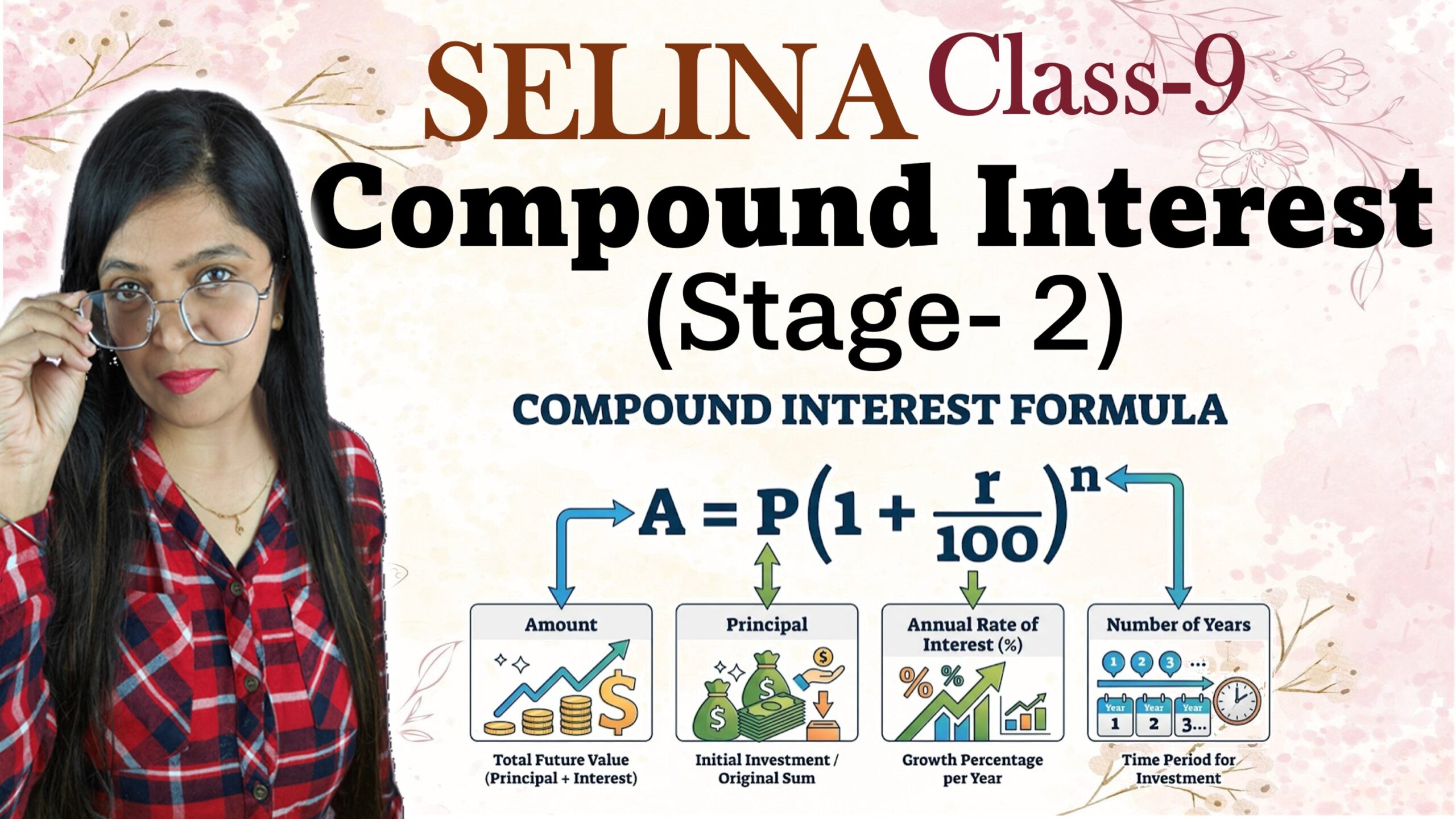
a. If P = sum lent, r = rate of interest per year, n = number of years and amount = A, then:
Step 1: Identify the standard variables used in the compound interest calculation.
Step 2: Recall the standard mathematical formula for calculating the total compound amount (A).
Step 3: The relation between the amount and principal is defined as:
\[
A = P \left(1 + \frac{r}{100}\right)^n
\]
Step 4: Compare this expression with the given choices to find the exact match.
Answer: i. \( A = P \left(1 + \frac{r}{100}\right)^n \)
b. If the letters used have usual meanings; r₁% and r₂% are rates of interests for two consecutive years then:
Step 1: Note that the rate changes for each consecutive year instead of remaining constant.
Step 2: For the first year, the growth multiplier is \( \left(1 + \frac{r_1}{100}\right) \).
Step 3: For the second year, the growth multiplier applied to the new principal is \( \left(1 + \frac{r_2}{100}\right) \).
Step 4: Combine the multipliers to formulate the final amount equation:
\[
A = P \left(1 + \frac{r_1}{100}\right)\left(1 + \frac{r_2}{100}\right)
\]
Answer: ii. \( A = P \left(1 + \frac{r_1}{100}\right)\left(1 + \frac{r_2}{100}\right) \)
c. Compound interest on ₹ 6,000 in 2 years at 5% per annum is:
Step 1: Identify the given values from the problem statement.
Step 2: Principal \( (P) = \text{₹ } 6,000 \), Rate \( (r) = 5\% \) per annum, Time \( (n) = 2 \) years.
Step 3: Apply the compound interest amount formula:
\[
A = P \left(1 + \frac{r}{100}\right)^n
\]
Step 4: Substitute the given parameters into the equation:
\[
A = 6000 \left(1 + \frac{5}{100}\right)^2
\]
Step 5: Simplify the fraction within the brackets:
\[
A = 6000 \left(1 + \frac{1}{20}\right)^2 \\
A = 6000 \left(\frac{21}{20}\right)^2
\]
Step 6: Expand the square of the fraction:
\[
A = 6000 \times \frac{441}{400}
\]
Step 7: Compute the final accumulated amount:
\[
A = 15 \times 441 \\
A = \text{₹ } 6,615
\]
Step 8: Calculate compound interest (C.I.) using the formula:
\[
\text{C.I.} = A – P \\
\text{C.I.} = 6615 – 6000 \\
\text{C.I.} = \text{₹ } 615
\]
Answer: i. ₹ 615
d. A sum of money, lent at 10% C.I. compounded yearly becomes ₹ 6,050 in 2 years. The sum lent is:
Step 1: Let the initial cost or sum lent be ₹ x.
Step 2: Identify the parameters: Amount \( (A) = \text{₹ } 6,050 \), Rate \( (r) = 10\% \), Time \( (n) = 2 \) years.
Step 3: Set up the equation using the compound amount formula:
\[
A = x \left(1 + \frac{r}{100}\right)^n
\]
Step 4: Substitute the known values into the equation:
\[
6050 = x \left(1 + \frac{10}{100}\right)^2
\]
Step 5: Simplify the values inside the bracket expression:
\[
6050 = x \left(1 + \frac{1}{10}\right)^2 \\
6050 = x \left(\frac{11}{10}\right)^2
\]
Step 6: Expand the squared term to isolate x:
\[
6050 = x \left(\frac{121}{100}\right)
\]
Step 7: Rearrange the terms to solve directly for x:
\[
x = \frac{6050 \times 100}{121}
\]
Step 8: Perform the final division step:
\[
x = 50 \times 100 \\
x = 5000
\]
Answer: iii. ₹ 5,000
e. On a certain sum, the compound interest accrued in one year is ₹ 550. If the rate of interest is 10%, the sum is:
Step 1: Let the initial sum of money be ₹ x.
Step 2: Note that for the first year, compound interest is equal to simple interest.
Step 3: Identify parameters: Interest \( (I) = \text{₹ } 550 \), Rate \( (r) = 10\% \), Time \( (n) = 1 \) year.
Step 4: Write out the basic interest equation:
\[
\text{Interest} = \frac{x \times r \times n}{100}
\]
Step 5: Plug the given numbers directly into our equation:
\[
550 = \frac{x \times 10 \times 1}{100}
\]
Step 6: Simplify the algebraic expression to extract x:
\[
550 = \frac{x}{10} \\
x = 550 \times 10 \\
x = 5500
\]
Answer: iv. ₹ 5,500
f. ₹ 4,000 amounts to ₹ 4,600 in 1 year at compound interest compounded yearly. The rate of interest is:
Step 1: Extract given values: Principal \( (P) = \text{₹ } 4,000 \), Amount \( (A) = \text{₹ } 4,600 \), Time \( (n) = 1 \) year.
Step 2: For a single year period, use the direct formula:
\[
A = P \left(1 + \frac{r}{100}\right)
\]
Step 3: Insert the numerical amounts into the formula expression:
\[
4600 = 4000 \left(1 + \frac{r}{100}\right)
\]
Step 4: Divide both sides by 4,000 to isolate the bracket:
\[
\frac{4600}{4000} = 1 + \frac{r}{100} \\
\frac{46}{40} = 1 + \frac{r}{100} \\
1.15 = 1 + \frac{r}{100}
\]
Step 5: Subtract 1 from both sides of the equation:
\[
\frac{r}{100} = 1.15 – 1 \\
\frac{r}{100} = 0.15
\]
Step 6: Multiply by 100 to solve for percentage rate r:
\[
r = 0.15 \times 100 \\
r = 15\%
\]
Answer: i. 15%
g. ₹ 4,000 amount to ₹ 5017.60 in two months at compound interest compounded per month. The rate of interest per month is:
Step 1: Identify values: Principal \( (P) = \text{₹ } 4,000 \), Amount \( (A) = \text{₹ } 5,017.60 \), Time \( (n) = 2 \) months.
Step 2: Set up the per-month formula format:
\[
A = P \left(1 + \frac{r}{100}\right)^n
\]
Step 3: Substitute the variables with given problem numbers:
\[
5017.60 = 4000 \left(1 + \frac{r}{100}\right)^2
\]
Step 4: Isolate the squared exponential component term:
\[
\left(1 + \frac{r}{100}\right)^2 = \frac{5017.60}{4000} \\
\left(1 + \frac{r}{100}\right)^2 = \frac{50176}{40000}
\]
Step 5: Reduce the fractional value by dividing both sides by 4:
\[
\left(1 + \frac{r}{100}\right)^2 = \frac{12544}{10000}
\]
Step 6: Take the square root of both sides of our expression:
\[
1 + \frac{r}{100} = \sqrt{\frac{12544}{10000}} \\
1 + \frac{r}{100} = \frac{112}{100} \\
1 + \frac{r}{100} = 1.12
\]
Step 7: Subtract 1 to isolate our rate variable fraction:
\[
\frac{r}{100} = 1.12 – 1 \\
\frac{r}{100} = 0.12
\]
Step 8: Calculate final monthly interest rate value r:
\[
r = 0.12 \times 100 \\
r = 12\%
\]
Answer: i. 12%
Q2: Find the amount and the compound interest on ₹ 12,000 in 3 years at 5% interest being compounded annually.
Step 1: Identify the given values from the problem statement.
Step 2: Principal \( (P) = \text{₹ } 12,000 \), Rate \( (r) = 5\% \) per annum, Time \( (n) = 3 \) years.
Step 3: Apply the standard compound interest amount formula:
\[
A = P \left(1 + \frac{r}{100}\right)^n
\]
Step 4: Substitute the given parameters into the equation:
\[
A = 12000 \left(1 + \frac{5}{100}\right)^3
\]
Step 5: Simplify the fraction within the brackets:
\[
A = 12000 \left(1 + \frac{1}{20}\right)^3 \\
A = 12000 \left(\frac{21}{20}\right)^3
\]
Step 6: Expand the cube of the fraction:
\[
A = 12000 \times \frac{9261}{8000}
\]
Step 7: Compute the final accumulated amount by multiplying the terms:
\[
A = \frac{12 \times 9261}{8} \\
A = \frac{3 \times 9261}{2} \\
A = \frac{27783}{2} \\
A = \text{₹ } 13,891.50
\]
Step 8: Calculate compound interest (C.I.) using the formula:
\[
\text{C.I.} = A – P \\
\text{C.I.} = 13891.50 – 12000 \\
\text{C.I.} = \text{₹ } 1,891.50
\]
Answer: Amount = ₹ 13,891.50 and Compound Interest = ₹ 1,891.50
Q3: Calculate the amount if ₹ 15,000 is lent at compound interest for 2 years and the rates for the successive years are 8% p.a. and 10% p.a. respectively.
Step 1: Identify the given values from the problem statement.
Step 2: Principal \( (P) = \text{₹ } 15,000 \), Rate for first year \( (r_1) = 8\% \) p.a., Rate for second year \( (r_2) = 10\% \) p.a.
Step 3: Apply the formula for different rates of interest for successive years:
\[
A = P \left(1 + \frac{r_1}{100}\right)\left(1 + \frac{r_2}{100}\right)
\]
Step 4: Substitute the known parameters into the equation:
\[
A = 15000 \left(1 + \frac{8}{100}\right)\left(1 + \frac{10}{100}\right)
\]
Step 5: Simplify the fractions within the brackets:
\[
A = 15000 \left(\frac{108}{100}\right)\left(\frac{110}{100}\right)
\]
Step 6: Cancel out the zeros to simplify the expression:
\[
A = 15 \times 108 \times 11
\]
Step 7: Multiply the remaining numbers step-by-step:
\[
A = 1620 \times 11 \\
A = \text{₹ } 17,820
\]
Answer: Amount = ₹ 17,820
Q4: Calculate compound interest accrued on ₹ 6,000 in 3 years, compounded yearly, if the rates successive years are 5%, 8% and 10% respectively.
Step 1: Identify the given values from the problem statement.
Step 2: Principal \( (P) = \text{₹ } 6,000 \), Rate for first year \( (r_1) = 5\% \) p.a., Rate for second year \( (r_2) = 8\% \) p.a., Rate for third year \( (r_3) = 10\% \) p.a.
Step 3: Apply the compound interest amount formula for successive rates across three years:
\[
A = P \left(1 + \frac{r_1}{100}\right)\left(1 + \frac{r_2}{100}\right)\left(1 + \frac{r_3}{100}\right)
\]
Step 4: Substitute the known parameters into the equation:
\[
A = 6000 \left(1 + \frac{5}{100}\right)\left(1 + \frac{8}{100}\right)\left(1 + \frac{10}{100}\right)
\]
Step 5: Simplify the fraction terms inside each bracket:
\[
A = 6000 \left(\frac{105}{100}\right)\left(\frac{108}{100}\right)\left(\frac{110}{100}\right)
\]
Step 6: Reduce the numbers by canceling out common zeros:
\[
A = \frac{6 \times 105 \times 108 \times 11}{100}
\]
Step 7: Perform the step-by-step multiplication for the numerator:
\[
A = \frac{630 \times 108 \times 11}{100} \\
A = \frac{68040 \times 11}{100} \\
A = \frac{748440}{100} \\
A = \text{₹ } 7,484.40
\]
Step 8: Calculate compound interest (C.I.) using the compound relation:
\[
\text{C.I.} = A – P \\
\text{C.I.} = 7484.40 – 6000 \\
\text{C.I.} = \text{₹ } 1,484.40
\]
Answer: Compound Interest = ₹ 1,484.40
Q5: What sum of money will amount to ₹ 5,445 in 2 years at 10% per annum compound interest?
Step 1: Let the initial cost or sum of money be ₹ x.
Step 2: Identify the given values from the problem: Amount \( (A) = \text{₹ } 5,445 \), Time \( (n) = 2 \) years, Rate \( (r) = 10\% \) p.a.
Step 3: Apply the standard compound interest amount formula:
\[
A = x \left(1 + \frac{r}{100}\right)^n
\]
Step 4: Substitute the known parameters into the equation:
\[
5445 = x \left(1 + \frac{10}{100}\right)^2
\]
Step 5: Simplify the fraction within the brackets:
\[
5445 = x \left(1 + \frac{1}{10}\right)^2 \\
5445 = x \left(\frac{11}{10}\right)^2
\]
Step 6: Expand the squared term to isolate x:
\[
5445 = x \left(\frac{121}{100}\right)
\]
Step 7: Rearrange the terms to solve directly for x:
\[
x = \frac{5445 \times 100}{121}
\]
Step 8: Perform the division step: \( 5445 \div 121 = 45 \)
\[
x = 45 \times 100 \\
x = 4500
\]
Answer: Sum lent = ₹ 4,500
Q6: On what sum of money will the compound interest for 2 years at 5 per cent per annum amount to ₹ 768.75?
Step 1: Let the initial sum of money be ₹ x.
Step 2: Identify the given values from the problem: Compound Interest \( (\text{C.I.}) = \text{₹ } 768.75 \), Time \( (n) = 2 \) years, Rate \( (r) = 5\% \) p.a.
Step 3: Apply the standard formula connecting compound interest and principal:
\[
\text{C.I.} = x \left[\left(1 + \frac{r}{100}\right)^n – 1\right]
\]
Step 4: Substitute the known parameters into the equation:
\[
768.75 = x \left[\left(1 + \frac{5}{100}\right)^2 – 1\right]
\]
Step 5: Simplify the fraction within the brackets:
\[
768.75 = x \left[\left(1 + \frac{1}{20}\right)^2 – 1\right] \\
768.75 = x \left[\left(\frac{21}{20}\right)^2 – 1\right]
\]
Step 6: Expand the squared fraction term:
\[
768.75 = x \left[\frac{441}{400} – 1\right]
\]
Step 7: Simplify the subtraction inside the bracket:
\[
768.75 = x \left[\frac{441 – 400}{400}\right] \\
768.75 = x \left[\frac{41}{400}\right]
\]
Step 8: Rearrange the expression to solve directly for x:
\[
x = \frac{768.75 \times 400}{41} \\
x = \frac{307500}{41} \\
x = 7500
\]
Answer: Sum of money = ₹ 7,500
Q7: Find the sum on which the compound interest for 3 years at 10% per annum amounts to ₹ 1,655?
Step 1: Let the initial sum of money be ₹ x.
Step 2: Identify the given values from the problem: Compound Interest \( (\text{C.I.}) = \text{₹ } 1,655 \), Time \( (n) = 3 \) years, Rate \( (r) = 10\% \) p.a.
Step 3: Apply the compound interest formula in terms of principal:
\[
\text{C.I.} = x \left[\left(1 + \frac{r}{100}\right)^n – 1\right]
\]
Step 4: Substitute the known parameters into the equation:
\[
1655 = x \left[\left(1 + \frac{10}{100}\right)^3 – 1\right]
\]
Step 5: Simplify the fraction within the brackets:
\[
1655 = x \left[\left(1 + \frac{1}{10}\right)^3 – 1\right] \\
1655 = x \left[\left(\frac{11}{10}\right)^3 – 1\right]
\]
Step 6: Expand the cubed fraction term:
\[
1655 = x \left[\frac{1331}{1000} – 1\right]
\]
Step 7: Simplify the subtraction inside the bracket:
\[
1655 = x \left[\frac{1331 – 1000}{1000}\right] \\
1655 = x \left[\frac{331}{1000}\right]
\]
Step 8: Rearrange the terms to solve directly for x:
\[
x = \frac{1655 \times 1000}{331}
\]
Step 9: Perform the division step: \( 1655 \div 331 = 5 \)
\[
x = 5 \times 1000 \\
x = 5000
\]
Answer: Sum of money = ₹ 5,000
Q8: At what rate per cent per annum will ₹ 6,000 amount to ₹ 6,615 in 2 years when interest is compounded annually?
Step 1: Identify the given values from the problem statement.
Step 2: Principal \( (P) = \text{₹ } 6,000 \), Amount \( (A) = \text{₹ } 6,615 \), Time \( (n) = 2 \) years.
Step 3: Let the required rate of interest per annum be \( r \% \).
Step 4: Set up the compound interest amount formula:
\[
A = P \left(1 + \frac{r}{100}\right)^n
\]
Step 5: Substitute the known parameters into the formula expression:
\[
6615 = 6000 \left(1 + \frac{r}{100}\right)^2
\]
Step 6: Isolate the squared exponential term by dividing both sides by 6,000:
\[
\left(1 + \frac{r}{100}\right)^2 = \frac{6615}{6000}
\]
Step 7: Simplify the fraction by dividing the numerator and denominator by 15:
\[
\left(1 + \frac{r}{100}\right)^2 = \frac{441}{400}
\]
Step 8: Take the square root on both sides of the expression:
\[
1 + \frac{r}{100} = \sqrt{\frac{441}{400}} \\
1 + \frac{r}{100} = \frac{21}{20}
\]
Step 9: Subtract 1 from both sides to isolate the rate fraction:
\[
\frac{r}{100} = \frac{21}{20} – 1 \\
\frac{r}{100} = \frac{1}{20}
\]
Step 10: Multiply by 100 to solve for percentage rate value r:
\[
r = \frac{100}{20} \\
r = 5
\]
Answer: Rate of interest = 5% per annum
Q9: What principal will amount to ₹ 9,856 in two years, if the rates of interest for successive years are 10% and 12% respectively?
Step 1: Let the principal (initial sum) be ₹ x.
Step 2: Identify the given values from the problem statement: Amount \( (A) = \text{₹ } 9,856 \), Time \( (n) = 2 \) years, Rate for the first year \( (r_1) = 10\% \) p.a., and Rate for the second year \( (r_2) = 12\% \) p.a.
Step 3: Apply the compound interest amount formula for successive rates:
\[
A = x \left(1 + \frac{r_1}{100}\right)\left(1 + \frac{r_2}{100}\right)
\]
Step 4: Substitute the known parameters into the equation:
\[
9856 = x \left(1 + \frac{10}{100}\right)\left(1 + \frac{12}{100}\right)
\]
Step 5: Simplify the fraction terms inside each bracket:
\[
9856 = x \left(\frac{110}{100}\right)\left(\frac{112}{100}\right) \\
9856 = x \left(\frac{11}{10}\right)\left(\frac{28}{25}\right)
\]
Step 6: Multiply the fractional values together:
\[
9856 = x \left(\frac{308}{250}\right)
\]
Step 7: Rearrange the terms to isolate and solve for x:
\[
x = \frac{9856 \times 250}{308}
\]
Step 8: Perform the division step where \( 9856 \div 308 = 32 \):
\[
x = 32 \times 250 \\
x = 8000
\]
Answer: Principal = ₹ 8,000
Q10: On a certain sum, the compound interest in 2 years amounts to ₹ 4,240. If the rates of interest for successive years are 10% and 15% respectively, find the sum.
Step 1: Let the initial cost or sum of money be ₹ x.
Step 2: Identify the given values from the problem statement: Compound Interest \( (\text{C.I.}) = \text{₹ } 4,240 \), Rate for the first year \( (r_1) = 10\% \) p.a., and Rate for the second year \( (r_2) = 15\% \) p.a.
Step 3: Write down the compound amount formula for successive years:
\[
A = x \left(1 + \frac{r_1}{100}\right)\left(1 + \frac{r_2}{100}\right)
\]
Step 4: Substitute the interest rate values into the amount expression:
\[
A = x \left(1 + \frac{10}{100}\right)\left(1 + \frac{15}{100}\right)
\]
Step 5: Simplify the values inside the bracket terms:
\[
A = x \left(\frac{110}{100}\right)\left(\frac{115}{100}\right) \\
A = x \left(\frac{11}{10}\right)\left(\frac{23}{20}\right) \\
A = x \left(\frac{253}{200}\right)
\]
Step 6: Formulate the compound interest expression using \( \text{C.I.} = A – x \):
\[
\text{C.I.} = x \left(\frac{253}{200}\right) – x \\
\text{C.I.} = x \left(\frac{253 – 200}{200}\right) \\
\text{C.I.} = x \left(\frac{53}{200}\right)
\]
Step 7: Substitute the given compound interest value to solve for x:
\[
4240 = x \left(\frac{53}{200}\right)
\]
Step 8: Rearrange the terms to isolate our variable directly:
\[
x = \frac{4240 \times 200}{53}
\]
Step 9: Perform the division step where \( 4240 \div 53 = 80 \):
\[
x = 80 \times 200 \\
x = 16000
\]
Answer: Sum of money = ₹ 16,000
Q11: At what rate cent compound interest, does a sum of money become 1.44 times of itself in 2 years?
Step 1: Let the initial sum of money (Principal) be ₹ x.
Step 2: According to the question, the amount becomes 1.44 times the principal: Amount \( (A) = 1.44x \).
Step 3: Identify the given time period: Time \( (n) = 2 \) years.
Step 4: Let the required rate of interest per annum be \( r \% \).
Step 5: Write down the standard compound interest amount formula:
\[
A = P \left(1 + \frac{r}{100}\right)^n
\]
Step 6: Substitute the values of A, P, and n into the equation:
\[
1.44x = x \left(1 + \frac{r}{100}\right)^2
\]
Step 7: Divide both sides by x to eliminate the variable:
\[
1.44 = \left(1 + \frac{r}{100}\right)^2
\]
Step 8: Write 1.44 in fraction form to make calculation easier:
\[
\frac{144}{100} = \left(1 + \frac{r}{100}\right)^2
\]
Step 9: Take the square root on both sides of the expression:
\[
\sqrt{\frac{144}{100}} = 1 + \frac{r}{100} \\
\frac{12}{10} = 1 + \frac{r}{100} \\
1.2 = 1 + \frac{r}{100}
\]
Step 10: Subtract 1 from both sides to isolate the rate term:
\[
\frac{r}{100} = 1.2 – 1 \\
\frac{r}{100} = 0.2
\]
Step 11: Multiply by 100 to find the final percentage value of r:
\[
r = 0.2 \times 100 \\
r = 20\%
\]
Answer: Rate of interest = 20% per annum
Q12: At what rate per cent will a sum of ₹ 4,000 yield ₹ 1,324 as compound interest in 3 years?
Step 1: Identify the given values from the problem statement.
Step 2: Principal \( (P) = \text{₹ } 4,000 \), Compound Interest \( (\text{C.I.}) = \text{₹ } 1,324 \), and Time \( (n) = 3 \) years.
Step 3: Calculate the final accumulated Amount \( (A) \) using the formula \( A = P + \text{C.I.} \):
\[
A = 4000 + 1324 \\
A = \text{₹ } 5,324
\]
Step 4: Let the required rate of interest per annum be \( r \% \).
Step 5: Write down the standard compound interest amount formula:
\[
A = P \left(1 + \frac{r}{100}\right)^n
\]
Step 6: Substitute the known parameters into the equation:
\[
5324 = 4000 \left(1 + \frac{r}{100}\right)^3
\]
Step 7: Isolate the cubed term by dividing both sides by 4,000:
\[
\left(1 + \frac{r}{100}\right)^3 = \frac{5324}{4000}
\]
Step 8: Simplify the fraction by dividing the numerator and denominator by 4:
\[
\left(1 + \frac{r}{100}\right)^3 = \frac{1331}{1000}
\]
Step 9: Express the right-hand side as a perfect cube:
\[
\left(1 + \frac{r}{100}\right)^3 = \left(\frac{11}{10}\right)^3
\]
Step 10: Take the cube root on both sides of the expression:
\[
1 + \frac{r}{100} = \frac{11}{10} \\
1 + \frac{r}{100} = 1.1
\]
Step 11: Subtract 1 from both sides to isolate the rate fraction:
\[
\frac{r}{100} = 1.1 – 1 \\
\frac{r}{100} = 0.1
\]
Step 12: Multiply by 100 to solve for the final percentage rate r:
\[
r = 0.1 \times 100 \\
r = 10\%
\]
Answer: Rate of interest = 10% per annum
Q13: A invests ₹ 5,000 for three years at a certain rate of interest compounded annually. At the end of two years this sum amounts to ₹ 6,272. Calculate:
i. the rate of interest per annum
Step 1: Identify the given values for the first two years.
Step 2: Principal \( (P) = \text{₹ } 5,000 \), Amount after 2 years \( (A_2) = \text{₹ } 6,272 \), and Time \( (n) = 2 \) years.
Step 3: Let the rate of interest per annum be \( r \% \).
Step 4: Write down the compound interest amount formula:
\[
A_2 = P \left(1 + \frac{r}{100}\right)^n
\]
Step 5: Substitute the known values into the equation:
\[
6272 = 5000 \left(1 + \frac{r}{100}\right)^2
\]
Step 6: Isolate the squared exponential term:
\[
\left(1 + \frac{r}{100}\right)^2 = \frac{6272}{5000}
\]
Step 7: Simplify the fraction by multiplying both numerator and denominator by 2:
\[
\left(1 + \frac{r}{100}\right)^2 = \frac{12544}{10000}
\]
Step 8: Take the square root on both sides of the expression:
\[
1 + \frac{r}{100} = \sqrt{\frac{12544}{10000}} \\
1 + \frac{r}{100} = \frac{112}{100} \\
1 + \frac{r}{100} = 1.12
\]
Step 9: Subtract 1 from both sides to isolate the rate fraction:
\[
\frac{r}{100} = 1.12 – 1 \\
\frac{r}{100} = 0.12
\]
Step 10: Multiply by 100 to solve for the final interest rate percentage:
\[
r = 0.12 \times 100 \\
r = 12\%
\]
Answer: Rate of interest = 12% per annum
ii. the amount at the end of the third year
Step 11: Use the amount at the end of the second year as the principal for the third year.
Step 12: New Principal for the 3rd year \( (P_3) = \text{₹ } 6,272 \), Rate \( (r) = 12\% \), and Time \( (n) = 1 \) year.
Step 13: Set up the formula for the final amount after the third year \( (A_3) \):
\[
A_3 = P_3 \left(1 + \frac{r}{100}\right)
\]
Step 14: Substitute the values into the formula:
\[
A_3 = 6272 \left(1 + \frac{12}{100}\right) \\
A_3 = 6272 \left(\frac{112}{100}\right) \\
A_3 = 6272 \times 1.12 \\
A_3 = 7024.64
\]
Answer: Amount at the end of the third year = ₹ 7,024.64
Q14: In how many years will ₹ 7,000 amount to ₹ 9,317 at 10 per cent per annum compound interest?
Step 1: Identify the given values from the problem statement.
Step 2: Principal \( (P) = \text{₹ } 7,000 \), Amount \( (A) = \text{₹ } 9,317 \), and Rate \( (r) = 10\% \) per annum.
Step 3: Let the required time period be \( n \) years.
Step 4: Write down the standard compound interest amount formula:
\[
A = P \left(1 + \frac{r}{100}\right)^n
\]
Step 5: Substitute the known parameters into the equation:
\[
9317 = 7000 \left(1 + \frac{10}{100}\right)^n
\]
Step 6: Isolate the exponential component term by dividing both sides by 7,000:
\[
\frac{9317}{7000} = \left(1 + \frac{10}{100}\right)^n
\]
Step 7: Simplify the fraction within the brackets on the right side:
\[
\frac{9317}{7000} = \left(1 + \frac{1}{10}\right)^n \\
\frac{9317}{7000} = \left(\frac{11}{10}\right)^n
\]
Step 8: Reduce the fraction on the left side by dividing the numerator and denominator by 7:
\[
\frac{1331}{1000} = \left(\frac{11}{10}\right)^n
\]
Step 9: Express the left-hand fraction as a perfect exponential power of base \( \frac{11}{10} \):
\[
\left(\frac{11}{10}\right)^3 = \left(\frac{11}{10}\right)^n
\]
Step 10: Compare the exponents on both sides since the bases are identical:
\[
n = 3
\]
Answer: Time period = 3 years
Q15: Find the time, in years, in which ₹ 4,000 will produce ₹ 630.50 as compound interest at 5 per cent p.a. interest being compounded annually.
Step 1: Identify the given values from the problem statement.
Step 2: Principal \( (P) = \text{₹ } 4,000 \), Compound Interest \( (\text{C.I.}) = \text{₹ } 630.50 \), and Rate \( (r) = 5\% \) p.a.
Step 3: Calculate the final accumulated Amount \( (A) \) using the relationship \( A = P + \text{C.I.} \):
\[
A = 4000 + 630.50 \\
A = \text{₹ } 4,630.50
\]
Step 4: Let the required time period be \( n \) years.
Step 5: Write down the standard compound interest amount formula:
\[
A = P \left(1 + \frac{r}{100}\right)^n
\]
Step 6: Substitute the known variables into the formula expression:
\[
4630.50 = 4000 \left(1 + \frac{5}{100}\right)^n
\]
Step 7: Isolate the exponential component block by dividing both sides by 4,000:
\[
\frac{4630.50}{4000} = \left(1 + \frac{1}{20}\right)^n \\
\frac{463050}{400000} = \left(\frac{21}{20}\right)^n
\]
Step 8: Reduce the fractional term on the left side by dividing by 50:
\[
\frac{9261}{8000} = \left(\frac{21}{20}\right)^n
\]
Step 9: Express the left-hand fraction block as a perfect power of the base \( \frac{21}{20} \):
\[
\left(\frac{21}{20}\right)^3 = \left(\frac{21}{20}\right)^n
\]
Step 10: Compare indices on both sides since the geometric bases match exactly:
\[
n = 3
\]
Answer: Time period = 3 years
Q16: Divide ₹ 28,730 between A and B so that when their shares are lent out at 10 per cent compound interest compounded per year, the amount that A receives in 3 years is the same as what B receives in 5 years.
Step 1: Identify the given values from the problem statement.
Step 2: Total sum to be divided = ₹ 28,730, Rate of interest \( (r) = 10\% \) p.a.
Step 3: Let the share of A be ₹ x.
Step 4: Then, the share of B will be \( \text{₹ } (28730 – x) \).
Step 5: Write down the compound interest amount formula:
\[
A = P \left(1 + \frac{r}{100}\right)^n
\]
Step 6: Formulate the equation for the amount received by A in 3 years:
\[
\text{Amount of A} = x \left(1 + \frac{10}{100}\right)^3
\]
Step 7: Formulate the equation for the amount received by B in 5 years:
\[
\text{Amount of B} = (28730 – x) \left(1 + \frac{10}{100}\right)^5
\]
Step 8: According to the given condition, equate both amounts:
\[
x \left(1 + \frac{10}{100}\right)^3 = (28730 – x) \left(1 + \frac{10}{100}\right)^5
\]
Step 9: Divide both sides by \( \left(1 + \frac{10}{100}\right)^3 \) to simplify the exponential terms:
\[
x = (28730 – x) \left(1 + \frac{10}{100}\right)^{5 – 3} \\
x = (28730 – x) \left(1 + \frac{10}{100}\right)^2
\]
Step 10: Simplify the fraction within the bracket terms:
\[
x = (28730 – x) \left(1 + \frac{1}{10}\right)^2 \\
x = (28730 – x) \left(\frac{11}{10}\right)^2
\]
Step 11: Expand the squared term on the right-hand side:
\[
x = (28730 – x) \left(\frac{121}{100}\right)
\]
Step 12: Multiply by 100 to eliminate the fraction denominator:
\[
100x = 121(28730 – x) \\
100x = 3476330 – 121x
\]
Step 13: Transpose the variable term to isolate x:
\[
100x + 121x = 3476330 \\
221x = 3476330
\]
Step 14: Divide by 221 to calculate A’s share value x:
\[
x = \frac{3476330}{221} \\
x = 15730
\]
Step 15: Calculate B’s share by substituting the value of x:
\[
\text{Share of B} = 28730 – 15730 \\
\text{Share of B} = 13000
\]
Answer: Share of A = ₹ 15,730 and Share of B = ₹ 13,000
Q17: A sum of ₹ 44,200 is divided between John and Smith, 12 years and 14 years old respectively, in such a way that if their portions be invested at 10 percent per annum compound interest, they will receive equal amounts on reaching 16 years of age.
i. What is the share of each out of ₹ 44,200?
Step 1: Identify the given parameters from the problem statement.
Step 2: Total sum to be divided = ₹ 44,200, Rate of interest \( (r) = 10\% \) p.a.
Step 3: Calculate the investment time period for each person up to the age of 16 years.
Step 4: Time period for John \( (n_1) = 16 – 12 = 4 \) years.
Step 5: Time period for Smith \( (n_2) = 16 – 14 = 2 \) years.
Step 6: Let John’s share be ₹ x.
Step 7: Then, Smith’s share will be \( \text{₹ } (44200 – x) \).
Step 8: Write down the compound interest amount formula:
\[
A = P \left(1 + \frac{r}{100}\right)^n
\]
Step 9: Formulate the equation for John’s final accumulated amount:
\[
\text{John’s Amount} = x \left(1 + \frac{10}{100}\right)^4
\]
Step 10: Formulate the equation for Smith’s final accumulated amount:
\[
\text{Smith’s Amount} = (44200 – x) \left(1 + \frac{10}{100}\right)^2
\]
Step 11: Since they receive equal amounts at age 16, equate both expressions:
\[
x \left(1 + \frac{10}{100}\right)^4 = (44200 – x) \left(1 + \frac{10}{100}\right)^2
\]
Step 12: Divide both sides by \( \left(1 + \frac{10}{100}\right)^2 \) to simplify the powers:
\[
x \left(1 + \frac{10}{100}\right)^{4 – 2} = 44200 – x \\
x \left(1 + \frac{10}{100}\right)^2 = 44200 – x
\]
Step 13: Simplify the fraction inside the bracket term:
\[
x \left(1 + \frac{1}{10}\right)^2 = 44200 – x \\
x \left(\frac{11}{10}\right)^2 = 44200 – x
\]
Step 14: Expand the squared term fraction:
\[
x \left(\frac{121}{100}\right) = 44200 – x \\
\frac{121x}{100} = 44200 – x
\]
Step 15: Transpose the variable term to isolate the x terms together:
\[
\frac{121x}{100} + x = 44200 \\
\frac{121x + 100x}{100} = 44200 \\
\frac{221x}{100} = 44200
\]
Step 16: Rearrange the expression to solve for x:
\[
x = \frac{44200 \times 100}{221}
\]
Step 17: Perform the division step where \( 44200 \div 221 = 200 \):
\[
x = 200 \times 100 \\
x = 20000
\]
Step 18: Calculate Smith’s share by substituting the value of x:
\[
\text{Smith’s Share} = 44200 – 20000 = 24200
\]
Answer: John’s share = ₹ 20,000 and Smith’s share = ₹ 24,200.
ii. What will each receive, when 16 years old?
Step 19: Compute the final amount for either person (since both amounts are equal). Let’s use Smith’s share for easier calculation.
Step 20: Substitute Smith’s parameters into his amount formula:
\[
\text{Amount} = 24200 \left(1 + \frac{10}{100}\right)^2 \\
\text{Amount} = 24200 \left(\frac{11}{10}\right)^2 \\
\text{Amount} = 24200 \times \frac{121}{100}
\]
Step 21: Simplify by canceling out the zeros from the denominator:
\[
\text{Amount} = 242 \times 121 \\
\text{Amount} = 29282
\]
Answer: Each will receive ₹ 29,282 when 16 years old.
Q18: The simple interest on a certain sum of money at 10% per annum is ₹ 6,000 in 2 years. Find:
i. the sum:
Step 1: Identify the given values from the first part of the problem statement.
Step 2: Simple Interest \( (\text{S.I.}) = \text{₹ } 6,000 \), Rate \( (r) = 10\% \) p.a., and Time \( (t) = 2 \) years.
Step 3: Let the sum of money (Principal) be ₹ x.
Step 4: Write down the standard simple interest formula:
\[
\text{S.I.} = \frac{x \times r \times t}{100}
\]
Step 5: Substitute the given values into the formula:
\[
6000 = \frac{x \times 10 \times 2}{100}
\]
Step 6: Simplify the algebraic expression to solve for x:
\[
6000 = \frac{20x}{100} \\
6000 = \frac{x}{5} \\
x = 6000 \times 5 \\
x = 30000
\]
Answer: Sum = ₹ 30,000
ii. the amount due at the end of 3 years and at the same rate of interest compounded annually.
Step 7: Use the calculated sum as the principal for the compound interest calculation.
Step 8: Principal \( (P) = \text{₹ } 30,000 \), Rate \( (r) = 10\% \) p.a., and Time \( (n) = 3 \) years.
Step 9: Apply the standard compound interest amount formula:
\[
A = P \left(1 + \frac{r}{100}\right)^n
\]
Step 10: Substitute the parameters into the equation:
\[
A = 30000 \left(1 + \frac{10}{100}\right)^3
\]
Step 11: Simplify the values inside the bracket term:
\[
A = 30000 \left(1 + \frac{1}{10}\right)^3 \\
A = 30000 \left(\frac{11}{10}\right)^3
\]
Step 12: Expand the cubed fraction expression:
\[
A = 30000 \times \frac{1331}{1000}
\]
Step 13: Simplify the calculation by canceling out three zeros:
\[
A = 30 \times 1331 \\
A = 39930
\]
Answer: Amount after 3 years = ₹ 39,930
iii. the compound interest earned in 3 years.
Step 14: Apply the interest calculation formula: \( \text{C.I.} = A – P \).
Step 15: Substitute the accumulated amount and principal to find the difference:
\[
\text{C.I.} = 39930 – 30000 \\
\text{C.I.} = 9930
\]
Answer: Compound Interest = ₹ 9,930
Q19: Find the difference between compound interest and simple interest on ₹ 8,000 in 2 years and at 5% per annum.
Step 1: Identify the given values from the problem statement.
Step 2: Principal \( (P) = \text{₹ } 8,000 \), Time \( (n \text{ or } t) = 2 \) years, and Rate \( (r) = 5\% \) per annum.
Step 3: Calculate the Simple Interest (S.I.) using the formula:
\[
\text{S.I.} = \frac{P \times r \times t}{100}
\]
Step 4: Substitute the given values into the simple interest formula:
\[
\text{S.I.} = \frac{8000 \times 5 \times 2}{100} \\
\text{S.I.} = 80 \times 10 \\
\text{S.I.} = \text{₹ } 800
\]
Step 5: Now, calculate the compound interest amount (A) using the formula:
\[
A = P \left(1 + \frac{r}{100}\right)^n
\]
Step 6: Substitute the parameters into the compound interest equation:
\[
A = 8000 \left(1 + \frac{5}{100}\right)^2
\]
Step 7: Simplify the fraction values within the brackets:
\[
A = 8000 \left(1 + \frac{1}{20}\right)^2 \\
A = 8000 \left(\frac{21}{20}\right)^2
\]
Step 8: Expand the squared terms to calculate the final amount:
\[
A = 8000 \times \frac{441}{400} \\
A = 20 \times 441 \\
A = \text{₹ } 8,820
\]
Step 9: Calculate the Compound Interest (C.I.) using the formula \( \text{C.I.} = A – P \):
\[
\text{C.I.} = 8820 – 8000 \\
\text{C.I.} = \text{₹ } 820
\]
Step 10: Find the final difference between Compound Interest and Simple Interest:
\[
\text{Difference} = \text{C.I.} – \text{S.I.} \\
\text{Difference} = 820 – 800 \\
\text{Difference} = \text{₹ } 20
\]
Answer: The difference between compound interest and simple interest is ₹ 20.
Leave a Comment