

Exercise: 13-D
Assertion- Reason Questions
Q1: Assertion (A): If \(x+\frac{1}{x}=4\), then \(x^2+\frac{1}{x^2}\) is equal to 14.
Reason (R): \(\left(x+\frac{1}{x}\right)^2=x^2+\frac{1}{x^2}+2\).
Step 1: Use the identity given in Reason (R):
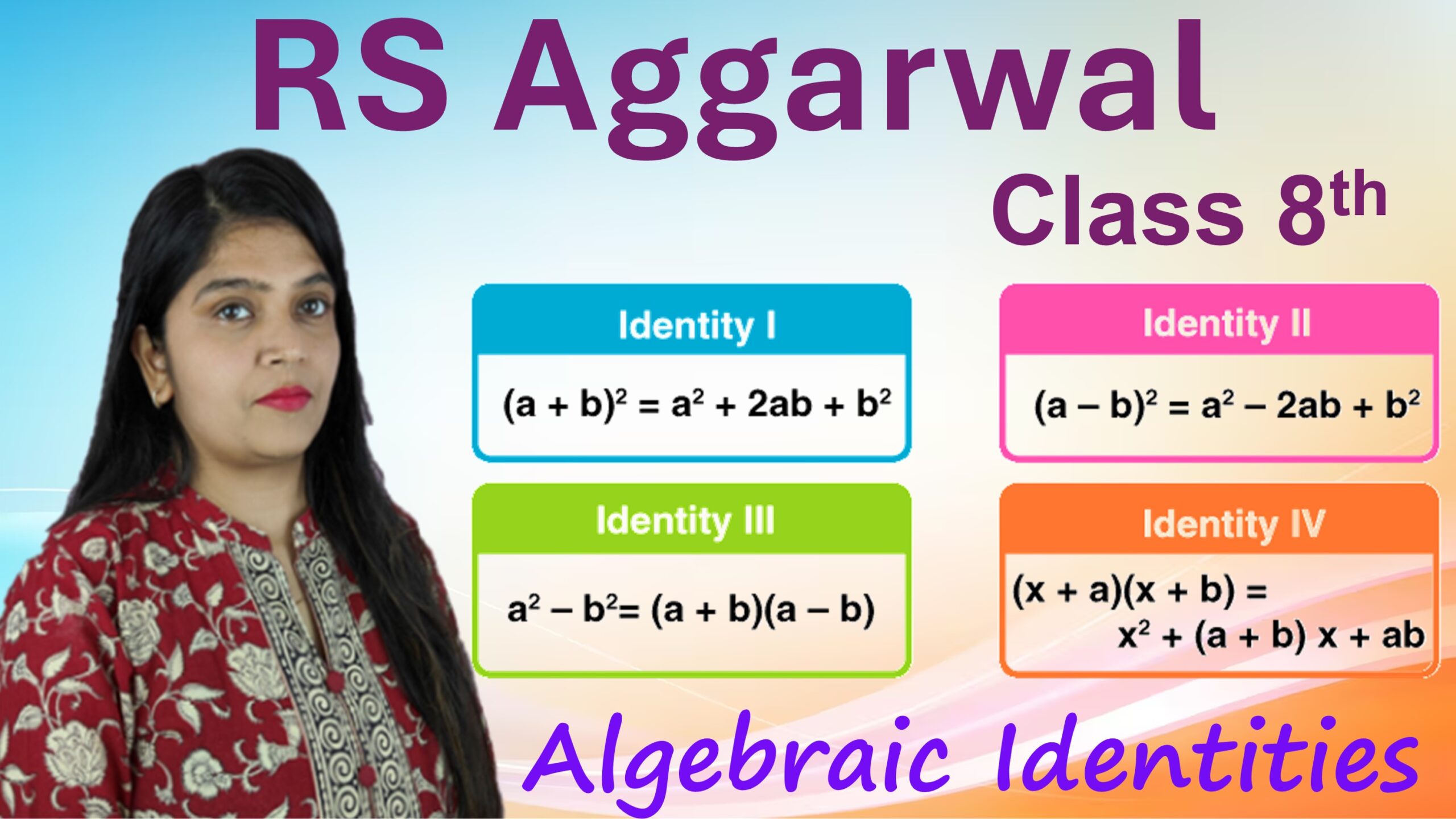
\((x+\frac{1}{x})^2 = x^2 + \frac{1}{x^2} + 2\)
Step 2: Substitute \(x+\frac{1}{x}=4\):
\((4)^2 = x^2 + \frac{1}{x^2} + 2\)
Step 3: Simplify:
\(16 = x^2 + \frac{1}{x^2} + 2\)
Step 4: Solve for \(x^2 + \frac{1}{x^2}\):
\(x^2 + \frac{1}{x^2} = 16 – 2 = 14\)
Step 5: Verify the statements:
– Assertion (A) is true.
– Reason (R) is true and correctly explains the assertion.
Answer: a. Both Assertion and Reason are true, and Reason is the correct explanation of Assertion
Q2: Assertion (A): The product of \(\left(2x-4\right)\) and \(\left(2x+1\right)\) is \(4x^2-3x-4\).
Reason (R): \(\left(x-a\right)\left(x+a\right)=x^2-a^2\).
Step 1: Expand the product in Assertion (A):
\((2x-4)(2x+1) = (2x)(2x) + (2x)(1) + (-4)(2x) + (-4)(1)\)
Step 2: Simplify each term:
\((2x)(2x) = 4x^2\)
\((2x)(1) = 2x\)
\((-4)(2x) = -8x\)
\((-4)(1) = -4\)
Step 3: Add all terms:
\(4x^2 + 2x – 8x – 4 = 4x^2 – 6x – 4\)
Step 4: Compare with Assertion (A):
Assertion claims \(4x^2 – 3x – 4\), but actual product is \(4x^2 – 6x – 4\)
Step 5: Check Reason (R):
Reason (R) is \((x-a)(x+a) = x^2 – a^2\), which applies **only to sum and difference form**, not to \((2x-4)(2x+1)\). So Reason is **false**.
Answer: d. Assertion is false but Reason is true
Q3: Assertion (A): The square of 998 is 996004.
Reason (R): We can find the square of 998 using the identity \(\left(x-y\right)^2=x^2+y^2-2xy\).
Step 1: Use the identity \((x-y)^2 = x^2 – 2xy + y^2\) to calculate \(998^2\).
Here, \(x = 1000\), \(y = 2\) (since 998 = 1000 – 2)
Step 2: Substitute values into the formula:
\((998)^2 = (1000 – 2)^2 = (1000)^2 – 2 \cdot 1000 \cdot 2 + (2)^2\)
Step 3: Calculate each term:
\((1000)^2 = 1000000\)
\(-2 \cdot 1000 \cdot 2 = -4000\)
\((2)^2 = 4\)
Step 4: Add the results:
\(1000000 – 4000 + 4 = 996004\)
Step 5: Compare with Assertion:
Assertion (A) claims \(998^2 = 996004\), which is correct.
Reason (R) correctly explains **how the square is obtained using identity**.
Answer: a. Both Assertion and Reason are true and Reason is the correct explanation of Assertion


Leave a Comment