

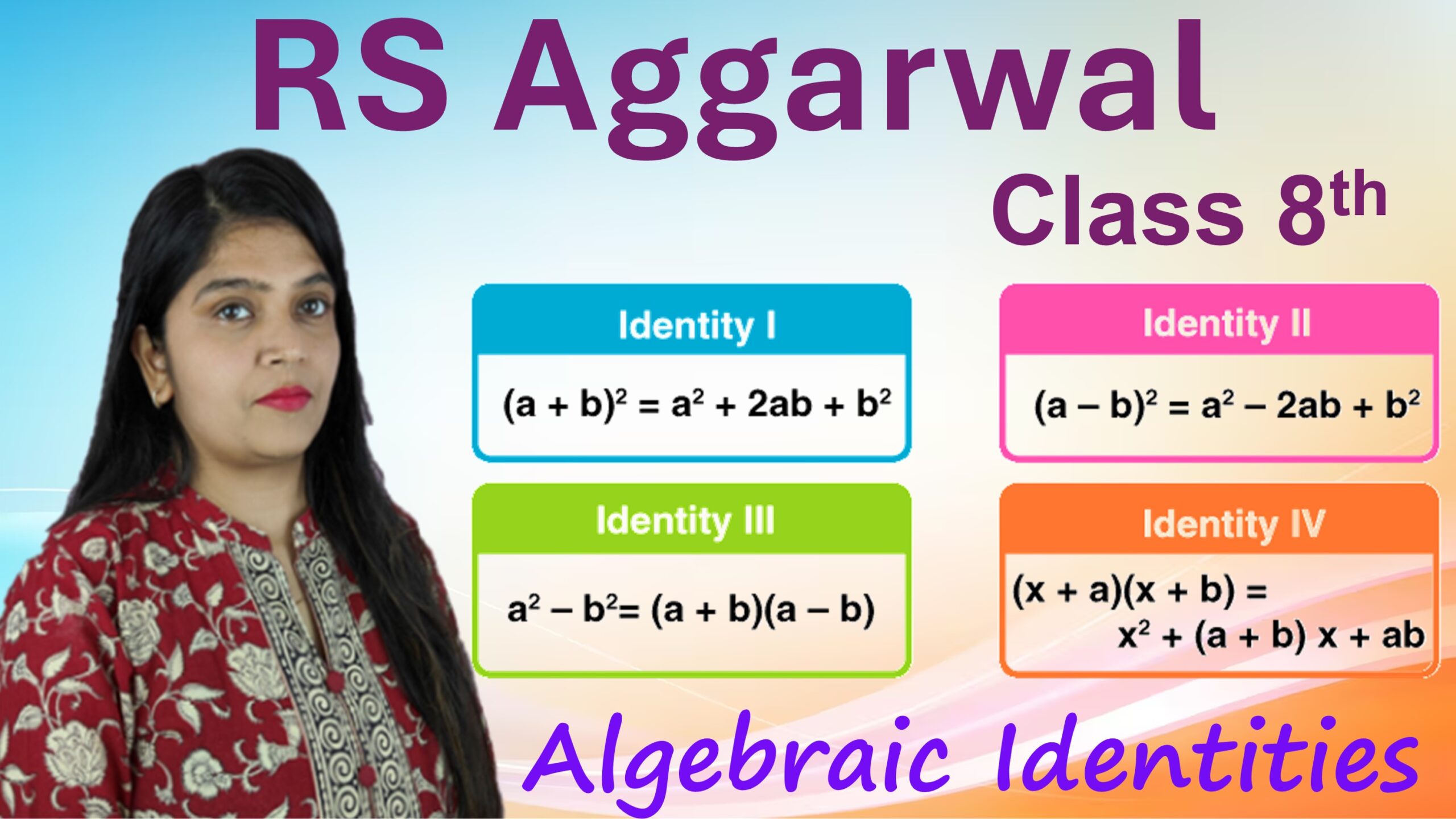
Exercise: 13-B
Q1: Find the following products:
i. \((y+9)(y-9)\)
Step 1: Recognize identity:
\((a+b)(a-b) = a^2 – b^2\)
Here, \(a = y, \; b = 9\)
Step 2: Apply identity:
\(y^2 – 9^2\)
Step 3: Simplify:
\(y^2 – 81\)
Answer: \(y^2 – 81\)
ii. \((4+b)(4-b)\)
Step 1: Recognize identity:
\((a+b)(a-b) = a^2 – b^2\)
Here, \(a = 4, \; b = b\)
Step 2: Apply identity:
\(4^2 – b^2\)
Step 3: Simplify:
\(16 – b^2\)
Answer: \(16 – b^2\)
iii. \(\left(z+\frac{1}{2}\right)\left(z-\frac{1}{2}\right)\)
Step 1: Recognize identity:
\((a+b)(a-b) = a^2 – b^2\)
Here, \(a = z, \; b = \frac{1}{2}\)
Step 2: Apply identity:
\(z^2 – \left(\frac{1}{2}\right)^2\)
Step 3: Simplify:
\(z^2 – \frac{1}{4}\)
Answer: \(z^2 – \frac{1}{4}\)
iv. \(\left(a-\frac{2}{3}\right)\left(a+\frac{2}{3}\right)\)
Step 1: Recognize identity:
\((a-b)(a+b) = a^2 – b^2\)
Here, \(a = a, \; b = \frac{2}{3}\)
Step 2: Apply identity:
\(a^2 – \left(\frac{2}{3}\right)^2\)
Step 3: Simplify:
\(a^2 – \frac{4}{9}\)
Answer: \(a^2 – \frac{4}{9}\)
Q2: Find the following products:
i. \((3x-5)(3x+5)\)
Step 1: Recognize identity:
\((a-b)(a+b) = a^2 – b^2\)
Here, \(a = 3x, \; b = 5\)
Step 2: Apply identity:
\((3x)^2 – (5)^2\)
Step 3: Simplify:
\(9x^2 – 25\)
Answer: \(9x^2 – 25\)
ii. \((2+7x)(2-7x)\)
Step 1: Recognize identity:
\((a+b)(a-b) = a^2 – b^2\)
Here, \(a = 2, \; b = 7x\)
Step 2: Apply identity:
\((2)^2 – (7x)^2\)
Step 3: Simplify:
\(4 – 49x^2\)
Answer: \(4 – 49x^2\)
iii. \(\left(\frac{a}{2}+3\right)\left(\frac{a}{2}-3\right)\)
Step 1: Recognize identity:
\((a+b)(a-b) = a^2 – b^2\)
Here, \(a = \frac{a}{2}, \; b = 3\)
Step 2: Apply identity:
\(\left(\frac{a}{2}\right)^2 – (3)^2\)
Step 3: Simplify:
\(\frac{a^2}{4} – 9\)
Answer: \(\frac{a^2}{4} – 9\)
iv. \((4x+3y)(4x-3y)\)
Step 1: Recognize identity:
\((a+b)(a-b) = a^2 – b^2\)
Here, \(a = 4x, \; b = 3y\)
Step 2: Apply identity:
\(\left(4x\right)^2 – \left(3y\right)^2\)
Step 3: Simplify:
\(16x^2 – 9y^2\)
Answer: \(16x^2 – 9y^2\)
Q3: Find the following products:
i. \(\left(\frac{a}{3}-\frac{b}{4}\right)\left(\frac{a}{3}+\frac{b}{4}\right)\)
Step 1: Recognize the identity:
\((p – q)(p + q) = p^2 – q^2\)
Here, \(p = \frac{a}{3}, \; q = \frac{b}{4}\)
Step 2: Apply identity:
\(\left(\frac{a}{3}\right)^2 – \left(\frac{b}{4}\right)^2\)
Step 3: Simplify:
\(\frac{a^2}{9} – \frac{b^2}{16}\)
Answer: \(\frac{a^2}{9} – \frac{b^2}{16}\)
ii. \(\left(\frac{t}{2}-\frac{1}{3}\right)\left(\frac{t}{2}+\frac{1}{3}\right)\)
Step 1: Recognize the identity:
\((p – q)(p + q) = p^2 – q^2\)
Here, \(p = \frac{t}{2}, \; q = \frac{1}{3}\)
Step 2: Apply identity:
\(\left(\frac{t}{2}\right)^2 – \left(\frac{1}{3}\right)^2\)
Step 3: Simplify:
\(\frac{t^2}{4} – \frac{1}{9}\)
Answer: \(\frac{t^2}{4} – \frac{1}{9}\)
Q4: Find the following products:
i. \(\left(\frac{2}{x}+\frac{3}{y}\right)\left(\frac{2}{x}-\frac{3}{y}\right)\)
Step 1: Recognize the identity:
\((p+q)(p-q) = p^2 – q^2\)
Here, \(p = \frac{2}{x}, \; q = \frac{3}{y}\)
Step 2: Apply identity:
\(\left(\frac{2}{x}\right)^2 – \left(\frac{3}{y}\right)^2\)
Step 3: Simplify:
\(\frac{4}{x^2} – \frac{9}{y^2}\)
Answer: \(\frac{4}{x^2} – \frac{9}{y^2}\)
ii. \(\left(\frac{1}{a}-\frac{1}{b}\right)\left(\frac{1}{a}+\frac{1}{b}\right)\)
Step 1: Recognize the identity:
\((p – q)(p + q) = p^2 – q^2\)
Here, \(p = \frac{1}{a}, \; q = \frac{1}{b}\)
Step 2: Apply identity:
\(\left(\frac{1}{a}\right)^2 – \left(\frac{1}{b}\right)^2\)
Step 3: Simplify:
\(\frac{1}{a^2} – \frac{1}{b^2}\)
Answer: \(\frac{1}{a^2} – \frac{1}{b^2}\)
iii. \(\left(\frac{1}{3x}+\frac{2}{5y}\right)\left(\frac{1}{3x}-\frac{2}{5y}\right)\)
Step 1: Recognize the identity:
\((p+q)(p-q) = p^2 – q^2\)
Here, \(p = \frac{1}{3x}, \; q = \frac{2}{5y}\)
Step 2: Apply identity:
\(\left(\frac{1}{3x}\right)^2 – \left(\frac{2}{5y}\right)^2\)
Step 3: Simplify:
\(\frac{1}{9x^2} – \frac{4}{25y^2}\)
Answer: \(\frac{1}{9x^2} – \frac{4}{25y^2}\)
iv. \(\left(1.1x-0.3y\right)\left(1.1x+0.3y\right)\)
Step 1: Recognize the identity:
\((p – q)(p + q) = p^2 – q^2\)
Here, \(p = 1.1x, \; q = 0.3y\)
Step 2: Apply identity:
\((1.1x)^2 – (0.3y)^2\)
Step 3: Simplify:
\(1.21x^2 – 0.09y^2\)
Answer: \(1.21x^2 – 0.09y^2\)
Q5: Find the following products:
i. \(\left(a^2+2b^2\right)\left(a^2-2b^2\right)\)
Step 1: Recognize the identity:
\((p+q)(p-q) = p^2 – q^2\)
Here, \(p = a^2, \; q = 2b^2\)
Step 2: Apply identity:
\((a^2)^2 – (2b^2)^2\)
Step 3: Simplify:
\(a^4 – 4b^4\)
Answer: \(a^4 – 4b^4\)
ii. \(\left(6x^2-7y^2\right)\left(6x^2+7y^2\right)\)
Step 1: Recognize the identity:
\((p – q)(p + q) = p^2 – q^2\)
Here, \(p = 6x^2, \; q = 7y^2\)
Step 2: Apply identity:
\((6x^2)^2 – (7y^2)^2\)
Step 3: Simplify:
\(36x^4 – 49y^4\)
Answer: \(36x^4 – 49y^4\)
iii. \(\left(4x^2+2yz\right)\left(2x^2-yz\right)\)
Step 1: Expand using distributive law:
\((4x^2)(2x^2) + (4x^2)(-yz) + (2yz)(2x^2) + (2yz)(-yz)\)
Step 2: Multiply each term:
\(8x^4 – 4x^2yz + 4x^2yz – 2y^2z^2\)
Step 3: Simplify like terms:
\(-4x^2yz + 4x^2yz = 0\)
So expression = \(8x^4 – 2y^2z^2\)
Answer: \(8x^4 – 2y^2z^2\)
iv. \(\left(ab-\frac{3}{2}cd\right)\left(2ab+3cd\right)\)
Step 1: Expand using distributive property:
\((ab)(2ab) + (ab)(3cd) + \left(-\frac{3}{2}cd\right)(2ab) + \left(-\frac{3}{2}cd\right)(3cd)\)
Step 2: Multiply each term:
\(2a^2b^2 + 3abcd – 3abcd – \frac{9}{2}c^2d^2\)
Step 3: Simplify like terms:
\(3abcd – 3abcd = 0\)
So expression = \(2a^2b^2 – \frac{9}{2}c^2d^2\)
Answer: \(2a^2b^2 – \frac{9}{2}c^2d^2\)
Q6: Find the following products:
i. \((2x+3)(2x-3)(4x^2+9)\)
Note / Assumption: The original text had \((2x+3)(2-3)(4x^2+9)\); here we assume the intended factor is \((2x-3)\) to match the standard identity.
Step 1: Recognize the identity:
\((u+v)(u-v)(u^2+v^2)=u^4 – v^4\).
Step 2: Put \(u=2x,\; v=3\).
Step 3: Apply identity:
\((2x+3)(2x-3)(4x^2+9) = (2x)^4 – 3^4\).
Step 4: Simplify:
\((2x)^4 = 16x^4,\; 3^4=81\) ⟹ \(16x^4 – 81\).
Answer:\(16x^4 – 81\)
ii. \((x+2y)(x-2y)(x^2+4y^2)\)
Step 1: Identity:
\((u+v)(u-v)(u^2+v^2)=u^4 – v^4\).
Step 2: Put \(u=x,\; v=2y\).
\strong style=”color:#8A6900″>Step 3: Apply identity:
\(x^4 – (2y)^4\).
Step 4: Simplify:
\((2y)^4 = 16y^4\) ⟹ \(x^4 – 16y^4\).
Answer:\(x^4 – 16y^4\)
iii. \((a+bc)(a-bc)(a^2+b^2c^2)\)
Step 1: Identity:
\((u+v)(u-v)(u^2+v^2)=u^4 – v^4\).
Step 2: Put \(u=a,\; v=bc\).
Step 3: Apply identity:
\(a^4 – (bc)^4\).
Step 4: Simplify:
\((bc)^4 = b^4c^4\) ⟹ \(a^4 – b^4c^4\).
Answer:\(a^4 – b^4c^4\)
iv. \(\left(\frac{2}{5}+x\right)\left(\frac{2}{5}-x\right)\left(\frac{4}{25}+x^2\right)\)
Step 1: Identity:
\((u+v)(u-v)(u^2+v^2)=u^4 – v^4\).
Step 2: Put \(u=\frac{2}{5},\; v=x\).
Step 3: Apply identity:
\(\left(\frac{2}{5}\right)^4 – x^4\).
Step 4: Simplify:
\(\left(\frac{2}{5}\right)^4 = \frac{16}{625}\) ⟹ \(\frac{16}{625} – x^4\).
Answer:\(\frac{16}{625} – x^4\)
Q7: Using the identical \(\left(a+b\right)\left(a-b\right)=(a^2-b^2)\), evaluate the following:
i. \(88\times112\)
Step 1: Write the factors around a convenient centre \(a\).
\(88 = 100 – 12\) and \(112 = 100 + 12\).
Step 2: Apply \((a-b)(a+b)=a^2-b^2\).
\((100-12)(100+12)=100^2-12^2\).
Step 3: Simplify.
\(100^2-12^2=10000-144=9856\).
Answer: 9856
ii. \(153\times167\)
Step 1: Choose centre \(a=160\):
\(153 = 160 – 7\) and \(167 = 160 + 7\).
Step 2: Apply identity:
\((160-7)(160+7)=160^2-7^2\).
Step 3: Simplify.
\(160^2-7^2=25600-49=25551\).
Answer: 25551
iii. \(10.8\times9.2\)
Step 1: Write about \(a=10\):
\(10.8 = 10 + 0.8\) and \(9.2 = 10 – 0.8\).
Step 2: Apply identity:
\((10+0.8)(10-0.8)=10^2-(0.8)^2\).
Step 3: Simplify.
\(100 – 0.64 = 99.36\).
Answer: 99.36
iv. \(3\frac{1}{3}\times4\frac{2}{3}\)
Step 1: Convert to improper fractions.
\(3\frac{1}{3}=\frac{10}{3}\) and \(4\frac{2}{3}=\frac{14}{3}\).
Step 2: Recognise centre \(a=4\) and offset \(b=\frac{2}{3}\):
\(\frac{10}{3}=4-\frac{2}{3}\) and \(\frac{14}{3}=4+\frac{2}{3}\).
Step 3: Apply identity:
\((4-\frac{2}{3})(4+\frac{2}{3})=4^2-(\frac{2}{3})^2\).
Step 4: Simplify.
\(16-\frac{4}{9}=\frac{144}{9}-\frac{4}{9}=\frac{140}{9}\).
Answer: \(\frac{140}{9}\) or \(15\frac{5}{9}\)
v. \(9\frac{1}{4}\times15\frac{3}{4}\)
Step 1: Convert to improper fractions.
\(9\frac{1}{4}=\frac{37}{4}\) and \(15\frac{3}{4}=\frac{63}{4}\).
Step 2: Choose a decimal centre \(a=12.5\) and offset \(b=3.25\) (or work purely with fractions).
\(\frac{37}{4}=12.5-3.25\) and \(\frac{63}{4}=12.5+3.25\).
Step 3: Apply identity:
\((12.5-3.25)(12.5+3.25)=(12.5)^2-(3.25)^2\).
Step 4: Simplify (decimal method).
\(12.5^2=156.25\) and \(3.25^2=10.5625\).
\(156.25-10.5625=145.6875\).
Fraction form: Multiply fractions directly: \(\frac{37}{4}\times\frac{63}{4}=\frac{2331}{16} = 145\frac{11}{16}\).
Answer: \(145\frac{11}{16}\) or \(\frac{2331}{16}\)


Leave a Comment