

Exercise-20
Q1: Which of the following geometrical figures has exactly one line of symmetry?
i. A rectangle
Step 1: A rectangle has two lines of symmetry.
One vertical line and one horizontal line through the center.
Step 2: Since the number of lines of symmetry = 2,
it does NOT satisfy the given condition.
ii. A semicircle
Step 1: A semicircle has only one line of symmetry.
This line passes through the center and is perpendicular to the diameter.
Step 2: There is no other line that can divide the semicircle into two equal mirror images.
iii. A regular pentagon
Step 1: A regular pentagon has all sides and angles equal.
Step 2: It has 5 lines of symmetry.
Hence, it does NOT have exactly one line of symmetry.
iv. A rhombus
Step 1: A rhombus has two diagonals.
Step 2: Each diagonal acts as a line of symmetry.
Therefore, number of lines of symmetry = 2.
Answer: ii. A semicircle
Q2: Which of the following geometrical figures has exactly two lines of symmetry?
i. A square
Step 1: A square has four equal sides and four equal angles.
Step 2: It has four lines of symmetry.
Two diagonals and two lines through the midpoints of opposite sides.
Step 3: Since number of lines of symmetry = 4,
it does NOT satisfy the given condition.
ii. A parallelogram
Step 1: In a general parallelogram, opposite sides are parallel and equal.
Step 2: A parallelogram has no line of symmetry.
Step 3: Hence, it does NOT satisfy the given condition.
iii. An isosceles trapezium
Step 1: In an isosceles trapezium, only one pair of opposite sides is parallel.
Step 2: The non-parallel sides are equal in length.
Step 3: It has exactly one line of symmetry.
This line passes through the midpoints of the parallel sides.
iv. A rectangle
Step 1: A rectangle has opposite sides equal and all angles equal to 90°.
Step 2: It has exactly two lines of symmetry.
One horizontal and one vertical line through the center.
Answer: iv. A rectangle
Q3: An equilateral triangle has three lines of symmetry, an isosceles triangle will have:
i. No line of symmetry
Step 1: An isosceles triangle has two equal sides and one unequal side.
Step 2: Such a triangle always has at least one line of symmetry.
Step 3: Therefore, it cannot have zero lines of symmetry.
ii. One line of symmetry
Step 1: The line joining the vertex angle to the midpoint of the base divides the triangle into two equal halves.
Step 2: This line acts as a line of symmetry.
Step 3: There is no other line that can divide the triangle into two mirror images.
iii. Two lines of symmetry
Step 1: If an isosceles triangle had two lines of symmetry,
then all sides would be equal.
Step 2: This would make it an equilateral triangle, not an isosceles triangle.
iv. Three line of symmetry
Step 1: A triangle with three lines of symmetry must have all sides and angles equal.
Step 2: This property belongs only to an equilateral triangle.
Answer: ii. One line of symmetry
Q4: A square and a rectangle have:
i. Only one line of symmetry
Step 1: A square has four lines of symmetry.
Step 2: A rectangle has two lines of symmetry.
Step 3: Since neither has only one line of symmetry,
this option is incorrect.
ii. Two lines of symmetry each
Step 1: A rectangle has exactly two lines of symmetry.
Step 2: A square has four lines of symmetry.
Step 3: Since both figures do not have two lines each,
this option is incorrect.
iii. Four lines of symmetry each
Step 1: A square has four lines of symmetry.
Two diagonals and two lines through the midpoints of opposite sides.
Step 2: A rectangle has only two lines of symmetry.
Step 3: Hence, both figures do not have four lines each.
iv. An unequal number of lines of symmetry
Step 1: A square has four lines of symmetry.
Step 2: A rectangle has two lines of symmetry.
Step 3: Since the number of lines of symmetry are different,
they have an unequal number of lines of symmetry.
Answer: iv. An unequal number of lines of symmetry
Q5: Which of the following letters of English alphabet does not possess a linear symmetry?
i. C
Step 1: The letter C has one horizontal line of symmetry.
Step 2: If folded along the horizontal line,
both halves coincide.
ii. M
Step 1: The letter M has one vertical line of symmetry.
Step 2: The left and right halves are mirror images of each other.
iii. S
Step 1: The letter S does not coincide with itself on folding along any line.
Step 2: It has neither vertical nor horizontal line of symmetry.
iv. B
Step 1: The letter B has one horizontal line of symmetry.
Step 2: The upper and lower parts are mirror images.
Answer: iii. S
Q6: Draw all possible lines of symmetry in each of the following figures and state the number of lines of symmetry in each case:
i.
Step 1: Identify the central vertical axis of the lamp.
Step 2: A vertical line through the tip of the flame and the base center divides it into two mirror halves.
Answer: Number of lines of symmetry = 1
ii.
Step 1: Examine the internal curve that divides the circle.
Step 2: Try drawing any straight line (diameter) through the center.
Step 3: Observe that because the curve flows in opposite directions, one side is not a reflection of the other. It has rotational symmetry but no reflectional symmetry.
Answer: Number of lines of symmetry = 0
iii.
Step 1: Identify the 90> corner.
Step 2: Draw a line bisecting this angle into two 45> parts.
Answer: Number of lines of symmetry = 1
iv.
Step 1: Locate the 5 vertices of the star.
Step 2: Draw lines from each vertex to the midpoint of the opposite base.
Answer: Number of lines of symmetry = 5
Q7: Construct a triangle PQR such that QR = 4 cm, ∠Q = 45° and ∠R = 90°. Draw the lines of symmetry for this triangle.
Step 1: Draw a line segment QR = 4 cm using a ruler.
Step 2: At point R, construct an angle of 90° using a protractor. Draw a ray RX.
Step 3: At point Q, construct an angle of 45° using a protractor. Draw a ray QY.
Step 4: Mark the point where ray RX and ray QY intersect as P. Triangle PQR is formed.
Step 5: By Angle Sum Property: ∠P = 180° – (90° + 45°) = 45°.
Step 6: Since ∠Q = ∠P = 45°, the sides opposite to them are equal (PR = QR = 4 cm).
Step 7: This is an Isosceles Right-Angled Triangle, so it has exactly one line of symmetry.
Step 8: Draw the line of symmetry by bisecting the 90° angle at vertex R.
Answer: Triangle PQR is an isosceles right-angled triangle. It has 1 line of symmetry which passes through vertex R and the midpoint of side PQ.
Q8: Construct a triangle XYZ such that XY = 3.5 cm and ∠X = ∠Y = 65°. Draw the lines of symmetry for this triangle.
Step 1: Draw a line segment \(XY = 3.5\text{ cm}\) using a ruler.
Step 2: Place the protractor at point \(X\) and mark an angle of \(65^\circ\). Draw a ray \(XA\).
Step 3: Place the protractor at point \(Y\) and mark an angle of \(65^\circ\). Draw a ray \(YB\).
Step 4: Mark the point where rays \(XA\) and \(YB\) intersect as \(Z\). Triangle \(XYZ\) is the required triangle.
Step 5: By Angle Sum Property: \(\angle Z = 180^\circ – (65^\circ + 65^\circ) = 50^\circ\).
Step 6: Since \(\angle X = \angle Y\), triangle \(XYZ\) is an Isosceles Triangle.
Step 7: An isosceles triangle has only one line of symmetry.
Step 8: Draw the line of symmetry from vertex \(Z\) to the midpoint of base \(XY\).
Answer: Triangle XYZ is an isosceles triangle. It has exactly one line of symmetry which passes through vertex Z and bisects the base XY at a 90° angle.
Q9: Construct an angle ∠PQR = 80°. Draw its line of symmetry if PQ = QR = 6.5 cm.
Step 1: Draw a line segment QR = 6.5 cm using a ruler and label the points Q and R.
Step 2: Place the protractor at point Q, align it with QR, and mark a point at 80°.
Step 3: Draw a ray from Q through the 80° mark.
Step 4: Use a compass set to 6.5 cm. Placing the needle at Q, draw an arc on the ray to find point P.
Step 5: Join P and Q. Now, ∠PQR = 80° and PQ = QR = 6.5 cm.
Step 6: To draw the line of symmetry, draw an arc from Q intersecting PQ and QR at two points.
Step 7: From these intersection points, draw two arcs of equal radius that cross each other at point S.
Step 8: Draw a line from Q through S. This is the angle bisector and the line of symmetry.
Answer: The line of symmetry for ∠PQR is its angle bisector. Since PQ = QR = 6.5 cm, the figure is symmetric, and the line of symmetry divides the 80° angle into two equal angles of 40° each.
Q10: State and explain the type(s) of symmetry possessed by each of the following figure.
i.
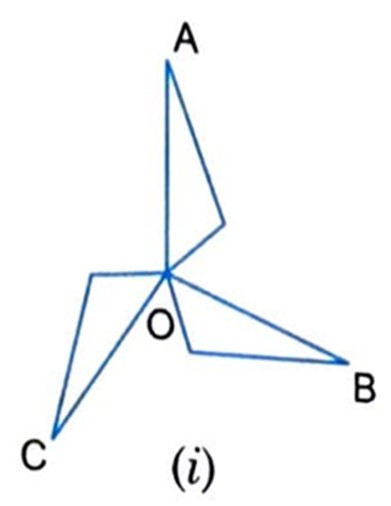
Step 1:
Observe the figure carefully.
No line can divide it into two identical mirror halves.
Step 2:
So, it has no reflection symmetry.
Step 3:
When rotated about point O through 120°, it fits exactly on itself.
Step 4:
But it does not match after 180° rotation.
Answer:
Reflection symmetry: No
Point symmetry: No
Rotational symmetry: Yes (order 3)
ii.
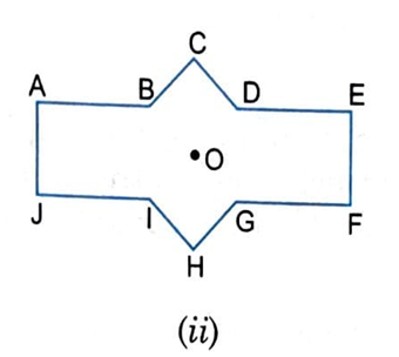
Step 1:
The figure can be divided into two identical halves vertically and horizontally.
Step 2:
So, it has reflection symmetry.
Step 3:
On rotating the figure through 180° about O, it fits exactly on itself.
Answer:
Reflection symmetry: Yes (2 lines)
Point symmetry: Yes
Rotational symmetry: Yes (order 2)
iii.
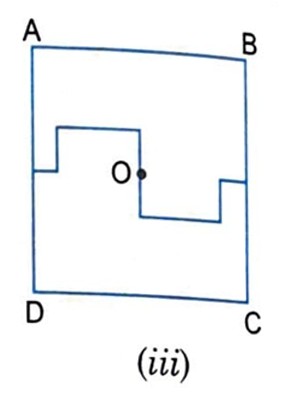
Step 1:
No straight line can divide the figure into two identical mirror parts.
Step 2:
So, it has no reflection symmetry.
Step 3:
On rotating the figure through 180° about O, it fits on itself.
Answer:
Reflection symmetry: No
Point symmetry: Yes
Rotational symmetry: Yes (order 2)
iv.
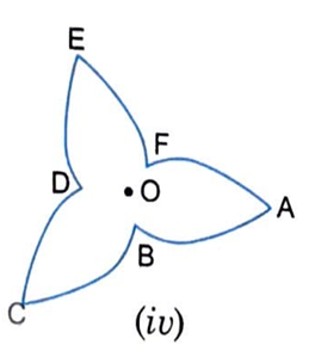
Step 1:
The figure has three identical curved arms.
Step 2:
It can be divided into identical halves in three different ways.
Step 3:
It also fits on itself after rotation of 120° and 240°.
Answer:
Reflection symmetry: Yes (3 lines)
Point symmetry: No
Rotational symmetry: Yes (order 3)
v.
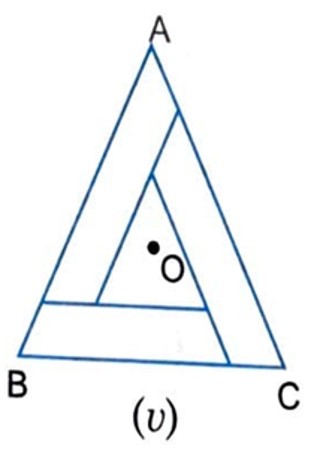
Step 1:
This figure has no line of symmetry.
Step 2:
It does not match itself after 180° rotation.
Step 3:
It also fits on itself after rotation of 120° and 240°.
Answer:
Reflection symmetry: No
Point symmetry: No
Rotational symmetry: Yes (order 3)
vi.
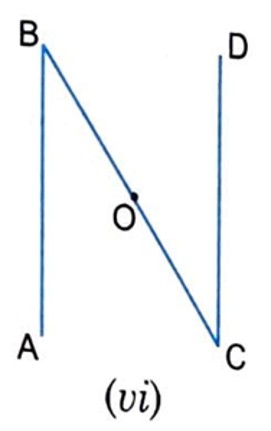
Step 1:
The figure has no mirror line.
Step 2:
On rotating it through 180° about point O, it fits exactly on itself.
Answer:
Reflection symmetry: No
Point symmetry: Yes
Rotational symmetry: Yes (order 2)
Leave a Comment