

Exercise: 23A
Q1: Multiple Choice Type:
i. The volume of a cuboid is 4800 cm³. If its length is 24 cm and breadth is 20 cm; its height is:
Step 1: Use the formula for volume of cuboid:
Volume = length × breadth × height
Step 2: Substitute the known values:
4800 = 24 × 20 × height
Step 3: Calculate the product of length and breadth:
24 × 20 = 480
Step 4: Find height by dividing volume by product of length and breadth:
height = \(\frac{4800}{480}\) = 10 cm
Answer: b. 10 cm
ii. The length, breadth and height of cuboid are in the ratio 3 : 2 : 1 and its volume is 162 cm³; the longest side of the cuboids is:
Step 1: Let the common ratio be \(x\). Then length = 3x, breadth = 2x, height = x.
Step 2: Use the volume formula:
Volume = length × breadth × height = 3x × 2x × x = 6x³
Step 3: Substitute volume = 162:
6x³ = 162
Step 4: Solve for \(x³\):
\(x³ = \frac{162}{6} = 27\)
Step 5: Find \(x\):
\(x = \sqrt[3]{27} = 3\) cm
Step 6: Find the longest side (length):
length = 3x = 3 × 3 = 9 cm
Answer: b. 9 cm
iii. The length of a cuboid is doubled, breadth is halved and height is tripled, the volume of the cuboid will become:
Step 1: Let original dimensions be length = \(l\), breadth = \(b\), height = \(h\). Original volume = \(V = l \times b \times h\).
Step 2: New dimensions:
New length = \(2l\), New breadth = \(\frac{b}{2}\), New height = \(3h\).
Step 3: Calculate new volume \(V’\):
\(V’ = 2l \times \frac{b}{2} \times 3h = (2l \times \frac{b}{2}) \times 3h = (l \times b) \times 3h = 3 \times (l \times b \times h) = 3V\)
Answer: c. Three times
iv. Each side of a cube is tripled, its surface area will become:
Step 1: Surface area of cube = \(6 \times (side)^2\). Let original side be \(a\), original surface area = \(6a^2\).
Step 2: New side = \(3a\). New surface area:
\(= 6 \times (3a)^2 = 6 \times 9a^2 = 9 \times 6a^2\)
Step 3: New surface area is 9 times original surface area.
Answer: c. Nine times
v. A cuboid has a total surface area of 80 m² and the lateral surface area of 50 m²; the area of its base is:
Step 1: Total surface area (TSA) of cuboid = \(2(lb + bh + hl)\).
Step 2: Lateral surface area (LSA) = \(2h(l + b)\).
Step 3: The difference between TSA and LSA is the area of two bases:
Area of two bases = TSA – LSA = 80 – 50 = 30 m²
Step 4: Area of one base = \(\frac{30}{2} = 15\) m²
Answer: c. 15 m²
Q2: The length, the breadth and the height of a cuboid are in the ratio 5 : 3 : 2. If its volume is 240 cm³, find its dimensions. Also, find the total surface area of cuboid.
Step 1: Let the common ratio be \(x\). Then,
Length = \(5x\), Breadth = \(3x\), Height = \(2x\)
Step 2: Use the volume formula:
\[
\text{Volume} = \text{length} \times \text{breadth} \times \text{height}
\]
Substitute the values:
\[
240 = 5x \times 3x \times 2x = 30x^3
\]Step 3: Solve for \(x^3\):
\[
x^3 = \frac{240}{30} = 8
\]Step 4: Find \(x\):
\[
x = \sqrt[3]{8} = 2 \, \text{cm}
\]Step 5: Find the dimensions:
Length = \(5x = 5 \times 2 = 10\, \text{cm}\)
Breadth = \(3x = 3 \times 2 = 6\, \text{cm}\)
Height = \(2x = 2 \times 2 = 4\, \text{cm}\)
Step 6: Find the total surface area (TSA) of the cuboid:
\[
\text{TSA} = 2(lb + bh + hl)
\]
Substitute the values:
\[
= 2(10 \times 6 + 6 \times 4 + 4 \times 10)
\]
Calculate inside the bracket:
\[
= 2(60 + 24 + 40) = 2(124) = 248\, \text{cm}^2
\]Answer: The dimensions are 10 cm, 6 cm, and 4 cm. The total surface area is 248 cm².
Q3: The length, breadth and height of a cuboid are in the ratio 6 : 5 : 3. If its total surface area is 504 cm², find its dimensions. Also, find the volume of the cuboid.
Step 1: Let the common ratio be \(x\). Then,
Length = \(6x\), Breadth = \(5x\), Height = \(3x\)
Step 2: Use the formula for total surface area (TSA) of cuboid:
\[
\text{TSA} = 2(lb + bh + hl)
\]
Substitute the given TSA:
\[
504 = 2[(6x)(5x) + (5x)(3x) + (3x)(6x)]
\]Step 3: Simplify inside the bracket:
\[
504 = 2[30x^2 + 15x^2 + 18x^2] = 2[63x^2] = 126x^2
\]Step 4: Solve for \(x^2\):
\[
126x^2 = 504 \\
\Rightarrow x^2 = \frac{504}{126} = 4
\]Step 5: Find \(x\):
\[
x = \sqrt{4} = 2\, \text{cm}
\]Step 6: Find the dimensions:
Length = \(6x = 6 \times 2 = 12\, \text{cm}\)
Breadth = \(5x = 5 \times 2 = 10\, \text{cm}\)
Height = \(3x = 3 \times 2 = 6\, \text{cm}\)
Step 7: Find the volume of the cuboid:
\[
\text{Volume} = l \times b \times h = 12 \times 10 \times 6 = 720\, \text{cm}^3
\]Answer: The dimensions are 12 cm, 10 cm, and 6 cm. The volume of the cuboid is 720 cm³.
Q4: Find length of each side of a cube, if its volume is:
i. 216 cm³
Step 1: Let the length of each side of the cube be \(a\) cm.
Step 2: Volume of cube formula:
\[
V = a^3
\]Step 3: Substitute the volume:
\[
a^3 = 216
\]Step 4: Find \(a\) by taking cube root:
\[
a = \sqrt[3]{216} = 6 \, \text{cm}
\]Answer: Length of each side = 6 cm
ii. 1.728 m³
Step 1: Let the length of each side of the cube be \(a\) m.
Step 2: Volume of cube formula:
\[
V = a^3
\]Step 3: Substitute the volume:
\[
a^3 = 1.728
\]Step 4: Find \(a\) by taking cube root:
\[
a = \sqrt[3]{1.728} = 1.2 \, \text{m}
\]Answer: Length of each side = 1.2 m
Q5: The total surface area of a cube is 216 cm². Find its volume.
Step 1: Let the length of each side of the cube be \(a\) cm.
Step 2: Formula for total surface area (TSA) of cube:
\[
\text{TSA} = 6a^2
\]Step 3: Substitute the given TSA:
\[
6a^2 = 216
\]Step 4: Solve for \(a^2\):
\[
a^2 = \frac{216}{6} = 36
\]Step 5: Find \(a\):
\[
a = \sqrt{36} = 6 \, \text{cm}
\]Step 6: Find volume of the cube:
\[
V = a^3 = 6^3 = 216 \, \text{cm}^3
\]Answer: The volume of the cube is 216 cm³.
Q6: A wall 9 m long, 6 m high and 20 cm thick, is to be constructed using bricks of dimensions 30 cm, 15 cm and 10 cm. How many bricks will be required?
Step 1: Convert all dimensions of the wall into cm:
Length = 9 m = 900 cm
Height = 6 m = 600 cm
Thickness = 20 cm (already in cm)
Step 2: Calculate the volume of the wall:
\[
\text{Volume of wall} = \text{length} \times \text{height} \times \text{thickness} \\
= 900 \times 600 \times 20 = 10,800,000 \, \text{cm}^3
\]Step 3: Calculate the volume of one brick:
Length = 30 cm, Breadth = 15 cm, Height = 10 cm
\[
\text{Volume of one brick} = 30 \times 15 \times 10 = 4500 \, \text{cm}^3
\]Step 4: Find the number of bricks required:
\[
\text{Number of bricks} = \frac{\text{Volume of wall}}{\text{Volume of one brick}} = \frac{10,800,000}{4500} = 2400
\]Answer: Number of bricks required = 2400
Q7: A solid cube of edge 14 cm is melted down and recast into smaller and equal cubes each of edge 2 cm. Find the number of smaller cubes obtained.
Step 1: Find the volume of the original cube:
\[
V_{\text{original}} = (\text{edge})^3 = 14^3 = 14 \times 14 \times 14 = 2744 \, \text{cm}^3
\]Step 2: Find the volume of one smaller cube:
\[
V_{\text{small}} = 2^3 = 2 \times 2 \times 2 = 8 \, \text{cm}^3
\]Step 3: Find the number of smaller cubes formed:
\[
\text{Number of smaller cubes} = \frac{V_{\text{original}}}{V_{\text{small}}} = \frac{2744}{8} = 343
\]Answer: Number of smaller cubes obtained = 343
Q8: A closed box is a cuboid in shape with length = 40 cm, breadth = 30 cm and height = 50 cm. It is made of thin metal sheet. Find the cost of metal sheets required to make 20 such boxes, if 1 m² of metal sheet costs ₹45.
Step 1: Find the surface area of one cuboid (closed box).
Formula for total surface area of cuboid:
\[
\text{TSA} = 2(lb + bh + hl)
\]Step 2: Substitute given values (all in cm):
Length \(l = 40\) cm, Breadth \(b = 30\) cm, Height \(h = 50\) cm
\[
\text{TSA} = 2(40 \times 30 + 30 \times 50 + 50 \times 40)
\]Step 3: Calculate each product:
\[
40 \times 30 = 1200, \quad 30 \times 50 = 1500, \quad 50 \times 40 = 2000
\]
Sum:
\[
1200 + 1500 + 2000 = 4700
\]Step 4: Calculate total surface area:
\[
\text{TSA} = 2 \times 4700 = 9400 \, \text{cm}^2
\]Step 5: Convert surface area into m²:
\[
1 \, \text{m}^2 = 10,000 \, \text{cm}^2 \\
\text{TSA in m}^2 = \frac{9400}{10,000} = 0.94 \, \text{m}^2
\]Step 6: Find surface area for 20 boxes:
\[
20 \times 0.94 = 18.8 \, \text{m}^2
\]Step 7: Cost of metal sheet for 1 m² is ₹45.
So, cost for 18.8 m² is:
\[
45 \times 18.8 = ₹846
\]Answer: The cost of metal sheets required to make 20 boxes is ₹846.
Q9: Four cubes, each of edge 9 cm, are joined as shown. Write the dimensions of the cuboid obtained. Also find its total surface area and volume.
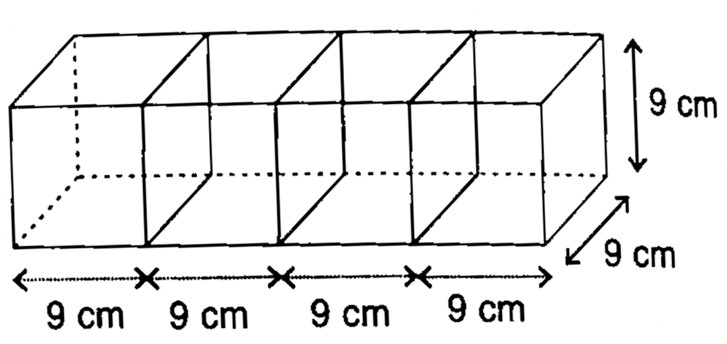
i. Finding the dimensions of the cuboid
Step 1: Each cube has edge = 9 cm.
Step 2: Four cubes are joined in a row lengthwise.
Length of cuboid:
\[
= 4 \times 9 = 36\text{ cm}
\]Breadth of cuboid:
\[
= 9\text{ cm}
\]Height of cuboid:
\[
= 9\text{ cm}
\]Answer: Dimensions of cuboid = 36 cm × 9 cm × 9 cm
ii. Finding the total surface area of the cuboid
Step 1: Formula for total surface area of a cuboid:
\[
= 2(lb + bh + hl)
\]Step 2: Substitute:
\[
l = 36,\; b = 9,\; h = 9 \\
\text{TSA} = 2(36 \times 9 + 9 \times 9 + 36 \times 9) \\
= 2(324 + 81 + 324) \\
= 2 \times 729 \\
= 1458\text{ cm}^2
\]Answer: Total surface area = 1458 cm²
iii. Finding the volume of the cuboid
Step 1: Formula for volume of a cuboid:
\[
= l \times b \times h
\]Step 2: Substitute the values:
\[
= 36 \times 9 \times 9 \\
= 2916\text{ cm}^3
\]Answer: Volume of the cuboid = 2916 cm³
Q10: What is the maximum length of a rod which can be kept in a rectangular box with internal dimensions 32 cm × 24 cm × 8 cm?
Step 1: The maximum length of the rod that can be kept inside the rectangular box is the length of the space diagonal of the box.
Step 2: Use the formula for the space diagonal \(d\) of a cuboid:
\[
d = \sqrt{l^2 + b^2 + h^2}
\]
where \(l = 32\) cm, \(b = 24\) cm, and \(h = 8\) cm.
Step 3: Calculate the squares:
\[
32^2 = 1024, \quad 24^2 = 576, \quad 8^2 = 64
\]Step 4: Sum the squares:
\[
1024 + 576 + 64 = 1664
\]Step 5: Find the square root:
\[
d = \sqrt{1664} \approx 40.79 \, \text{cm}
\]Answer: The maximum length of the rod that can be kept in the box is approximately 40.79 cm.
Q11: The diagonal of a cube is \(25\sqrt{3}\) m. Find its surface area.
Step 1: Let the side of the cube be \(a\) meters.
Step 2: The formula for the space diagonal \(d\) of a cube is:
\[
d = a\sqrt{3}
\]Step 3: Given diagonal:
\[
d = 25\sqrt{3}
\]Step 4: Equate and solve for \(a\):
\[
a\sqrt{3} = 25\sqrt{3} \\
\Rightarrow a = 25 \, \text{m}
\]Step 5: Formula for total surface area (TSA) of cube:
\[
\text{TSA} = 6a^2
\]Step 6: Calculate TSA:
\[
= 6 \times 25^2 = 6 \times 625 = 3750 \, \text{m}^2
\]Answer: The surface area of the cube is 3750 m².
Q12: A rectangular room is 4.5 m long, 4 m wide and 3 m high. Find the cost of white washing its walls and the roof at ₹ 15 per square metre.
Step 1: Calculate the area of the walls.
There are 2 pairs of opposite walls:
– Two walls of size \(4.5 \times 3\) meters
– Two walls of size \(4 \times 3\) meters
Total wall area:
\[
2 \times (4.5 \times 3) + 2 \times (4 \times 3) = 2 \times 13.5 + 2 \times 12 = 27 + 24 = 51 \, \text{m}^2
\]Step 2: Calculate the area of the roof:
\[
\text{Roof area} = \text{length} \times \text{width} = 4.5 \times 4 = 18 \, \text{m}^2
\]Step 3: Calculate total area to be whitewashed:
\[
\text{Total area} = \text{wall area} + \text{roof area} = 51 + 18 = 69 \, \text{m}^2
\]Step 4: Calculate cost of white washing:
\[
\text{Cost} = \text{total area} \times \text{rate per square meter} = 69 \times 15 = ₹1035
\]Answer: The cost of white washing the walls and roof is ₹1035.

Leave a Comment