

Exercise: 27-B
Q1: In rolling a die, the probability of getting an even composite number is:
Step 1: When a die is rolled, the possible outcomes are the numbers from 1 to 6.
Sample Space,
\( S = \{1, 2, 3, 4, 5, 6\} \)
Total number of outcomes \( = 6 \).
Step 2: Even numbers in the sample space are:
\( \{2, 4, 6\} \)
Composite numbers are numbers greater than 1 which are not prime.
Even composite numbers are:
\( \{4, 6\} \)
Number of favourable outcomes \( = 2 \).
Step 3: Using probability formula:
\( P(E) = \frac{\text{Number of favourable outcomes}}{\text{Total number of outcomes}} \)
Substituting the values,
\( P(\text{even composite}) = \frac{2}{6} = \frac{1}{3} \)
Answer: b. \( \frac{1}{3} \)
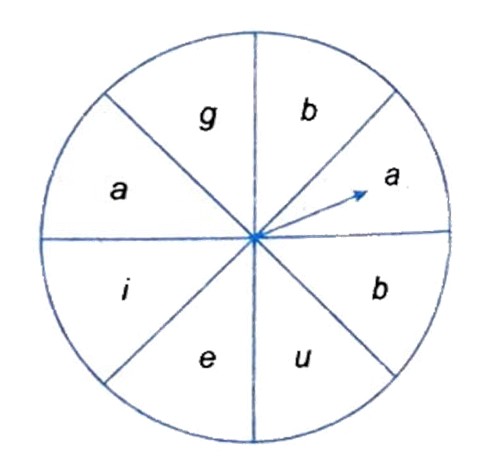
Q2: If the adjoining wheel is turned, the probability of getting a vowel is:
Step 1: Identify the total number of possible outcomes.
The wheel is divided into \(8\) equally likely sections.
Total possible outcomes \(n(S) = 8\)
Step 2: Count the number of favorable outcomes (vowels).
The sections contain the letters: i, g, a, b, a, b, e, u.
The vowels are ‘i’, ‘a’, ‘a’, ‘e’, ‘u’.
Number of favorable outcomes \(n(E) = 5\)
Step 3: Calculate the probability.
Probability \(P(\text{Vowel}) = \frac{n(E)}{n(S)}\)
\(P(\text{Vowel}) = \frac{5}{8}\)
Answer: d. \(\frac{5}{8}\)
Q3: There are 35 students in a class, of whom 20 are boys and 15 are girls. From these students, one is chosen at random. What is the probability that the chosen student is a girl?
Step 1: The favourable outcome is selecting a girl from the class.
Number of favourable outcomes \( = 15 \).
Total number of possible outcomes \( = 35 \).
Step 2: Using the probability formula:
\( P(E) = \frac{\text{Number of favourable outcomes}}{\text{Total number of outcomes}} \)
Substituting the values,
\( P(\text{girl}) = \frac{15}{35} = \frac{3}{7} \).
Answer: b. \( \frac{3}{7} \)
Q4: Two coins are tossed simultaneously. What is the probability of getting one head and one tail?
Step 1: When two coins are tossed simultaneously, all possible outcomes are:
Sample Space,
\( S = \{HH, HT, TH, TT\} \)
Total number of outcomes \( = 4 \).
Step 2: One head and one tail occur in the outcomes:
\( \{HT, TH\} \)
Number of favourable outcomes \( = 2 \).
Step 3: Using probability formula:
\( P(E) = \frac{\text{Number of favourable outcomes}}{\text{Total number of outcomes}} \)
Substituting the values,
\( P(\text{one head and one tail}) = \frac{2}{4} = \frac{1}{2} \).
Answer: b. \( \frac{1}{2} \)
Q5: A bag contains 4 black and 6 white balls. One ball is drawn at random. What is the probability that the ball drawn is black?
Step 1: Number of black balls in the bag \( = 4 \).
Number of white balls in the bag \( = 6 \).
Total number of balls in the bag is:
\( \text{Total balls} = 4 + 6 = 10 \).
Step 2: The favourable outcome is drawing a black ball.
Number of favourable outcomes \( = 4 \).
Total number of possible outcomes \( = 10 \).
Step 3: Using the probability formula:
\( P(E) = \frac{\text{Number of favourable outcomes}}{\text{Total number of outcomes}} \)
Substituting the values,
\( P(\text{black}) = \frac{4}{10} = \frac{2}{5} \).
Answer: c. \( \frac{2}{5} \)
Q6: The probability that a letter chosen at random from the letters of the word PORCUPINE is a vowel is:
Step 1: The given word is PORCUPINE.
Letters of the word are:
P, O, R, C, U, P, I, N, E
Total number of letters \( = 9 \).
Step 2: Vowels are the letters \( A, E, I, O, U \).
Vowels present in the word PORCUPINE are:
O, U, I, E
Number of vowels \( = 4 \).
Step 3: Using the probability formula:
\( P(E) = \frac{\text{Number of favourable outcomes}}{\text{Total number of outcomes}} \)
Substituting the values,
\( P(\text{vowel}) = \frac{4}{9} \).
Answer: b. \( \frac{4}{9} \)
Q7: Ten cards, numbered from 1 to 10, are kept in a box and mixed thoroughly. One card is chosen at random. What is the probability of getting a number less than 7?
Step 1: The numbers written on the cards are from 1 to 10.
Sample Space,
\( S = \{1, 2, 3, 4, 5, 6, 7, 8, 9, 10\} \)
Total number of outcomes \( = 10 \).
Step 2: Numbers less than 7 are:
\( \{1, 2, 3, 4, 5, 6\} \)
Number of favourable outcomes \( = 6 \).
Step 3: Using probability formula:
\( P(E) = \frac{\text{Number of favourable outcomes}}{\text{Total number of outcomes}} \)
Substituting the values,
\( P(\text{number} \lt 7) = \frac{6}{10} = \frac{3}{5} \).
Answer: c. \( \frac{3}{5} \)
Q8: One card is drawn from a well-shuffled deck of 52 cards. What is the probability that the card drawn is a 5?
Step 1: Total number of cards in the deck, \( n(S) = 52 \).
Step 2: Number of favorable outcomes (cards with number 5) = 4 (5 of Hearts, 5 of Diamonds, 5 of Clubs, 5 of Spades).
Step 3: Probability \( P \) of drawing a 5 is given by:
\[
P(\text{drawing a 5}) = \frac{\text{Number of favorable outcomes}}{\text{Total number of outcomes}} = \frac{4}{52} = \frac{1}{13}
\]Answer: a. \( \frac{1}{13} \)
Leave a Comment