

Exercise- 23 D
Q1: Find the perimeter and area of a semi-circle whose radius is:
i. 35 cm
Step 1: Calculate the Area of the semi-circle.
Radius \( (r) = 35 \text{ cm} \)
Area \( = \frac{1}{2} \pi r^2 \)
Area \( = \frac{1}{2} \times \frac{22}{7} \times 35 \times 35 \)
Area \( = 11 \times 5 \times 35 \)
Area \( = 1925 \text{ cm}^2 \)
Step 2: Calculate the Perimeter of the semi-circle.
Perimeter \( = \pi r + 2r \)
Perimeter \( = (\frac{22}{7} \times 35) + (2 \times 35) \)
Perimeter \( = 110 + 70 \)
Perimeter \( = 180 \text{ cm} \)
Answer: Area = 1925 cm², Perimeter = 180 cm
ii. 4.2 cm
Step 1: Calculate the Area of the semi-circle.
Radius \( (r) = 4.2 \text{ cm} \)
Area \( = \frac{1}{2} \pi r^2 \)
Area \( = \frac{1}{2} \times \frac{22}{7} \times 4.2 \times 4.2 \)
Area \( = 11 \times 0.6 \times 4.2 \)
Area \( = 27.72 \text{ cm}^2 \)
Step 2: Calculate the Perimeter of the semi-circle.
Perimeter \( = \pi r + 2r \)
Perimeter \( = (\frac{22}{7} \times 4.2) + (2 \times 4.2) \)
Perimeter \( = 13.2 + 8.4 \)
Perimeter \( = 21.6 \text{ cm} \)
Answer: Area = 27.72 cm², Perimeter = 21.6 cm
iii. 15.4 cm
Step 1: Calculate the Area of the semi-circle.
Radius \( (r) = 15.4 \text{ cm} \)
Area \( = \frac{1}{2} \pi r^2 \)
Area \( = \frac{1}{2} \times \frac{22}{7} \times 15.4 \times 15.4 \)
Area \( = 11 \times 2.2 \times 15.4 \)
Area \( = 372.68 \text{ cm}^2 \)
Step 2: Calculate the Perimeter of the semi-circle.
Perimeter \( = \pi r + 2r \)
Perimeter \( = (\frac{22}{7} \times 15.4) + (2 \times 15.4) \)
Perimeter \( = 48.4 + 30.8 \)
Perimeter \( = 79.2 \text{ cm} \)
Answer: Area = 372.68 cm², Perimeter = 79.2 cm
Q2: Find the perimeter and area of a semi-circle whose diameter is:
i. 18.2 cm
Step 1: Find the radius of the semi-circle.
Diameter \( (d) = 18.2 \text{ cm} \)
Radius \( (r) = \frac{d}{2} = \frac{18.2}{2} = 9.1 \text{ cm} \)
Step 2: Calculate the Area of the semi-circle.
Area \( = \frac{1}{2} \pi r^2 \)
Area \( = \frac{1}{2} \times \frac{22}{7} \times 9.1 \times 9.1 \)
Area \( = 11 \times 1.3 \times 9.1 \)
Area \( = 130.13 \text{ cm}^2 \)
Step 3: Calculate the Perimeter of the semi-circle.
Perimeter \( = \pi r + d \)
Perimeter \( = (\frac{22}{7} \times 9.1) + 18.2 \)
Perimeter \( = 28.6 + 18.2 \)
Perimeter \( = 46.8 \text{ cm} \)
Answer: Area = 130.13 cm², Perimeter = 46.8 cm
ii. 5.6 cm
Step 1: Find the radius of the semi-circle.
Diameter \( (d) = 5.6 \text{ cm} \)
Radius \( (r) = \frac{d}{2} = \frac{5.6}{2} = 2.8 \text{ cm} \)
Step 2: Calculate the Area of the semi-circle.
Area \( = \frac{1}{2} \pi r^2 \)
Area \( = \frac{1}{2} \times \frac{22}{7} \times 2.8 \times 2.8 \)
Area \( = 11 \times 0.4 \times 2.8 \)
Area \( = 12.32 \text{ cm}^2 \)
Step 3: Calculate the Perimeter of the semi-circle.
Perimeter \( = \pi r + d \)
Perimeter \( = (\frac{22}{7} \times 2.8) + 5.6 \)
Perimeter \( = 8.8 + 5.6 \)
Perimeter \( = 14.4 \text{ cm} \)
Answer: Area = 12.32 cm², Perimeter = 14.4 cm
Q3: Taking \(\pi = 3.14\), find the perimeter and area of a semi-circle whose radius is:
i. 8 cm
Step 1: Perimeter of semi-circle:
\[
\text{Perimeter} = \pi r + 2r = 3.14 \times 8 + 2 \times 8 = 25.12 + 16 = 41.12 \, cm
\]
Step 2: Area of semi-circle:
\[
\text{Area} = \frac{1}{2} \pi r^2 = \frac{1}{2} \times 3.14 \times 8^2 = \frac{1}{2} \times 3.14 \times 64 = 100.48 \, cm^2
\]Answer: i. Perimeter = 41.12 cm, Area = 100.48 cm²
ii. 15 cm
Step 3: Perimeter:
\[
\text{Perimeter} = 3.14 \times 15 + 2 \times 15 = 47.1 + 30 = 77.1 \, cm
\]
Step 4: Area:
\[
\text{Area} = \frac{1}{2} \times 3.14 \times 15^2 = \frac{1}{2} \times 3.14 \times 225 = 353.25 \, cm^2
\]Answer: Perimeter = 77.1 cm, Area = 353.25 cm²
iii. 20 cm
Step 5: Perimeter:
\[
\text{Perimeter} = 3.14 \times 20 + 2 \times 20 = 62.8 + 40 = 102.8 \, cm
\]
Step 6: Area:
\[
\text{Area} = \frac{1}{2} \times 3.14 \times 20^2 = \frac{1}{2} \times 3.14 \times 400 = 628 \, cm^2
\]Answer: Perimeter = 102.8 cm, Area = 628 cm²
Q4: Find the area of a semi-circle whose perimeter is:
i. 54 cm
Step 1: Determine the radius using the perimeter formula.
Perimeter of semi-circle \( = \pi r + 2r = r(\pi + 2) \)
\( 54 = r(\frac{22}{7} + 2) \)
\( 54 = r(\frac{22 + 14}{7}) \)
\( 54 = r(\frac{36}{7}) \)
\( r = \frac{54 \times 7}{36} \)
\( r = 10.5 \text{ cm} \)
Step 2: Calculate the Area of the semi-circle.
Area \( = \frac{1}{2} \pi r^2 \)
Area \( = \frac{1}{2} \times \frac{22}{7} \times 10.5 \times 10.5 \)
Area \( = 11 \times 1.5 \times 10.5 \)
Area \( = 173.25 \text{ cm}^2 \)
Answer: Area = 173.25 cm²
ii. 144 cm
Step 1: Determine the radius using the perimeter formula.
Perimeter \( = r(\pi + 2) \)
\( 144 = r(\frac{22}{7} + 2) \)
\( 144 = r(\frac{36}{7}) \)
\( r = \frac{144 \times 7}{36} \)
\( r = 4 \times 7 = 28 \text{ cm} \)
Step 2: Calculate the Area of the semi-circle.
Area \( = \frac{1}{2} \pi r^2 \)
Area \( = \frac{1}{2} \times \frac{22}{7} \times 28 \times 28 \)
Area \( = 11 \times 4 \times 28 \)
Area \( = 1232 \text{ cm}^2 \)
Answer: Area = 1232 cm²
Q5: Find the radius and perimeter of a semi-circle whose area is:
i. 77 cm²
Step 1: Find the radius using the Area formula.
Area of semi-circle \( = \frac{1}{2} \pi r^2 \)
\( 77 = \frac{1}{2} \times \frac{22}{7} \times r^2 \)
\( 77 = \frac{11}{7} \times r^2 \)
\( r^2 = \frac{77 \times 7}{11} \)
\( r^2 = 7 \times 7 = 49 \)
\( r = \sqrt{49} = 7 \text{ cm} \)
Step 2: Calculate the Perimeter of the semi-circle.
Perimeter \( = \pi r + 2r \)
Perimeter \( = (\frac{22}{7} \times 7) + (2 \times 7) \)
Perimeter \( = 22 + 14 \)
Perimeter \( = 36 \text{ cm} \)
Answer: Radius = 7 cm, Perimeter = 36 cm
ii. 12.32 m²
Step 1: Find the radius using the Area formula.
Area \( = \frac{1}{2} \pi r^2 \)
\( 12.32 = \frac{1}{2} \times \frac{22}{7} \times r^2 \)
\( 12.32 = \frac{11}{7} \times r^2 \)
\( r^2 = \frac{12.32 \times 7}{11} \)
\( r^2 = 1.12 \times 7 \)
\( r^2 = 7.84 \)
\( r = \sqrt{7.84} = 2.8 \text{ m} \)
Step 2: Calculate the Perimeter of the semi-circle.
Perimeter \( = \pi r + 2r \)
Perimeter \( = (\frac{22}{7} \times 2.8) + (2 \times 2.8) \)
Perimeter \( = 8.8 + 5.6 \)
Perimeter \( = 14.4 \text{ m} \)
Answer: Radius = 2.8 m, Perimeter = 14.4 m
Q6: A wire is in the form of a semi-circle of radius 28 cm. It is straightened and bent into the form of a square. What is the length of the side of the square?
Given:
Radius of semi-circle \(r = 28 \, cm\)
Step 1: Find the length of the wire (which is the perimeter of the semi-circle):
\[
\text{Length of wire} = \pi r + 2r = r(\pi + 2)
\]
Taking \(\pi = \frac{22}{7}\), substitute values:
\[
= 28 \times \left(\frac{22}{7} + 2\right) = 28 \times \left(\frac{22}{7} + \frac{14}{7}\right) = 28 \times \frac{36}{7} = 4 \times 36 = 144 \, cm
\]Step 2: When wire is bent into a square, perimeter of square = length of wire
Let the side of square be \(s\):
\[
4s = 144 \\
s = \frac{144}{4} = 36 \, cm
\]Answer: Length of side of the square = 36 cm
Q7: A wire is in the form of a square of side 49.5 cm. It is straightened and bent into a semi-circle. What is the radius of the semi-circle so formed?
Step 1: Calculate the total length of the wire.
The length of the wire is equal to the perimeter of the square.
Side of the square \( (s) = 49.5 \text{ cm} \)
Perimeter of square \( = 4 \times s \)
Length of wire \( = 4 \times 49.5 = 198 \text{ cm} \)
Step 2: Relate the wire length to the semi-circle’s perimeter.
When the wire is bent into a semi-circle, its total length becomes the perimeter of the semi-circle.
Perimeter of semi-circle \( = \pi r + 2r \)
\( 198 = r(\pi + 2) \)
Step 3: Solve for the radius \( (r) \).
Using \( \pi = \frac{22}{7} \):
\( 198 = r(\frac{22}{7} + 2) \)
\( 198 = r(\frac{22 + 14}{7}) \)
\( 198 = r(\frac{36}{7}) \)
\( r = \frac{198 \times 7}{36} \)
\( r = 5.5 \times 7 \)
\( r = 38.5 \text{ cm} \)
Answer: The radius of the semi-circle so formed is 38.5 cm.
Q8: A wire when in the form of a square encloses an area of 756.25 cm². If the same wire is bent to form a semi-circle, what will be the radius of the semi-circle so formed?
Given:
Area of square \(= 756.25 \, cm^2\)
Step 1: Find the side of the square:
\[
s^2 = 756.25 \\
s = \sqrt{756.25} = 27.5 \, cm
\]Step 2: Find the perimeter of the square (length of wire):
\[
\text{Perimeter} = 4 \times s = 4 \times 27.5 = 110 \, cm
\]Step 3: When the wire is bent to form a semi-circle, length of wire = perimeter of semi-circle
\[
\text{Perimeter of semi-circle} = \pi r + 2r = r(\pi + 2)
\]
Taking \(\pi = \frac{22}{7}\), substitute values:
\[
r \left(\frac{22}{7} + 2\right) = 110 \\
r \times \frac{36}{7} = 110 \\
r = \frac{110 \times 7}{36} = \frac{770}{36} = 21.39 \, cm
\]Answer: Radius of the semi-circle = 21.39 cm
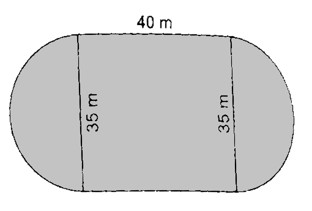
Q9: The shape of a park is a rectangle bounded by semi- circles at the ends, each of radius 17.5 m, as shown in the adjoining figure. Find the area and the perimeter of the park.
Step 1:
The given shape consists of:
(i) A rectangle
(ii) Two semicircles which together form one full circle
Radius of each semicircle,
\[
r = 17.5\text{ m}
\]Length of rectangle,
\[
l = 40\text{ m}
\]Breadth of rectangle (diameter of semicircle),
\[
b = 2r = 35\text{ m}
\]Step 2:
Area of the rectangular portion:
\[
\text{Area} = l \times b \\
= 40 \times 35 \\
= 1400\text{ m}^2
\]Step 3:
Area of the two semicircles (i.e., one full circle):
\[
\text{Area} = \pi r^2 \\
= \frac{22}{7} \times (17.5)^2 \\
= \frac{22}{7} \times 306.25 \\
= 962.5\text{ m}^2
\]Step 4:
Total area of the park:
\[
= 1400 + 962.5 \\
= 2362.5\text{ m}^2
\]Step 5:
Perimeter of the park consists of:
(i) Two lengths of the rectangle
(ii) Circumference of one full circle
Step 6:
Perimeter calculation:
\[
\text{Perimeter} = 2l + 2\pi r \\
= 2(40) + 2 \times \frac{22}{7} \times 17.5 \\
= 80 + 110 \\
= 190\text{ m}
\]Answer:
Area of the park = 2362.5 m²
Perimeter of the park = 190 m
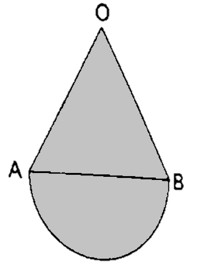
Q10: Find the perimeter and the area of the shaded region in the adjoining figure, it being given that OAB is an equilateral triangle of side 28 cm and one end is a semi-circle on AB as diameter.
Step 1: Identify the given dimensions of the figure.
Side of the equilateral triangle \( OAB (s) = 28 \text{ cm} \)
Diameter of the semi-circle \( (d) = AB = 28 \text{ cm} \)
Radius of the semi-circle \( (r) = \frac{d}{2} = \frac{28}{2} = 14 \text{ cm} \)
Step 2: Calculate the Area of the shaded region.
Total Area \( = \) Area of equilateral \( \triangle OAB + \) Area of semi-circle on \( AB \)
Area of \( \triangle OAB = \frac{\sqrt{3}}{4} \times s^2 \)
Area of \( \triangle OAB = \frac{1.73}{4} \times 28 \times 28 = 1.73 \times 7 \times 28 = 339.08 \text{ cm}^2 \)
Area of semi-circle \( = \frac{1}{2} \pi r^2 = \frac{1}{2} \times \frac{22}{7} \times 14 \times 14 = 11 \times 2 \times 14 = 308 \text{ cm}^2 \)
Total Area \( = 339.08 + 308 = 647.08 \text{ cm}^2 \)
Step 3: Calculate the Perimeter of the shaded region.
The perimeter consists of the two outer sides of the triangle and the curved arc of the semi-circle.
Perimeter \( = OA + OB + \text{Length of arc } AB \)
\( OA = OB = 28 \text{ cm} \)
Length of semi-circular arc \( = \pi r = \frac{22}{7} \times 14 = 44 \text{ cm} \)
Total Perimeter \( = 28 + 28 + 44 = 100 \text{ cm} \)
Answer: The perimeter of the shaded region is 100 cm and the area is 647.08 cm².
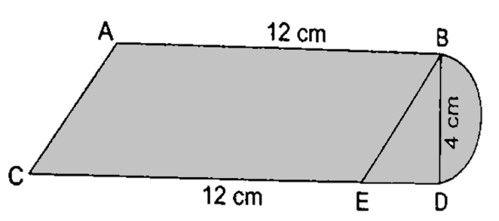
Q11: Find the perimeter and area of the adjoining figure, it being given that AB || CD, AB = 12 cm, CD = 15 cm, BD = 4 cm and one end of the figure is a semi-circle with BD as diameter.
Step 1: Identify the components and dimensions of the figure.
The figure consists of a trapezium \( ABDC \) and a semi-circle on side \( BD \).
Parallel sides: \( AB = 12 \text{ cm} \), \( CD = 15 \text{ cm} \)
Height: \( BD = 4 \text{ cm} \) (since \( AB || CD \) and \( BD \perp CD \))
Semi-circle diameter \( (d) = BD = 4 \text{ cm} \), so radius \( (r) = 2 \text{ cm} \)
Step 2: Find the length of the slanted side \( AC \).
Following the hint, draw \( BE || AC \). In parallelogram \( ABEC \):
\( CE = AB = 12 \text{ cm} \)
\( ED = CD – CE = 15 – 12 = 3 \text{ cm} \)
In right-angled \( \triangle BED \):
\( BE = \sqrt{ED^2 + BD^2} = \sqrt{3^2 + 4^2} = \sqrt{9 + 16} = 5 \text{ cm} \)
Since \( BE || AC \) and \( AB || CE \), \( AC = BE = 5 \text{ cm} \)
Step 3: Calculate the Area of the figure.
Total Area = Area of Trapezium \( ABDC \) + Area of semi-circle
Area of Trapezium \( = \frac{1}{2} \times (AB + CD) \times BD \)
Area of Trapezium \( = \frac{1}{2} \times (12 + 15) \times 4 = 27 \times 2 = 54 \text{ cm}^2 \)
Area of semi-circle \( = \frac{1}{2} \pi r^2 = \frac{1}{2} \times 3.14 \times 2 \times 2 = 6.28 \text{ cm}^2 \)
Total Area \( = 54 + 6.28 = 60.28 \text{ cm}^2 \)
Step 4: Calculate the Perimeter of the figure.
The perimeter consists of sides \( AC \), \( CD \), \( AB \), and the semi-circular arc \( BD \).
Length of semi-circular arc \( = \pi r = 3.14 \times 2 = 6.28 \text{ cm} \)
Total Perimeter \( = AC + CD + AB + \text{arc } BD \)
Total Perimeter \( = 5 + 15 + 12 + 6.28 = 38.28 \text{ cm} \)
Answer: The area of the figure is 60.28 cm² and the perimeter is 38.28 cm.
Q12: Find the area of the shaded region in the following figure:
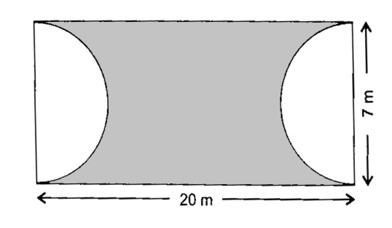
Step 1:
The given figure consists of:
(i) A rectangle
(ii) Two semicircles removed from the rectangle (one on each side)
Length of rectangle = 20 m
Breadth of rectangle = 7 m
Step 2:
Area of the rectangle:
\[
\text{Area} = l \times b \\
= 20 \times 7 \\
= 140\text{ m}^2
\]Step 3:
Each semicircle has diameter equal to the breadth of the rectangle.
So, radius of each semicircle:
\[
r = \frac{7}{2} = 3.5\text{ m}
\]Step 4:
Area of two semicircles = Area of one full circle:
\[
\text{Area} = \pi r^2 \\
= \frac{22}{7} \times (3.5)^2 \\
= \frac{22}{7} \times 12.25 \\
= 38.5\text{ m}^2
\]Step 5:
Area of the shaded region:
\[
= \text{Area of rectangle} – \text{Area of two semicircles} \\
= 140 – 38.5 \\
= 101.5\text{ m}^2
\]Answer: Area of the shaded region = 101.5 m²
Q13: Find the area of the shaded region in each of the following figures:
i. Figure (i)
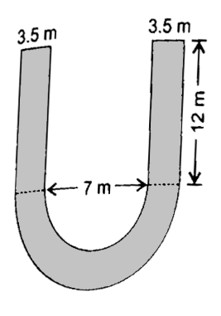
Step 1: Identify the components of the “U” shape.
The figure consists of two vertical rectangles and a semi-circular ring at the bottom.
Dimensions for each vertical rectangle: Length \( = 12 \text{ m} \), Breadth \( = 3.5 \text{ m} \).
Area of two rectangles \( = 2 \times (12 \times 3.5) = 84 \text{ m}^2 \).
Step 2: Calculate the area of the semi-circular ring.
Inner radius \( (r) = \frac{7}{2} = 3.5 \text{ m} \).
Outer radius \( (R) = 3.5 + 3.5 = 7 \text{ m} \).
Area of ring \( = \frac{1}{2} \pi (R^2 – r^2) = \frac{1}{2} \times \frac{22}{7} \times (7^2 – 3.5^2) \).
Area \( = \frac{11}{7} \times (49 – 12.25) = \frac{11}{7} \times 36.75 = 57.75 \text{ m}^2 \).
Step 3: Find the total shaded area.
Total Area \( = 84 + 57.75 = 141.75 \text{ m}^2 \).
Answer: 141.75 m²
ii. Figure (ii)
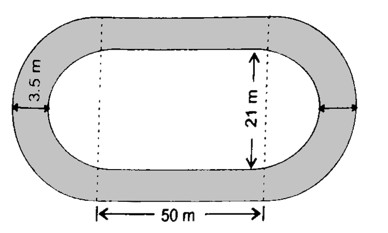
Step 1: Identify the components of the track.
The figure is a track formed by two rectangles and two semi-circular rings.
Area of top and bottom rectangles \( = 2 \times (50 \times 3.5) = 350 \text{ m}^2 \).
Step 2: Calculate the area of the two semi-circular rings (which make one full circular ring).
Inner radius \( (r) = \frac{21}{2} = 10.5 \text{ m} \).
Outer radius \( (R) = 10.5 + 3.5 = 14 \text{ m} \).
Area of circular ring \( = \pi (R^2 – r^2) = \frac{22}{7} \times (14^2 – 10.5^2) \).
Area \( = \frac{22}{7} \times (196 – 110.25) = \frac{22}{7} \times 85.75 = 269.5 \text{ m}^2 \).
Step 3: Find the total shaded area.
Total Area \( = 350 + 269.5 = 619.5 \text{ m}^2 \).
Answer: 619.5 m²
iii. Figure (iii)
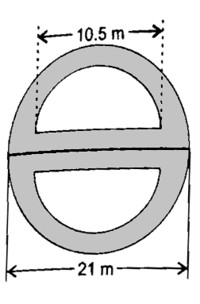
Step 1: Identify the components of the circle shape.
The figure is a large circle with a rectangular strip across the center and two semi-circular cutouts.
Outer diameter \( = 21 \text{ m} \), so radius \( (R) = 10.5 \text{ m} \).
Total Area of outer circle \( = \pi R^2 = \frac{22}{7} \times 10.5 \times 10.5 = 346.5 \text{ m}^2 \).
Step 2: Calculate the area of the unshaded parts.
Area of two unshaded semi-circles (one full circle) with diameter \( 10.5 \text{ m} \):
Radius \( (r) = \frac{10.5}{2} = 5.25 \text{ m} \).
Unshaded Area \( = \pi r^2 = \frac{22}{7} \times 5.25 \times 5.25 = 86.625 \text{ m}^2 \).
The horizontal strip is already part of the outer circle area and is shaded.
Step 3: Find the total shaded area.
Total Area \( = 346.5 – 86.625 = 259.875 \text{ m}^2 \).
Answer: 259.875 m²
iv. Figure (iv)
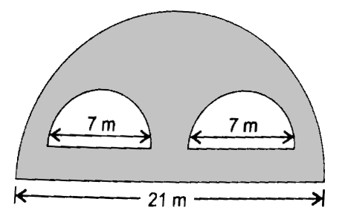
Step 1: Calculate the area of the outer semi-circle.
Diameter \( = 21 \text{ m} \), so radius \( (R) = 10.5 \text{ m} \).
Area of outer semi-circle \( = \frac{1}{2} \pi R^2 = \frac{1}{2} \times \frac{22}{7} \times 10.5 \times 10.5 = 173.25 \text{ m}^2 \).
Step 2: Calculate the area of the two smaller unshaded semi-circles.
Each has a diameter of \( 7 \text{ m} \), so radius \( (r) = 3.5 \text{ m} \).
Area of two semi-circles \( = \pi r^2 = \frac{22}{7} \times 3.5 \times 3.5 = 38.5 \text{ m}^2 \).
Step 3: Find the total shaded area.
Total Area \( = 173.25 – 38.5 = 134.75 \text{ m}^2 \).
Answer: 134.75 m²
Q14: Find the area of the shaded region in each of the following figures:
i. Figure (i)
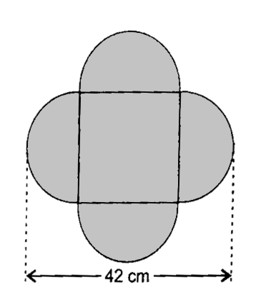
Step 1: Find the side of the square.
Let the side of the inner square be \( a \). The total width of 42 cm includes the side of the square plus two radii of the semi-circles.
Radius of each semi-circle \( (r) = \frac{a}{2} \)
Total width \( = \frac{a}{2} + a + \frac{a}{2} = 42 \text{ cm} \)
\( 2a = 42 \)
Side of square \( (a) = 21 \text{ cm} \)
Radius of semi-circles \( (r) = \frac{21}{2} = 10.5 \text{ cm} \)
Step 2: Calculate the Area of the square.
Area of square \( = a^2 \)
Area \( = 21 \times 21 = 441 \text{ cm}^2 \)
Step 3: Calculate the Area of the four semi-circles.
Four semi-circles make two full circles.
Area of 4 semi-circles \( = 2 \times \pi r^2 \)
Area \( = 2 \times \frac{22}{7} \times 10.5 \times 10.5 \)
Area \( = 2 \times 22 \times 1.5 \times 10.5 \)
Area \( = 693 \text{ cm}^2 \)
Step 4: Calculate the Total Area of the shaded region.
Total Area \( = \text{Area of square} + \text{Area of 4 semi-circles} \)
Total Area \( = 441 + 693 = 1134 \text{ cm}^2 \)
Answer: Area = 1134 cm²
ii. Figure (ii)
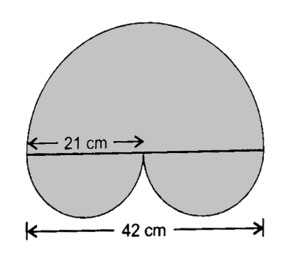
Step 1: Identify the components of the figure.
The figure consists of one large semi-circle (top) and two smaller semi-circles (bottom).
Diameter of large semi-circle \( (D) = 42 \text{ cm} \), so Radius \( (R) = 21 \text{ cm} \)
Diameter of each small semi-circle \( (d) = 21 \text{ cm} \), so Radius \( (r) = 10.5 \text{ cm} \)
Step 2: Calculate the Area of the large semi-circle.
Area \( = \frac{1}{2} \pi R^2 \)
Area \( = \frac{1}{2} \times \frac{22}{7} \times 21 \times 21 \)
Area \( = 11 \times 3 \times 21 = 693 \text{ cm}^2 \)
Step 3: Calculate the Area of the two small semi-circles.
Two semi-circles make one full circle.
Area \( = \pi r^2 \)
Area \( = \frac{22}{7} \times 10.5 \times 10.5 \)
Area \( = 22 \times 1.5 \times 10.5 = 346.5 \text{ cm}^2 \)
Step 4: Calculate the Total Area of the shaded region.
Total Area \( = \text{Area of large semi-circle} + \text{Area of 2 small semi-circles} \)
Total Area \( = 693 + 346.5 = 1039.5 \text{ cm}^2 \)
Answer: Area = 1039.5 cm²
Leave a Comment