

Exercise- 23 C
Q1: In the given figure, ABCD is a quadrilateral in which AC = 14 cm, BL ⊥ AC, DM ⊥ AC such that BL = 8 cm, DM = 6 cm. Find the area of quad. ABCD.
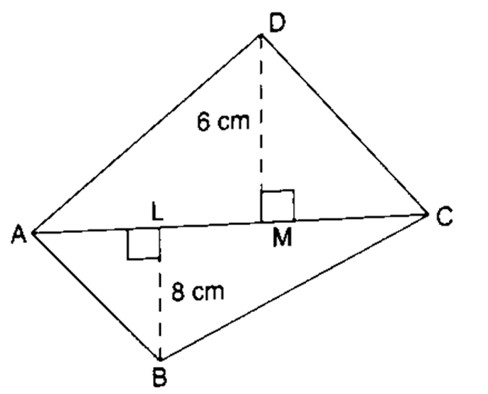
Step 1: Diagonal AC divides the quadrilateral ABCD into two triangles:
(i) △ABC
(ii) △ADC
Step 2: Area of △ABC using base AC and height BL:
\[
\text{Area of } \triangle ABC = \frac{1}{2} \times AC \times BL \\
= \frac{1}{2} \times 14 \times 8 \\
= 56\text{ cm}^2
\]Step 3: Area of △ADC using base AC and height DM:
\[
\text{Area of } \triangle ADC = \frac{1}{2} \times AC \times DM \\
= \frac{1}{2} \times 14 \times 6 \\
= 42\text{ cm}^2
\]Step 4: Area of quadrilateral ABCD:
\[
= \text{Area of } \triangle ABC + \text{Area of } \triangle ADC \\
= 56 + 42 \\
= 98\text{ cm}^2
\]Answer: Area of quadrilateral ABCD = 98 cm²
Q2: Find the area of the pentagon ABCDE shown in the adjoining figure. It is given that BF ⟂ AD, CH ⟂ AD and EG ⟂ AD such that AF = 9 cm, AG = 13 cm, AH = 19 cm, AD = 24 cm, BF = 6 cm, CH = 8 cm and EG = 9 cm.
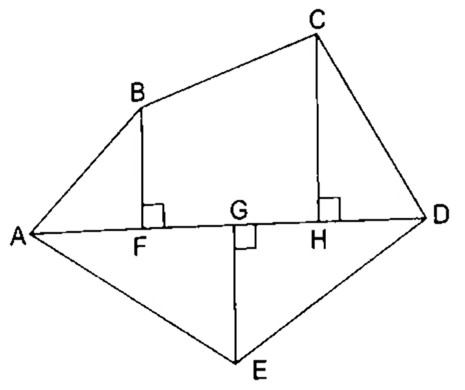
Step 1: Diagonal AD divides the pentagon into two parts:
(i) Region above AD (ABCD)
(ii) Region below AD (△AED)
Step 2: Area of △AFB:
\[
= \frac{1}{2} \times AF \times BF \\
= \frac{1}{2} \times 9 \times 6 \\
= 27\text{ cm}^2
\]Step 3: Distance FH = AH − AF
\[
= 19 – 9 = 10\text{ cm}
\]Area of trapezium FBHC:
\[
= \frac{1}{2} \times (BF + CH) \times FH \\
= \frac{1}{2} \times (6 + 8) \times 10 \\
= 70\text{ cm}^2
\]Step 4: Distance HD = AD − AH
\[
= 24 – 19 = 5\text{ cm}
\]Area of △HCD:
\[
= \frac{1}{2} \times HD \times CH \\
= \frac{1}{2} \times 5 \times 8 \\
= 20\text{ cm}^2
\]Step 5: Area of region ABCD (above AD):
\[
= 27 + 70 + 20 \\
= 117\text{ cm}^2
\]Step 6: Area of △AED (below AD):
\[
= \frac{1}{2} \times AD \times EG \\
= \frac{1}{2} \times 24 \times 9 \\
= 108\text{ cm}^2
\]Step 7: Total area of pentagon ABCDE:
\[
= 117 + 108 \\
= 225\text{ cm}^2
\]Answer: Area of pentagon ABCDE = 225 cm²
Q3: Find the area of pentagon PQRST in which QD ⟂ PR, RE ⟂ PS and TF ⟂ PS such that PR = 10 cm, PS = 12 cm, QD = 3 cm, RE = 7 cm and TF = 5 cm.
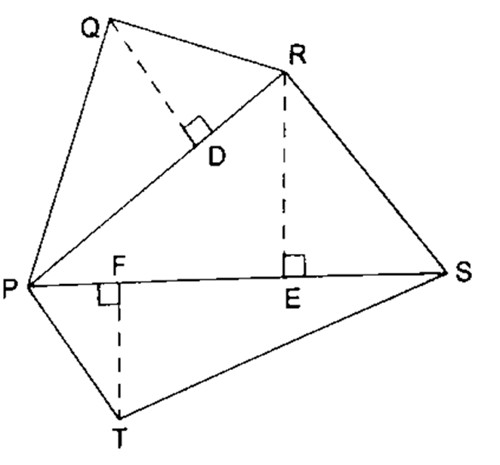
Step 1: Diagonal PR divides the pentagon PQRST into two parts:
(i) Triangle PQR (above PR)
(ii) Quadrilateral PRST (below PR)
Step 2: Area of △PQR using base PR and height QD:
\[
\text{Area of } \triangle PQR = \frac{1}{2} \times PR \times QD \\
= \frac{1}{2} \times 10 \times 3 \\
= 15\text{ cm}^2
\]Step 3: Now consider quadrilateral PRST.
Draw perpendiculars RE and TF on base PS.
Step 4: Area of △PRS using base PS and height RE:
\[
\text{Area of } \triangle PRS = \frac{1}{2} \times PS \times RE \\
= \frac{1}{2} \times 12 \times 7 \\
= 42\text{ cm}^2
\]Step 5: Area of △PST using base PS and height TF:
\[
\text{Area of } \triangle PST = \frac{1}{2} \times PS \times TF \\
= \frac{1}{2} \times 12 \times 5 \\
= 30\text{ cm}^2
\]Step 6: Area of quadrilateral PRST:
\[
= 42 + 30 \\
= 72\text{ cm}^2
\]Step 7: Total area of pentagon PQRST:
\[
= \text{Area of } \triangle PQR + \text{Area of quadrilateral PRST
} \\
= 15 + 72 \\
= 87\text{ cm}^2
\]Answer: Area of pentagon PQRST = 87 cm²
Q4: Find the area of the given hexagon ABCDEF in which BJ, CL, EM and FK are perpendicular to AD. Given: AJ = 6 cm, AK = 10 cm, AL = 18 cm, AM = 21 cm, AD = 27 cm, BJ = 5 cm, CL = 6 cm, EM = 4 cm and FK = 6 cm.
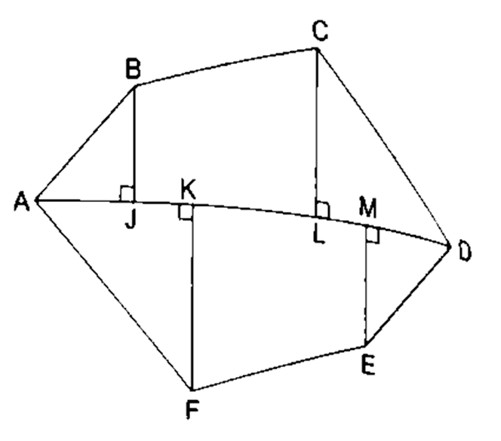
Step 1: Draw AD as the base. The hexagon is divided into two parts by AD:
(i) Region above AD (ABCD)
(ii) Region below AD (AFED)
Step 2: Area of region above AD is calculated by dividing it into three trapeziums.
From A to J:
\[
\text{Area} = \frac{1}{2}(0 + 5) \times 6 \\
= 15\text{ cm}^2
\]From J to L:
\[
\text{Length} = AL – AJ = 18 – 6 = 12\text{ cm} \\
\text{Area} = \frac{1}{2}(5 + 6) \times 12 \\
= 66\text{ cm}^2
\]From L to D:
\[
\text{Length} = AD – AL = 27 – 18 = 9\text{ cm} \\
\text{Area} = \frac{1}{2}(6 + 0) \times 9 \\
= 27\text{ cm}^2
\]Step 3: Area of region above AD:
\[
= 15 + 66 + 27 = 108\text{ cm}^2
\]Step 4: Now find the area of the region below AD, divided into three trapeziums.
From A to K:
\[
\text{Area} = \frac{1}{2}(0 + 6) \times 10 \\
= 30\text{ cm}^2
\]From K to M:
\[
\text{Length} = AM – AK = 21 – 10 = 11\text{ cm} \\
\text{Area} = \frac{1}{2}(6 + 4) \times 11 \\
= 55\text{ cm}^2
\]From M to D:
\[
\text{Length} = AD – AM = 27 – 21 = 6\text{ cm} \\
\text{Area} = \frac{1}{2}(4 + 0) \times 6 \\
= 12\text{ cm}^2
\]Step 5: Area of region below AD:
\[
= 30 + 55 + 12 = 97\text{ cm}^2
\]Step 6: Total area of hexagon ABCDEF:
\[
= 108 + 97 \\
= 205\text{ cm}^2
\]Answer: Area of hexagon ABCDEF = 205 cm²
Q5: Find the area of the given hexagon LMNPQR in which each side measures 5 cm, height MQ = 11 cm and width RP = 8 cm.
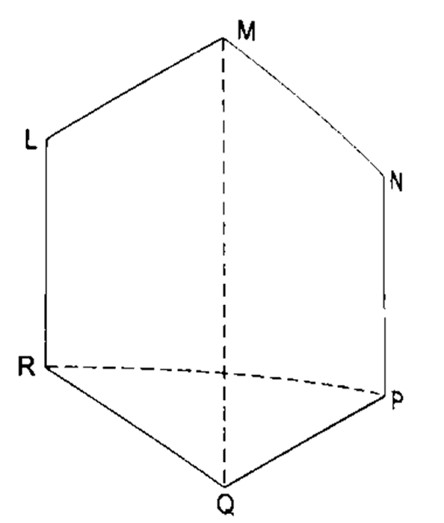
Step 1: Identify the given dimensions of the hexagon.
Each side \( = 5 \text{ cm} \)
Height \( (MQ) = 11 \text{ cm} \)
Width \( (RP) = 8 \text{ cm} \)
The hexagon is divided by the vertical line \(MQ\) into two congruent trapeziums: \(MNPQ\) and \(MLRQ\).
Step 2: Determine the dimensions of trapezium \(MNPQ\).
The parallel sides of the trapezium are \(LR\) (or \(NP\)) and the height \(MQ\).
Parallel side 1 \( (a) = NP = 5 \text{ cm} \)
Parallel side 2 \( (b) = MQ = 11 \text{ cm} \)
The distance between these parallel sides is half of the width \(RP\).
Height of trapezium \( (h) = \frac{RP}{2} = \frac{8}{2} = 4 \text{ cm} \)
Step 3: Calculate the area of trapezium \(MNPQ\).
Area of trapezium \( = \frac{1}{2} \times (a + b) \times h \)
Area \( = \frac{1}{2} \times (5 + 11) \times 4 \)
Area \( = \frac{1}{2} \times 16 \times 4 \)
Area \( = 32 \text{ cm}^2 \)
Step 4: Calculate the total area of the hexagon.
As per the hint, the required area is twice the area of trapezium \(MNPQ\).
Total Area \( = 2 \times \text{Area of trapezium } MNPQ \)
Total Area \( = 2 \times 32 \)
Total Area \( = 64 \text{ cm}^2 \)
Answer: The area of the given hexagon LMNPQR is 64 cm².
Q6: Find the area of an octagon ABCDEFGH having each side equal to 5 cm, HC = 11 cm and AP ⊥ HC such that AP = 4 cm.
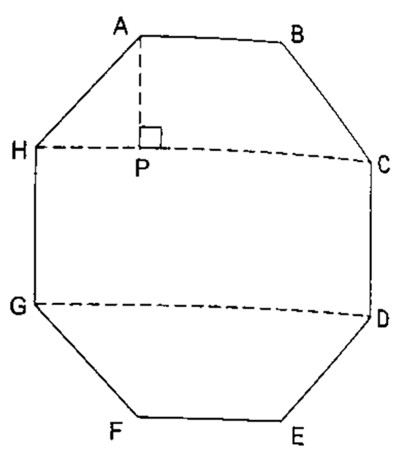
Step 1: Identify the given values and components of the octagon.
Side of the octagon \( = 5 \text{ cm} \)
Diagonal \( HC = 11 \text{ cm} \)
Perpendicular height of the top part \( (AP) = 4 \text{ cm} \)
The octagon can be divided into three parts:
1. Top trapezium \(ABCH\)
2. Middle rectangle \(CDGH\)
3. Bottom trapezium \(DEFG\)
Step 2: Calculate the Area of the Top Trapezium \(ABCH\).
Parallel sides are \(AB = 5 \text{ cm}\) and \(HC = 11 \text{ cm}\).
Height \( (AP) = 4 \text{ cm} \).
Area of trapezium \(ABCH = \frac{1}{2} \times (\text{sum of parallel sides}) \times \text{height} \)
Area \( = \frac{1}{2} \times (5 + 11) \times 4 \)
Area \( = \frac{1}{2} \times 16 \times 4 = 32 \text{ cm}^2 \)
Step 3: Calculate the Area of the Middle Rectangle \(CDGH\).
Length \( (HC) = 11 \text{ cm} \)
Breadth \( (CD) = 5 \text{ cm} \) (since it’s a side of the octagon)
Area of rectangle \( = \text{Length} \times \text{Breadth} \)
Area \( = 11 \times 5 = 55 \text{ cm}^2 \)
Step 4: Calculate the Total Area of the Octagon.
Based on the hint, the bottom trapezium \(DEFG\) is congruent to the top one \(ABCH\).
Area of \(DEFG = 32 \text{ cm}^2 \)
Total Area \( = 2 \times (\text{Area of Trapezium}) + \text{Area of Rectangle} \)
Total Area \( = (2 \times 32) + 55 \)
Total Area \( = 64 + 55 = 119 \text{ cm}^2 \)
Answer: The area of the octagon ABCDEFGH is 119 cm².
Q7: Find the area of the figure ABCDE, it being given that: AE ∥ BD, AF ⟂ BD, CG ⟂ BD, AE = 12 cm, BD = 16 cm, AF = 6.5 cm and CG = 8.5 cm.
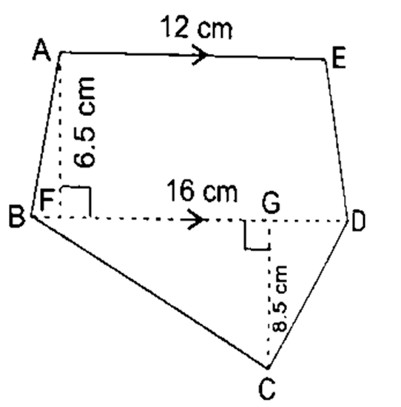
Step 1: Since AE ∥ BD, the figure can be divided by BD into two parts:
(i) Trapezium ABDE (above BD)
(ii) Triangle BCD (below BD)
Step 2: Area of trapezium ABDE:
Parallel sides = AE and BD
Height = AF
\[
\text{Area of trapezium} = \frac{1}{2} \times (AE + BD) \times AF \\
= \frac{1}{2} \times (12 + 16) \times 6.5 \\
= \frac{1}{2} \times 28 \times 6.5 \\
= 91\text{ cm}^2
\]Step 3: Area of triangle BCD:
Base = BD, Height = CG
\[
\text{Area of } \triangle BCD = \frac{1}{2} \times BD \times CG \\
= \frac{1}{2} \times 16 \times 8.5 \\
= 68\text{ cm}^2
\]Step 4: Total area of the figure ABCDE:
\[
= \text{Area of trapezium} + \text{Area of triangle} \\
= 91 + 68 \\
= 159\text{ cm}^2
\]Answer: Area of the figure ABCDE = 159 cm²
Q8: Find the area of the field ABCDEFA, in which BP ⟂ AD, CR ⟂ AD, FQ ⟂ AD and ES ⟂ AD such that AP = 20 m, AQ = 35 m, AR = 58 m, AS = 65 m, AD = 75 m, BP = 15 m, CR = 20 m, FQ = 10 m and ES = 15 m.
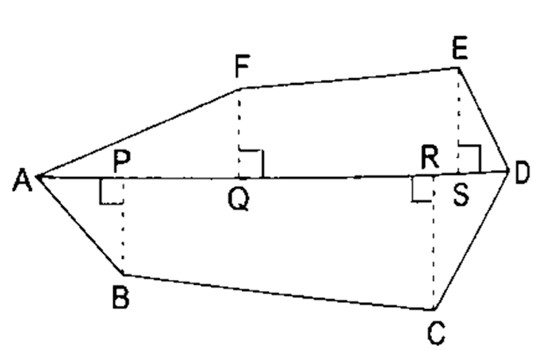
Step 1: Take AD as the base of the field.
Perpendiculars BP, FQ, CR and ES divide the field into simple regions above and below AD.
Step 2: Area of region above AD is divided into three trapeziums:
From A to Q:
\[
\text{Area} = \frac{1}{2} \times (0 + FQ) \times AQ \\
= \frac{1}{2} \times (0 + 10) \times 35 \\
= 175\text{ m}^2
\]From Q to S:
\[
\text{Length} = AS – AQ = 65 – 35 = 30\text{ m} \\
\text{Area} = \frac{1}{2} \times (FQ + ES) \times 30 \\
= \frac{1}{2} \times (10 + 15) \times 30 \\
= 375\text{ m}^2
\]From S to D:
\[
\text{Length} = AD – AS = 75 – 65 = 10\text{ m} \\
\text{Area} = \frac{1}{2} \times (15 + 0) \times 10 \\
= 75\text{ m}^2
\]Step 3: Total area above AD:
\[
= 175 + 375 + 75 \\
= 625\text{ m}^2
\]Step 4: Area of region below AD is divided into three trapeziums:
From A to P:
\[
\text{Area} = \frac{1}{2} \times (0 + BP) \times AP \\
= \frac{1}{2} \times 15 \times 20 \\
= 150\text{ m}^2
\]From P to R:
\[
\text{Length} = AR – AP = 58 – 20 = 38\text{ m} \\
\text{Area} = \frac{1}{2} \times (BP + CR) \times 38 \\
= \frac{1}{2} \times (15 + 20) \times 38 \\
= 665\text{ m}^2
\]From R to D:
\[
\text{Length} = AD – AR = 75 – 58 = 17\text{ m} \\
\text{Area} = \frac{1}{2} \times (20 + 0) \times 17 \\
= 170\text{ m}^2
\]Step 5: Total area below AD:
\[
= 150 + 665 + 170 \\
= 985\text{ m}^2
\]Step 6: Total area of the field ABCDEFA:
\[
= \text{Area above AD} + \text{Area below AD} \\
= 625 + 985 \\
= 1610\text{ m}^2
\]Answer: Area of the field ABCDEFA = 1610 m²
Leave a Comment