

Exercise- 23 B
Q1: Find the area of the parallelogram:
i. Base = 65 cm and height = 7.8 cm
Step 1: Formula for area of parallelogram:
\(\text{Area} = \text{base} \times \text{height}\)
Step 2: Substitute values:
\(\text{Area} = 65 \times 7.8 = 507 \, cm^2\)
Answer: Area = 507 cm²
ii. Base = 6.4 m and height = 75 cm
Step 1: Convert height to meters:
\(75 \, cm = \frac{75}{100} = 0.75 \, m\)
Step 2: Calculate area:
\(\text{Area} = 6.4 \times 0.75 = 4.8 \, m^2\)
Answer: Area = 4.8 m²
Q2: The height of a parallelogram is one-third of its base. If the area of the parallelogram is 192 cm², find the height and the base.
Step 1: Formula for area of parallelogram:
\(\text{Area} = base \times height\)
\(192 = b \times \frac{1}{3}b = \frac{b^2}{3}\)
Step 2: Multiply both sides by 3:
\(3 \times 192 = b^2\)
\(576 = b^2\)
Step 3: Take square root:
\(b = \sqrt{576} = 24 \, cm\)
Step 4: \(h = \frac{1}{3} \times 24 = 8 \, cm\)
Answer: Base = 24 cm, Height = 8 cm
Q3: PQRS is a parallelogram with PQ = 26 cm and QR = 20 cm. If the distance between its longer sides is 12.5 cm, find
Given:
PQ = 26 cm (longer side), QR = 20 cm (shorter side), height corresponding to longer side (distance between longer sides) = 12.5 cm
i. the area of the parallelogram
Step 1: Area of parallelogram = base × height
Taking PQ as base, height = 12.5 cm
\(\text{Area} = 26 \times 12.5 = 325 \, cm^2\)
Answer: Area of the parallelogram = 325 cm²
ii. the distance between its shorter sides
Step 1: Let the distance (height) between shorter sides be \(h_s\)
Using the area formula again, with QR as base:
\(\text{Area} = QR \times h_s\)
\(325 = 20 \times h_s\)
Step 2: Solve for \(h_s\):
\(h_s = \frac{325}{20} = 16.25 \, cm\)
Answer: Distance between shorter sides = 16.25 cm
Q4: ABCD is a parallelogram having adjacent sides AB = 16 cm and BC = 14 cm. If its area is 168 cm², find the distance between its longer sides and that between its shorter sides.
Given:
Sides: AB = 16 cm (longer side), BC = 14 cm (shorter side)
Area = 168 cm²
Step 1: Area formula:
\(\text{Area} = \text{base} \times \text{height}\)
Taking AB as base and height as \(h_1\):
\(168 = 16 \times h_1\)
Step 2: Solve for \(h_1\):
\(h_1 = \frac{168}{16} = 10.5 \, cm\)
Let the height corresponding to BC be \(h_2\)
Using the area formula again:
\(168 = 14 \times h_2\)
Step 3: Solve for \(h_2\):
\(h_2 = \frac{168}{14} = 12 \, cm\)
Answer: Distance between longer sides = 10.5 cm, Distance between shorter sides = 12 cm
Q5: In the adjoining figure, ABCD is a parallelogram in which AB = 28 cm, BC = 26 cm and diagonal AC = 30 cm. Find:
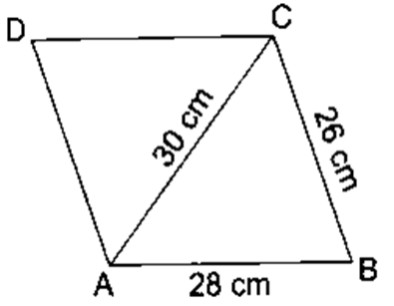
Step 1: Calculate the Area of Triangle ABC using Heron’s Formula.
In \(\triangle ABC\), sides are \(a = 26 \text{ cm}\), \(b = 30 \text{ cm}\), and \(c = 28 \text{ cm}\).
Semi-perimeter \( (s) = \frac{a + b + c}{2} \)
\( s = \frac{26 + 30 + 28}{2} = \frac{84}{2} = 42 \text{ cm} \)
Area of \(\triangle ABC = \sqrt{s(s-a)(s-b)(s-c)} \)
Area \( = \sqrt{42(42-26)(42-30)(42-28)} \)
Area \( = \sqrt{42 \times 16 \times 12 \times 14} \)
Area \( = \sqrt{(14 \times 3) \times (4 \times 4) \times (3 \times 4) \times 14} \)
Area \( = 14 \times 3 \times 4 \times 2 = 336 \text{ cm}^2 \)
i. The area of parallelogram ABCD:
Step 2: Find the total area of the parallelogram.
A diagonal divides a parallelogram into two triangles of equal area.
Area of parallelogram \(ABCD = 2 \times \text{Area of } \triangle ABC \)
Area \( = 2 \times 336 = 672 \text{ cm}^2 \)
Answer: Area = \( 672 \text{ cm}^2 \).
ii. The distance between AB and DC:
Step 3: Calculate the height with respect to base AB.
Let the distance (height) be \( h_1 \).
Area \( = \text{Base} \times \text{Height} \)
\( 672 = AB \times h_1 \)
\( 672 = 28 \times h_1 \)
\( h_1 = \frac{672}{28} = 24 \text{ cm} \)
Answer: Distance between AB and DC = \( 24 \text{ cm} \).
iii. The distance between CB and DA:
Step 4: Calculate the height with respect to base BC.
Let the distance (height) be \( h_2 \).
Area \( = \text{Base} \times \text{Height} \)
\( 672 = BC \times h_2 \)
\( 672 = 26 \times h_2 \)
\( h_2 = \frac{672}{26} \approx 25.85 \text{ cm} \)
Answer: Distance between CB and DA \(\approx 25.85 \text{ cm} \).
Q6: Find the area of a rhombus whose perimeter is 48 cm and altitude is 8.5 cm.
Step 1: Find the Side of the Rhombus.
A rhombus has four equal sides.
Perimeter \( = 48 \text{ cm} \)
Side \( (s) = \frac{\text{Perimeter}}{4} \)
Side \( (s) = \frac{48}{4} = 12 \text{ cm} \)
Step 2: Identify the Base and Altitude.
Base of the rhombus \( (b) = \text{Side} = 12 \text{ cm} \)
Altitude (Height) of the rhombus \( (h) = 8.5 \text{ cm} \)
Step 3: Calculate the Area of the Rhombus.
Area of a rhombus \( = \text{Base} \times \text{Altitude} \)
Area \( = 12 \text{ cm} \times 8.5 \text{ cm} \)
Area \( = 102 \text{ cm}^2 \)
Answer: The area of the rhombus is 102 cm².
Q7: The area of a rhombus is 139.2 cm² and its altitude is 9.6 cm. Find the perimeter of the rhombus.
Given:
Area \(= 139.2 \, cm^2\)
Altitude (height) \(= 9.6 \, cm\)
Step 1: Area of rhombus \(= \text{side} \times \text{altitude}\)
\(139.2 = side \times 9.6\)
Step 2: Solve for side:
\(side = \frac{139.2}{9.6} = 14.5 \, cm\)
Step 3: Find the perimeter of the rhombus
Perimeter \(P = 4 \times side = 4 \times 14.5 = 58 \, cm\)
Answer: Perimeter of the rhombus = 58 cm
Q8: The area of a rhombus is 184 cm² and its perimeter is 64 cm. Find its altitude.
Given:
Area \(= 184 \, cm^2\)
Perimeter \(P = 64 \, cm\)
Step 1: Find the side length of the rhombus:
Perimeter \(P = 4 \times side\)
\(64 = 4 \times side\)
\(side = \frac{64}{4} = 16 \, cm\)
Step 2: Find the altitude (height) of the rhombus
Area \(= side \times altitude\)
\(184 = 16 \times altitude\)
Step 3: Solve for altitude:
\(altitude = \frac{184}{16} = 11.5 \, cm\)
Answer: Altitude = 11.5 cm
Q9: Find the area of the rhombus for the given diagonals:
i. 16 cm, 24 cm
Step 1: Formula for area of rhombus:
\(\text{Area} = \frac{1}{2} \times d_1 \times d_2\)
Step 2: Substitute values:
\(\text{Area} = \frac{1}{2} \times 16 \times 24 = 8 \times 24 = 192 \, cm^2\)
Answer: Area = 192 cm²
ii. 14.8 cm. 12.5 cm
Step 1: Calculate area:
\(\text{Area} = \frac{1}{2} \times 14.8 \times 12.5 = 7.4 \times 12.5 = 92.5 \, cm^2\)
Answer: Area = 92.5 cm²
Q10: The area of a rhombus is 138 cm². If one of the diagonals is 11.5 cm long, find the length of the other diagonal.
Given:
Area \(= 138 \, cm^2\)
One diagonal \(d_1 = 11.5 \, cm\)
Step 1: Formula for area of rhombus:
\(\text{Area} = \frac{1}{2} \times d_1 \times d_2\)
Step 2: Substitute the known values:
\(138 = \frac{1}{2} \times 11.5 \times d_2\)
Step 3: Multiply both sides by 2:
\(276 = 11.5 \times d_2\)
Step 4: Solve for \(d_2\):
\(d_2 = \frac{276}{11.5} = 24 \, cm\)
Answer: Length of the other diagonal = 24 cm
Q11: Find the area of a rhombus, each side of which measures 20 cm and one of whose diagonals is 24 cm.
Given:
Side \(s = 20 \, cm\)
One diagonal \(d_1 = 24 \, cm\)
Step 1: Let the other diagonal be \(d_2\)
Step 2: In a rhombus, diagonals bisect each other at right angles.
So, half of each diagonal forms right triangles:
Half of \(d_1 = \frac{24}{2} = 12 \, cm\)
Half of \(d_2 = \frac{d_2}{2}\)
Step 3: Using Pythagoras theorem in one right triangle:
\[
s^2 = \left(\frac{d_1}{2}\right)^2 + \left(\frac{d_2}{2}\right)^2 \\
20^2 = 12^2 + \left(\frac{d_2}{2}\right)^2 \\
400 = 144 + \left(\frac{d_2}{2}\right)^2 \\
\left(\frac{d_2}{2}\right)^2 = 400 – 144 = 256 \\
\frac{d_2}{2} = \sqrt{256} = 16 \\
d_2 = 2 \times 16 = 32 \, cm
\]Step 4: Find the area of the rhombus
\[
\text{Area} = \frac{1}{2} \times d_1 \times d_2 = \frac{1}{2} \times 24 \times 32 = 12 \times 32 = 384 \, cm^2
\]Answer: Area of the rhombus = 384 cm²
Q12: Find the area of a trapezium whose parallel sides are 23.7 cm and 16.3 cm and the distance between them is 11.4 cm.
Given:
Parallel sides \(a = 23.7 \, cm\), \(b = 16.3 \, cm\)
Distance (height) \(h = 11.4 \, cm\)
Step 1: Formula for area of trapezium:
\[
\text{Area} = \frac{1}{2} \times (a + b) \times h
\]
Step 2: Substitute values:
\[
\text{Area} = \frac{1}{2} \times (23.7 + 16.3) \times 11.4 \\
= \frac{1}{2} \times 40 \times 11.4 \\
= 20 \times 11.4 = 228 \, cm^2
\]Answer: Area of the trapezium = 228 cm²
Q13: Find the area of a trapezium whose parallel sides are 2.5 m and 1.3 m and the distance between them is 80 cm.
Given:
Parallel sides \(a = 2.5 \, m\), \(b = 1.3 \, m\)
Distance (height) \(h = 80 \, cm = \frac{80}{100} = 0.8 \, m\)
Step 1: Formula for area of trapezium:
\[
\text{Area} = \frac{1}{2} \times (a + b) \times h
\]
Step 2: Substitute values:
\[
\text{Area} = \frac{1}{2} \times (2.5 + 1.3) \times 0.8 \\
= \frac{1}{2} \times 3.8 \times 0.8 \\
= 1.9 \times 0.8 = 1.52 \, m^2
\]Answer: Area of the trapezium = 1.52 m²
Q14: The lengths of parallel sides of a trapezium are in the ratio 7 : 5 and the distance between them is 14 cm. If the area of the trapezium is 252 cm², find the lengths of its parallel sides.
Given:
Ratio of parallel sides = 7 : 5
Let the lengths be \(7x\) and \(5x\)
Distance (height) \(h = 14 \, cm\)
Area \(= 252 \, cm^2\)
Step 1: Formula for area of trapezium:
\[
\text{Area} = \frac{1}{2} \times (a + b) \times h \\
252 = \frac{1}{2} \times (7x + 5x) \times 14 \\
252 = \frac{1}{2} \times 12x \times 14 \\
252 = 6x \times 14 = 84x
\]Step 2: Solve for \(x\):
\[
x = \frac{252}{84} = 3
\]Step 3: Find the lengths of the parallel sides
\[
7x = 7 \times 3 = 21 \, cm \\
5x = 5 \times 3 = 15 \, cm
\]Answer: Lengths of parallel sides are 21 cm and 15 cm
Q15: The height of a trapezium of area 162 cm² is 6 cm. If one of the bases is 23 cm, find the other.
Given:
Area \(= 162 \, cm^2\)
Height \(h = 6 \, cm\)
One base \(a = 23 \, cm\)
Let the other base be \(b\) cm
Step 1: Formula for area of trapezium:
\[
\text{Area} = \frac{1}{2} \times (a + b) \times h \\
162 = \frac{1}{2} \times (23 + b) \times 6 \\
162 = 3 \times (23 + b)
\]Step 2: Solve for \(b\):
\[
23 + b = \frac{162}{3} = 54 \\
b = 54 – 23 = 31 \, cm
\]Answer: The other base = 31 cm
Q16: In the adjoining figure. ABCD is a in which parallel sides are AB = 78 cm, DC = 52 cm and the non- parallel sides are BC = 30 cm and AD = 28 cm. Find the area of the trapezium.
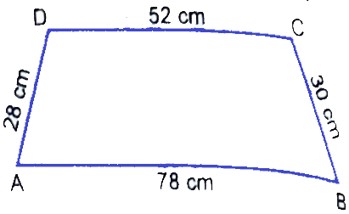
Step 1: Difference of parallel sides:
\[
AB – DC = 78 – 52 = 26\text{ cm}
\]Step 2: Let the perpendicular distance (height) between AB and DC be \(h\) cm.
Drop perpendiculars from D and C to AB.
Let the bases of the right-angled triangles be \(x\) cm and \(y\) cm.
\[
x + y = 26
\]Step 3: Applying Pythagoras theorem:
For \(\triangle AD\):
\[
x^2 + h^2 = 28^2 \quad (1)
\]For \(\triangle BC\):
\[
y^2 + h^2 = 30^2 \quad (2)
\]Step 4: Subtract equation (1) from equation (2):
\[
y^2 – x^2 = 30^2 – 28^2 \\
(y – x)(y + x) = 900 – 784 \\
(y – x)(26) = 116 \\
y – x = \frac{116}{26} = 4.46
\]Step 5: Solving the equations:
\[
x + y = 26 \\
y – x = 4.46 \\
y = 15.23,\quad x = 10.77
\]Step 6: Substitute \(x\) in equation (1):
\[
h^2 = 28^2 – (10.77)^2 \\
h^2 = 784 – 116 \\
h^2 = 668 \\
h = \sqrt{668} \approx 25.84\text{ cm}
\]Step 7: Area of trapezium:
\[
\text{Area} = \frac{1}{2}(AB + DC)\times h \\
= \frac{1}{2}(78 + 52)\times 25.84 \\
= 65 \times 25.84 \\
= 1679.6\text{ cm}^2
\]Answer: Area of the trapezium \(\approx 1680\text{ cm}^2\)
Q17: The parallel sides of a trapezium are 20 cm and 10 cm. Its non-parallel sides are both equal, each 13 cm. Find the area of the trapezium.
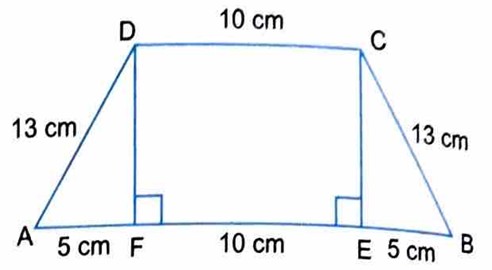
Step 1: Given that the trapezium is isosceles (non-parallel sides equal).
Let AB = 20 cm and DC = 10 cm be the parallel sides.
Step 2: Difference of parallel sides:
\[
20 – 10 = 10\text{ cm}
\]Since the trapezium is symmetric, this difference is equally divided on both sides.
\[
\text{Each part} = \frac{10}{2} = 5\text{ cm}
\]Step 3: Drop perpendiculars from the ends of the shorter base to the longer base.
This forms two right-angled triangles, each with base 5 cm and hypotenuse 13 cm.
Step 4: Using Pythagoras theorem to find the height \(h\):
\[
h^2 + 5^2 = 13^2 \\
h^2 = 169 – 25 \\
h^2 = 144 \\
h = 12\text{ cm}
\]Step 5: Area of trapezium:
\[
\text{Area} = \frac{1}{2} \times (\text{sum of parallel sides}) \times \text{height} \\
= \frac{1}{2} \times (20 + 10) \times 12 \\
= \frac{1}{2} \times 30 \times 12 \\
= 180\text{ cm}^2
\]Answer:Area of the trapezium = 180 cm²
Q18: The area of a trapezium is 198 cm² and its height is 9 cm. If one of the parallel sides is longer than the other by 8 cm, find the two parallel sides.
Given:
Area \(= 198 \, cm^2\)
Height \(h = 9 \, cm\)
Let the shorter base be \(x \, cm\), then the longer base = \(x + 8 \, cm\)
Step 1: Use the formula for area of trapezium:
\[
\text{Area} = \frac{1}{2} \times (a + b) \times h \\
198 = \frac{1}{2} \times (x + (x + 8)) \times 9 \\
198 = \frac{1}{2} \times (2x + 8) \times 9 \\
198 = \frac{9}{2} \times (2x + 8)
\]Step 2: Multiply both sides by 2:
\[
396 = 9 \times (2x + 8) \\
396 = 18x + 72
\]Step 3: Solve for \(x\):
\[
18x = 396 – 72 = 324 \\
x = \frac{324}{18} = 18
\]Step 4: Find the lengths of the parallel sides
\[
\text{Shorter base} = x = 18 \, cm \\
\text{Longer base} = x + 8 = 18 + 8 = 26 \, cm
\]Answer: The two parallel sides are 18 cm and 26 cm
Q19: In the adjoining figure, ABCD is a rectangle in which AB = 18 cm, BC = 8 cm and DE = 10 cm. Find the area of the shaded region EBCD.
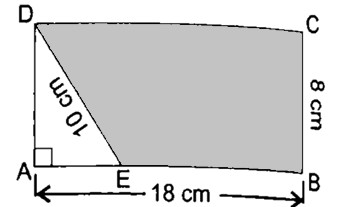
Step 1: Area of rectangle ABCD:
\[
\text{Area} = AB \times BC \\
= 18 \times 8 \\
= 144\text{ cm}^2
\]Step 2: The unshaded part is triangle ADE.
Triangle ADE is right-angled at A.
Step 3: Using Pythagoras theorem in \(\triangle ADE\):
\[
DE^2 = AD^2 + AE^2 \\
10^2 = 8^2 + AE^2 \\
100 = 64 + AE^2 \\
AE^2 = 36 \\
AE = 6\text{ cm}
\]Step 4: Area of \(\triangle ADE\):
\[
= \frac{1}{2} \times AD \times AE \\
= \frac{1}{2} \times 8 \times 6 \\
= 24\text{ cm}^2
\]Step 5: Area of shaded region EBCD:
\[
= \text{Area of rectangle} – \text{Area of triangle} \\
= 144 – 24 \\
= 120\text{ cm}^2
\]Answer: Area of the shaded region EBCD = 120 cm²
Q20: Find the area of the figure ABCDEFGH, given that AC = 17 m, BC = 8 m, GL ⟂ EF and GL = 3.6 m.
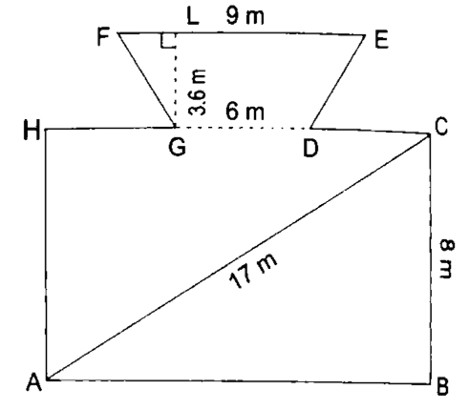
Step 1: Rectangle ABCD is part of the figure.
Given diagonal AC = 17 m and BC = 8 m.
Step 2: Find AB using Pythagoras theorem in △ABC:
\[
AC^2 = AB^2 + BC^2 \\
17^2 = AB^2 + 8^2 \\
289 = AB^2 + 64 \\
AB^2 = 225 \\
AB = 15\text{ m}
\]Step 3: Area of rectangle ABCD:
\[
= AB \times BC \\
= 15 \times 8 \\
= 120\text{ m}^2
\]Step 4: The top portion EFGD is a trapezium.
Parallel sides: EF = 9 m, GD = 6 m.
Height GL = 3.6 m.
Step 5: Area of trapezium EFGD:
\[
= \frac{1}{2} \times (\text{sum of parallel sides}) \times \text{height} \\
= \frac{1}{2} \times (9 + 6) \times 3.6 \\
= \frac{1}{2} \times 15 \times 3.6 \\
= 27\text{ m}^2
\]Step 6: Area of the whole figure ABCDEFGH:
\[
= \text{Area of rectangle} + \text{Area of trapezium} \\
= 120 + 27 \\
= 147\text{ m}^2
\]Answer: Area of the figure ABCDEFGH = 147 m²
Q21: Find the area of the shaded region in the figure given alongside.
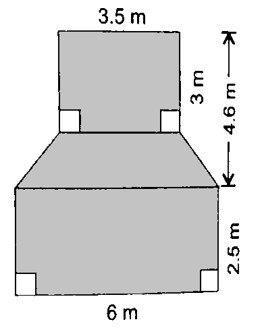
Step 1: The shaded figure is made up of three parts:
(i) Top rectangle
(ii) Middle trapezium
(iii) Bottom rectangle
Step 2: Area of the top rectangle:
Width = 3.5 m, Height = 3 m
\[
\text{Area} = 3.5 \times 3 \\
= 10.5\text{ m}^2
\]Step 3: Total height of top rectangle and trapezium = 4.6 m
Height of trapezium:
\[
= 4.6 – 3 = 1.6\text{ m}
\]Parallel sides of trapezium = 3.5 m and 6 m
Step 4: Area of the trapezium:
\[
= \frac{1}{2} \times (3.5 + 6) \times 1.6 \\
= \frac{1}{2} \times 9.5 \times 1.6 \\
= 7.6\text{ m}^2
\]Step 5: Area of the bottom rectangle:
Width = 6 m, Height = 2.5 m
\[
\text{Area} = 6 \times 2.5 \\
= 15\text{ m}^2
\]Step 6: Total area of the shaded region:
\[
= 10.5 + 7.6 + 15 \\
= 33.1\text{ m}^2
\]Answer: Area of the shaded region = 33.1 m²
Q22: Find the area of the shaded region given below.
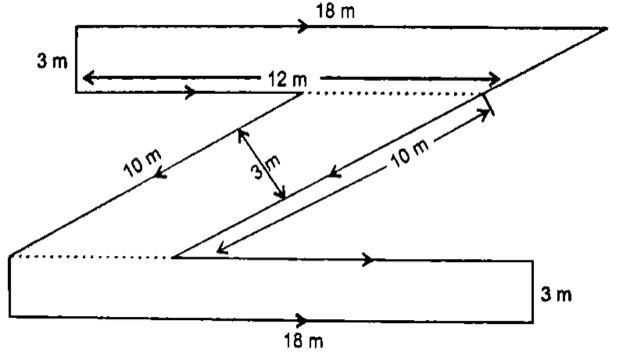
Step 1: The shaded figure consists of three parts:
(i) Top Trapezium
(ii) Middle parallelogram
(iii) Bottom rectangle
Step 2: Dimensions of the top trapezium:
\[
\text{Area} = \frac{1}{2} \times \text{(sum of parallel sides)} \times \text{(distance between them)} \\
\text{Area} = \frac{1}{2} \times (18 + 12) \times 3 \\
\text{Area} = 45 \text{ m}^2
\]Step 3: Dimensions of the bottom rectangle:
Length = 18 m, Breadth = 3 m
\[
\text{Area} = 18 \times 3 \\
= 54\text{ m}^2
\]Step 4: The middle portion is a parallelogram.
Base = 12 m, Height = 3 m
Step 5: Area of the parallelogram:
\[
\text{Area} = \text{base} \times \text{height} \\
= 10 \times 3 \\
= 30\text{ m}^2
\]Step 6: Total area of the shaded region:
\[
= 45 + 30 + 54 \\
= 129\text{ m}^2
\]Answer: Area of the shaded region = 129 m²
Leave a Comment