

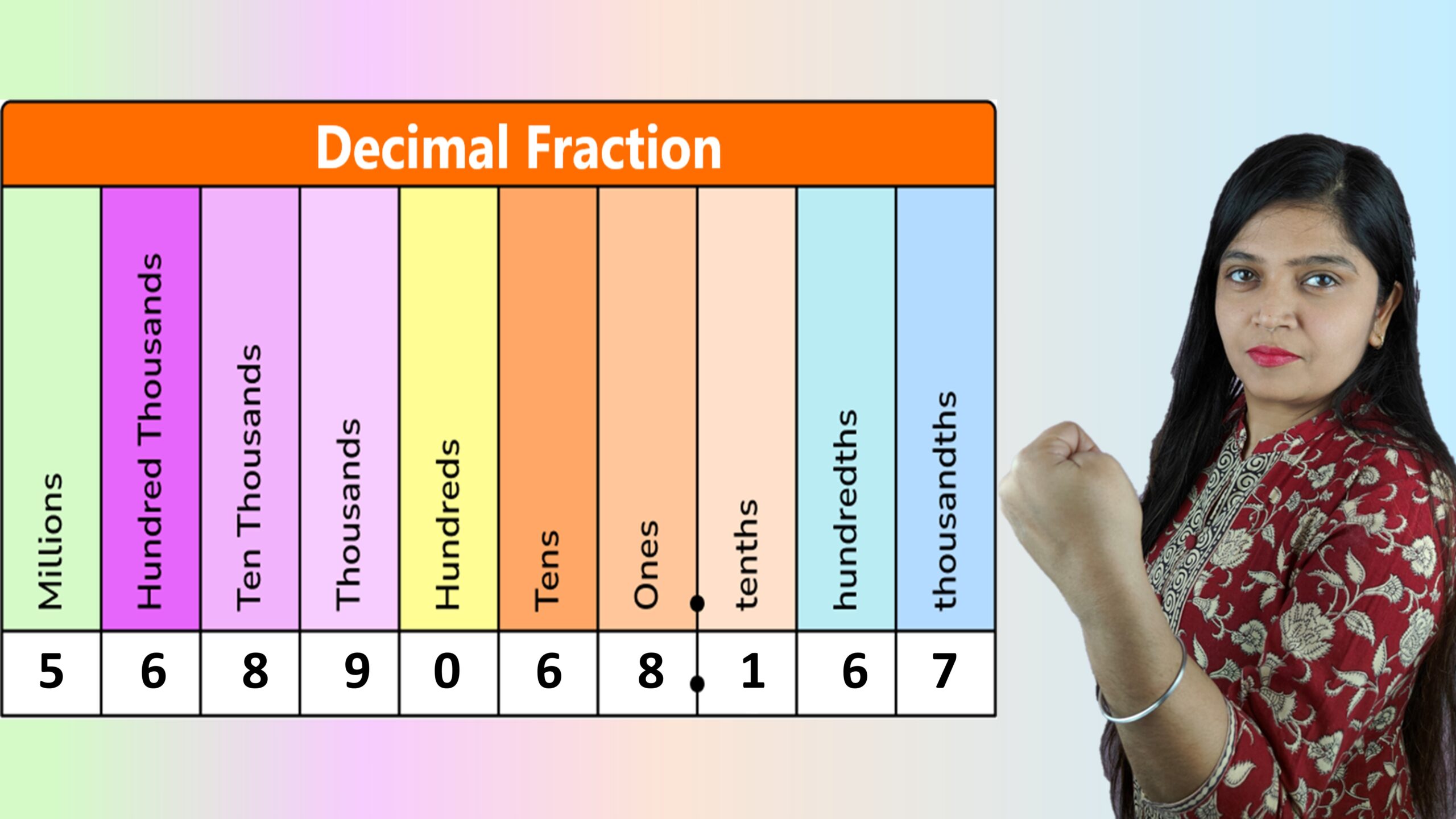
Exercise: 4-A
Q1: Convert the following into fractions in their lowest terms:
i. 3.75
Step 1: Write the decimal as a fraction.
\[
3.75 = \frac{375}{100}
\]
Step 2: Reduce to lowest terms.
\[
\frac{375 \div 25}{100 \div 25} = \frac{15}{4}
\]
Answer: \(\frac{15}{4}\)
ii. 0.5
Step 1: Write as a fraction.
\[
0.5 = \frac{5}{10}
\]
Step 2: Reduce to lowest terms.
\[
\frac{5 \div 5}{10 \div 5} = \frac{1}{2}
\]
Answer: \(\frac{1}{2}\)
iii. 2.04
Step 1: Write as a fraction.
\[
2.04 = \frac{204}{100}
\]
Step 2: Reduce to lowest terms.
\[
\frac{204 \div 4}{100 \div 4} = \frac{51}{25}
\]
Answer: \(\frac{51}{25}\)
iv. 0.65
Step 1: Write as a fraction.
\[
0.65 = \frac{65}{100}
\]
Step 2: Reduce to lowest terms.
\[
\frac{65 \div 5}{100 \div 5} = \frac{13}{20}
\]
Answer: \(\frac{13}{20}\)
v. 2.405
Step 1: Write as a fraction.
\[
2.405 = \frac{2405}{1000}
\]
Step 2: Reduce to lowest terms.
\[
\frac{2405 \div 5}{1000 \div 5} = \frac{481}{200}
\]
Answer: \(\frac{481}{200}\)
vi. 0.085
Step 1: Write as a fraction.
\[
0.085 = \frac{85}{1000}
\]
Step 2: Reduce to lowest terms.
\[
\frac{85 \div 5}{1000 \div 5} = \frac{17}{200}
\]
Answer: \(\frac{17}{200}\)
vii. 8.025
Step 1: Write as a fraction.
\[
8.025 = \frac{8025}{1000}
\]
Step 2: Reduce to lowest terms.
\[
\frac{8025 \div 25}{1000 \div 25} = \frac{321}{40}
\]
Answer: \(\frac{321}{40}\)
Q2: Convert into decimal fractions:
i. \(2\frac{4}{5}\)
Step 1: Convert to improper fraction:
\[
2\frac{4}{5} = \frac{(2 \times 5) + 4}{5} = \frac{14}{5}
\]
Step 2: Divide numerator by denominator:
\[
\frac{14}{5} = 2.8
\]
Answer: 2.8
ii. \(\frac{79}{100}\)
Step 1: Divide numerator by denominator:
\[
\frac{79}{100} = 0.79
\]
Answer: 0.79
iii. \(\frac{37}{10,000}\)
Step 1: Divide numerator by denominator:
\[
\frac{37}{10000} = 0.0037
\]
Answer: 0.0037
iv. \(\frac{7543}{{10}^4}\)
Step 1: \({10}^4 = 10000\)
\[
\frac{7543}{10000} = 0.7543
\]
Answer: 0.7543
v. \(\frac{3}{4}\)
Step 1: Divide numerator by denominator:
\[
\frac{3}{4} = 0.75
\]
Answer: 0.75
vi. \(9\frac{3}{5}\)
Step 1: Convert to improper fraction:
\[
9\frac{3}{5} = \frac{(9 \times 5) + 3}{5} = \frac{48}{5}
\]
Step 2: Divide numerator by denominator:
\[
\frac{48}{5} = 9.6
\]
Answer: 9.6
vii. \(8\frac{5}{8}\)
Step 1: Convert to improper fraction:
\[
8\frac{5}{8} = \frac{(8 \times 8) + 5}{8} = \frac{69}{8}
\]
Step 2: Divide numerator by denominator:
\[
\frac{69}{8} = 8.625
\]
Answer: 8.625
viii. \(5\frac{7}{8}\)
Step 1: Convert to improper fraction:
\[
5\frac{7}{8} = \frac{(5 \times 8) + 7}{8} = \frac{47}{8}
\]
Step 2: Divide numerator by denominator:
\[
\frac{47}{8} = 5.875
\]
Answer: 5.875
Q3: Write the number of decimal places in:
i. \(0.4762\)
Step 1: Count digits after the decimal point.
\[
\text{Digits after decimal in } 0.4762 = 4
\]
Answer: 4 decimal places
ii. \(7.00349\)
Step 1: Count digits after the decimal point.
\[
\text{Digits after decimal in } 7.00349 = 5
\]
Answer: 5 decimal places
iii. \(8235.403\)
Step 1: Count digits after the decimal point.
\[
\text{Digits after decimal in } 8235.403 = 3
\]
Answer: 3 decimal places
iv. \(35.4\)
Step 1: Count digits after the decimal point.
\[
\text{Digits after decimal in } 35.4 = 1
\]
Answer: 1 decimal place
v. \(2.608\)
Step 1: Count digits after the decimal point.
\[
\text{Digits after decimal in } 2.608 = 3
\]
Answer: 3 decimal places
vi. \(0.000879\)
Step 1: Count digits after the decimal point.
\[
\text{Digits after decimal in } 0.000879 = 6
\]
Answer: 6 decimal places
Q4: Write the following decimals as word statements:
i. \(0.4, 0.9, 0.1\)
Step 1: Express each decimal as “zero-point-” followed by digits read individually.
- \(0.4\) — zero-point-four
- \(0.9\) — zero-point-nine
- \(0.1\) — zero-point-one
Answer: zero-point-four, zero-point-nine, zero-point-one
ii. \(1.9, 4.4, 7.5\)
Step 1: Read the whole number, then say “point” followed by digits individually.
- \(1.9\) — one-point-nine
- \(4.4\) — four-point-four
- \(7.5\) — seven-point-five
Answer: one-point-nine, four-point-four, seven-point-five
iii. \(0.02, 0.56, 13.06\)
Step 1: Read as zero-point- for decimals less than 1 and whole number with point for others.
- \(0.02\) — zero-point-zero-two
- \(0.56\) — zero-point-five-six
- \(13.06\) — thirteen-point-zero-six
Answer: zero-point-zero-two, zero-point-five-six, thirteen-point-zero-six
iv. \(0.005, 0.207, 111.519\)
Step 1: Read digit-by-digit after decimal, starting with zero-point- for decimals less than 1.
- \(0.005\) — zero-point-zero-zero-five
- \(0.207\) — zero-point-two-zero-seven
- \(111.519\) — one hundred eleven-point-five-one-nine
Answer: zero-point-zero-zero-five, zero-point-two-zero-seven, one hundred eleven-point-five-one-nine
v. \(0.8, 0.08, 0.008, 0.0008\)
Step 1: Use zero-point- and read every digit after decimal individually.
- \(0.8\) — zero-point-eight
- \(0.08\) — zero-point-zero-eight
- \(0.008\) — zero-point-zero-zero-eight
- \(0.0008\) — zero-point-zero-zero-zero-eight
Answer: zero-point-eight, zero-point-zero-eight, zero-point-zero-zero-eight, zero-point-zero-zero-zero-eight
vi. \(256.1, 10.22, 0.634\)
Step 1: Read the whole number, then “point” followed by digits individually.
- \(256.1\) — two hundred fifty-six-point-one
- \(10.22\) — ten-point-two-two
- \(0.634\) — zero-point-six-three-four
Answer: two hundred fifty-six-point-one, ten-point-two-two, zero-point-six-three-four
Q5: Convert the given fractions into like fractions:
i. \(0.5, 3.62, 43.981, \text{ and } 232.0037\)
Step 1: Find the decimal with the greatest number of decimal places.
\[
0.5 = 0.5 \quad (\text{1 decimal place}) \\
3.62 = 3.62 \quad (\text{2 decimal places}) \\
43.981 = 43.981 \quad (\text{3 decimal places}) \\
232.0037 = 232.0037 \quad (\text{4 decimal places})
\]Step 2: Convert all decimals to have the same number of decimal places (4 decimal places, as in 232.0037) by adding zeros.
\[
0.5 = 0.5000 \\
3.62 = 3.6200 \\
43.981 = 43.9810 \\
232.0037 = 232.0037
\]Answer: 0.5000, 3.6200, 43.9810, 232.0037
ii. \(215.78, 33.0006, 530.3, \text{ and } 0.03569\)
Step 1: Find the decimal with the greatest number of decimal places.
\[
215.78 = 215.78 \quad (\text{2 decimal places}) \\
33.0006 = 33.0006 \quad (\text{4 decimal places}) \\
530.3 = 530.3 \quad (\text{1 decimal place}) \\
0.03569 = 0.03569 \quad (\text{5 decimal places})
\]Step 2: Convert all decimals to have the same number of decimal places (5 decimal places, as in 0.03569) by adding zeros.
\[
215.78 = 215.78000 \\
33.0006 = 33.00060 \\
530.3 = 530.30000 \\
0.03569 = 0.03569 \\
\]Answer: 215.78000, 33.00060, 530.30000, 0.03569


Leave a Comment