

Assertion- Reason Questions
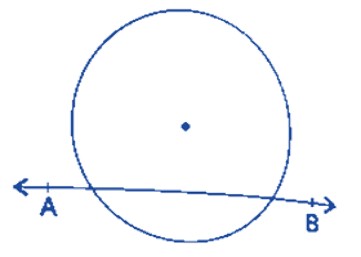
Q1: Assertion (A): In the figure, the line AB is a secant as well as a chord a of the circle.
Reason (R): A line segment whose end lie on a circle is called a chord.
i. Analyzing Assertion (A)
Step 1: Examine the line AB in the figure. It intersects the circle at two distinct points and extends indefinitely in both directions, which is the definition of a secant.
Step 2: A line segment whose endpoints lie on the circle is a chord.
Step 3: Since the ends point of line doesnot lie on circle, but intersects the circle at two distinct points so it is a secant, not chord. The assertion is false.
ii. Analyzing Reason (R)
Step 1: Recall the geometric definition: A line segment with both endpoints on the circumference of a circle is called a chord.
Step 2: The reason correctly defines what a chord is, making it a true statement.
Answer: c. Assertion (A) is true but Reason (R) is false.
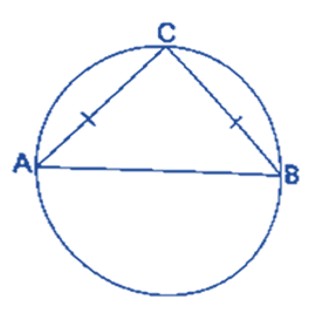
Q2: Assertion (A): In the figure, if AC = BC, then ∠BAC = 45°.
Reason (R): The angle in a semi-circle is a right angle.
i. Evaluating Reason (R)
Step 1: Recall the property of a circle that an angle subtended by the diameter at any point on the circumference is always \(90^{\circ}\).
Step 2: This is a standard geometric theorem, making Reason (R) a true statement.
ii. Evaluating Assertion (A)
Step 1: In the adjoining figure, segment \(AB\) is a diameter, which means \(\triangle ABC\) is inscribed in a semi-circle.
Step 2: From Reason (R), we know that \(\angle ACB = 90^{\circ}\).
Step 3: It is given that \(AC = BC\). In \(\triangle ABC\), since two sides are equal, it is an isosceles triangle.
Step 4: In an isosceles triangle, angles opposite to equal sides are equal. Therefore, \(\angle BAC = \angle ABC\).
Step 5: Use the angle sum property of a triangle: \(\angle BAC + \angle ABC + \angle ACB = 180^{\circ}\).
Step 6: Substituting the values: \(2 \times \angle BAC + 90^{\circ} = 180^{\circ}\).
Step 7: Solving for the angle: \(2 \times \angle BAC = 90^{\circ}\), which gives \(\angle BAC = 45^{\circ}\).
Step 8: Since the result matches the assertion, Assertion (A) is true.
iii. Determining the Relationship
Step 1: To prove that \(\angle BAC = 45^{\circ}\), we directly used the fact that \(\angle ACB = 90^{\circ}\) (angle in a semi-circle).
Step 2: Therefore, Reason (R) provides the correct and necessary explanation for Assertion (A).
Answer: (a) Both Assertion (A) and Reason (R) are true and Reason (R) is the correct explanation of Assertion (A).
Leave a Comment