

Exercise- 21 B
Q1: How many different chords are shown in the adjoining figure?
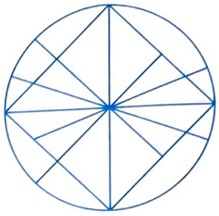
i. Analyzing the figure
Step 1: Recall the definition that a chord is any line segment whose endpoints both lie on the circumference of the circle.
Step 2: Identify the diameters passing through the center, as every diameter is a chord. In this figure, there are \(3\) diameters.
Step 3: Identify the other line segments whose endpoints touch the circle but do not pass through the center. There are \(4\) such additional chords forming the outer geometric shape.
Step 4: Calculate the total number of chords by adding them together: \(3 + 4 = 7\).
Answer: c. 7
Q2: How many different radii are shown in the figure above?
i. Counting the radii
Step 1: Identify the center point of the circle where multiple line segments intersect.
Step 2: Count each distinct line segment that starts from the center and ends at the circumference of the circle.
Step 3: Observing the figure, there are 3 full diameters passing through the center, each consisting of 2 radii (total 6). Additionally, there are 3 other line segments starting from the center and touching the boundary.
Step 4: Summing all the segments: \(6 + 3 = 9\).
Answer: a. 9
Q3: How many different diameters are shown in the figure above?
i. Counting the diameters
Step 1: Identify the center of the circle, where several line segments intersect.
Step 2: A diameter is a straight line segment that passes through the center of the circle and has its endpoints on the circumference.
Step 3: Look for continuous straight lines that cross from one side of the circle to the other through the central point.
Step 4: Counting these lines, we find one vertical, one horizontal, and one diagonal lines that are perfectly straight and pass through the center.
Step 5: Other segments starting from the center do not continue in a straight line to the opposite side, so they are only radii, not diameters.
Answer: b. 3
Q4: How many tangents and secants are shown in the adjoining figure?
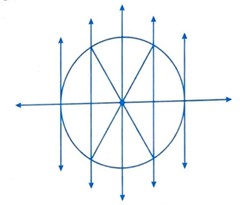
i. Identifying Tangents
Step 1: Recall that a tangent is a line that touches the circle at exactly one point.
Step 2: Look at the vertical lines on the far left and far right sides of the circle.
Step 3: These \(2\) vertical lines touch the edge of the circle without crossing through it.
ii. Identifying Secants
Step 1: Recall that a secant is a line that intersects the circle at two distinct points.
Step 2: Look for lines that pass through the interior of the circle and extend outward with arrows.
Step 3: Identify the lines: \(1\) horizontal line through the center, \(1\) vertical line through the center and \(2\) vertical lines on either side of the center line.
Step 4: Count the total number of such lines: \(1 + 1 + 2 = 4\).
Answer: a. 2 tangents, 4 secants
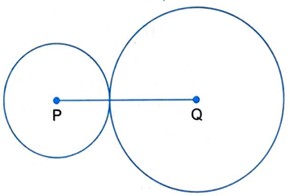
Q5: P and Q are the centres circles. If they are 15 cm apart and the radius of the bigger circle is the same as the diameter of the smaller circle, then the radius of the bigger circle is:
i. Establishing the Relationship between Radii
Step 1: Let the radius of the bigger circle be \(R\) and the radius of the smaller circle be \(r\).
Step 2: According to the problem, the radius of the bigger circle is equal to the diameter of the smaller circle. Thus, \(R = 2r\).
Step 3: From this, we can express the smaller radius as \(r = \frac{R}{2}\).
ii. Using the Distance Between Centres
Step 1: The figure shows two circles touching externally. In this case, the distance between their centres (\(PQ\)) is equal to the sum of their radii.
Step 2: Given that the centres are \(15\text{ cm}\) apart, we can write the equation: \(R + r = 15\).
Step 3: Substitute \(r = \frac{R}{2}\) into the equation: \(R + \frac{R}{2} = 15\).
Step 4: Simplify the equation: \(\frac{3R}{2} = 15\).
Step 5: Solve for \(R\): \(3R = 30\), therefore \(R = 10\).
Answer: c. 10 cm
Q6: In the adjoining figure, O is the centre of the circle. The measure of the angle marked x is:
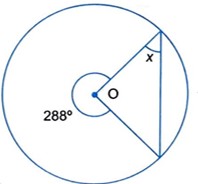
i. Finding the interior central angle
Step 1: Observe that the reflex angle at the centre \(O\) is given as \(288^{\circ}\).
Step 2: Since the total angle around a point is \(360^{\circ}\), calculate the interior central angle of the triangle.
Step 3: Interior angle at \(O = 360^{\circ} – 288^{\circ} = 72^{\circ}\).
ii. Solving for x using triangle properties
Step 1: The triangle is formed by two radii of the circle, which are equal in length. This makes it an isosceles triangle.
Step 2: In an isosceles triangle, the angles opposite to the equal sides are equal. Therefore, the other base angle is also \(x\).
Step 3: Use the angle sum property of a triangle: \(x + x + 72^{\circ} = 180^{\circ}\).
Step 4: Simplify the equation: \(2x + 72^{\circ} = 180^{\circ}\).
Step 5: Subtract \(72^{\circ}\) from both sides: \(2x = 108^{\circ}\).
Step 6: Divide by 2: \(x = \frac{108^{\circ}}{2} = 54^{\circ}\).
Answer: (d) 54°
Q7: How many circles can be drawn with a given point as the centre?
i. Analyzing the definition of a circle
Step 1: A circle is defined by its centre and its radius.
Step 2: For a fixed centre point, the size of the circle depends entirely on the length of the radius chosen.
Step 3: Since the radius can be any positive real number (e.g., \(1\text{ cm}\), \(1.1\text{ cm}\), \(2\text{ cm}\), \(100\text{ m}\), etc.), there are an unlimited number of possible radii.
Step 4: Because there are infinitely many possible radii for any single point, an infinite number of concentric circles can be drawn.
Answer: (d) Infinite
Q8: How many circles can be drawn to pass through two given points?
i. Understanding the geometry of points and centers
Step 1: For a circle to pass through two points, its centre must be equidistant from both points.
Step 2: All points that are equidistant from two given points lie on the perpendicular bisector of the line segment joining them.
Step 3: The perpendicular bisector is a straight line containing an infinite number of points.
Step 4: Since any point on this bisector can serve as the centre of a circle passing through the two given points, we can draw as many circles as there are points on the line.
Answer: (d) Infinite
Q9: How many circles can be drawn to pass through 3 non-collinear points?
i. Understanding the concept of a circumcircle
Step 1: Identify that three non-collinear points form the vertices of a unique triangle.
Step 2: Recall that the center of a circle passing through these points must be equidistant from all three vertices.
Step 3: This center, known as the circumcenter, is found at the intersection of the perpendicular bisectors of the triangle’s sides.
Step 4: In Euclidean geometry, the perpendicular bisectors of the sides of any triangle intersect at exactly one unique point.
Step 5: Since there is only one possible center and one possible radius (the distance from the circumcenter to any vertex), only one such circle can exist.
Answer: (b) 1
Q10: To define an arc we need at least how many points?
i. Understanding the definition of an arc
Step 1: Identify that an arc is a portion of a curve, such as the circumference of a circle.
Step 2: Note that simply naming two endpoints (e.g., A and B) is insufficient to uniquely define which “path” to take between them.
Step 3: With only two points, it is unclear if the arc is the minor arc (shorter path) or the major arc (longer path).
Step 4: Introducing a third point that lies on the arc itself helps determine the curvature and specifically identifies which segment of the circle is being referred to.
Step 5: Therefore, to uniquely and clearly define a specific arc in geometry, three distinct points are required.
Answer: (c) 3
Q11: In the adjoining figure, O is the centre of the circle. If AC = 15 cm, BC = 8 cm then AB is equal to:
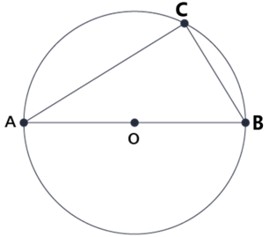
i. Identifying the type of Triangle
Step 1: Observe that line segment \(AB\) passes through the centre \(O\), which means \(AB\) is the diameter of the circle.
Step 2: Recall the geometric theorem that the angle subtended by a diameter at any point on the circumference is always a right angle (\(90^{\circ}\)).
Step 3: Therefore, \(\angle ACB = 90^{\circ}\), making \(\triangle ABC\) a right-angled triangle.
ii. Applying Pythagoras Theorem
Step 1: In right-angled \(\triangle ABC\), by Pythagoras theorem: \(AB^2 = AC^2 + BC^2\).
Step 2: Substitute the given values: \(AC = 15\text{ cm}\) and \(BC = 8\text{ cm}\).
Step 3: \(AB^2 = (15)^2 + (8)^2\).
Step 4: \(AB^2 = 225 + 64\).
Step 5: \(AB^2 = 289\).
Step 6: Taking square root on both sides: \(AB = \sqrt{289} = 17\).
Answer: (c) 17 cm
Leave a Comment