

Exercise- 21 A
Q1: Take a point O on your notebook and draw circles of radii 3.6 cm, 4.5 cm and 5.3 cm, each having the same centre O.
i. Circle with Radius 3.6 cm
Step 1: Mark center O.
Step 2: Draw the first circle with radius 3.6 cm.
ii. Circle with Radius 4.5 cm
Step 1: Keeping the same center O, adjust compass to 4.5 cm.
Step 2: Draw the second circle. The first circle remains visible.
iii. Circle with Radius 5.3 cm
Step 1: Adjust compass to 5.3 cm.
Step 2: Draw the third circle. All circles share the same center O.
Answer: Concentric circles of radii 3.6 cm, 4.5 cm, and 5.3 cm have been drawn where only the active radius is labeled.
Q2: Draw a circle with centre C and radius 4.2 cm. Mark points, P, Q, R such that P lies in the interior of the circle, Q lies on the circle and R lies in the exterior of the circle.
i. Construction of the Circle
Step 1: Mark a point and label it as ‘C’.
Step 2: Use a ruler to set the compass width to 4.2 cm.
Step 3: Place the compass needle at C and draw the circle.
ii. Marking the Points
Step 1: Mark point P inside the circle. Distance CP < 4.2 cm.
Step 2: Mark point Q exactly on the boundary. Distance CQ = 4.2 cm.
Step 3: Mark point R outside the boundary. Distance CR > 4.2 cm.
Answer: The circle with centre C and radius 4.2 cm is drawn, and points P (Interior), Q (On the circle), and R (Exterior) are successfully marked.
Q3: Draw a circle with centre O and radius 4.5 cm. Draw a chord AB of length 5.4 cm. Indicate by marking points X and Y, the minor arc AXB and the major arc AYB of the circle. Shade the major segment of the circle.
i. Construction of Circle and Chord
Step 1: Take a point O as the centre and draw a circle of radius 4.5 cm.
Step 2: To draw chord AB = 5.4 cm, take any point A on the circle.
Step 3: Using a compass set to 5.4 cm, place the pointer at A and cut an arc on the circle to mark point B.
Step 4: Join A and B to get the chord AB.
ii. Marking Arcs and Shading
Step 1: Mark a point X on the smaller part of the circle between A and B to show minor arc AXB.
Step 2: Mark a point Y on the larger part of the circle to show major arc AYB.
Step 3: Shade the region bounded by chord AB and the major arc AYB.
Answer: The circle with radius 4.5 cm, chord AB 5.4 cm, and the shaded major segment have been successfully constructed.
Q4: Draw a circle with centre O and radius 3.6 cm. Draw a sector OAXB having the angle 75°. Measure the length of chord AB.
i. Construction of the Sector
Step 1: Mark a point O and draw a circle of radius 3.6 cm. Label the radius OA.
Step 2: Place a protractor at centre O, aligned with OA, and mark a point B at 75°.
Step 3: Join OB. The region OAXB forms the required sector.
ii. Measuring Chord AB
Step 1: Join the points A and B with a straight line to form chord AB.
Step 2: Measure the length of AB using a ruler.
Step 3: Verification: Using the chord formula \(2r \sin(\theta/2)\), we get \(2(3.6) \sin(37.5°)\).
Answer: The radius is 3.6 cm, and the measured length of chord AB is approximately 4.4 cm.
Q5: State which of the following statements are true and which are false:
i. Every circle has a unique centre.
Step 1: A circle is defined as the set of all points in a plane which are at a fixed distance from a fixed point.
Step 2: That fixed point is called the centre of the circle.
Step 3: For a given circle, this fixed point is only one.
Answer: True
ii. Each radius of a circle is also a chord of the circle.
Step 1: A chord is a line segment whose both endpoints lie on the circle.
Step 2: A radius is a line segment joining the centre to a point on the circle.
Step 3: Since one endpoint of a radius is at the centre (not on the circle), it is not a chord.
Answer: False
iii. Every circle has a unique diameter.
Step 1: A diameter is a chord passing through the centre of the circle.
Step 2: Infinite lines can pass through the centre of a circle.
Step 3: Hence, infinite diameters can be drawn in a circle.
Answer: False
iv. A line can meet a circle at the most at two points.
Step 1: A line may not meet a circle (no intersection).
Step 2: A line may touch a circle at exactly one point (tangent).
Step 3: A line may cut a circle at two distinct points (secant).
Step 4: A line cannot intersect a circle at more than two points.
Answer: True
v. A circle consists of an infinite number of points.
Step 1: A circle is a continuous curve.
Step 2: Between any two points on a circle, infinitely many points exist.
Answer: True
vi. A secant of a circle is a segment having its end mints on the circle.
Step 1: A secant is a line that intersects a circle at two distinct points.
Step 2: A segment whose endpoints lie on the circle is called a chord.
Step 3: Therefore, the given definition is incorrect.
Answer: False
vii. One and only one tangent can be drawn to pass through a point on the circle.
Step 1: A tangent touches the circle at exactly one point.
Step 2: At a given point on the circle, only one line can be perpendicular to the radius at that point.
Step 3: Hence, only one tangent can be drawn at a point on the circle.
Answer: True
viii. One and only one tangent can be drawn to a circle from a point outside it.
Step 1: From a point outside a circle, exactly two tangents can be drawn.
Step 2: Therefore, the statement saying only one tangent is incorrect.
Answer: False
ix. An infinite number of chords can be drawn inside a circle.
Step 1: Any two distinct points on the circle can be joined to form a chord.
Step 2: Since a circle has infinitely many points, infinitely many chords can be drawn.
Answer: True
x. A minor arc is bigger than a semi-circle.
Step 1: A semicircle measures 180°.
Step 2: A minor arc measures less than 180°.
Step 3: Therefore, a minor arc is smaller than a semicircle.
Answer: False
Q6: Fill in the blanks:
i. ________ is the longest chord of a circle.
Step 1: A chord is a line segment whose endpoints lie on the circle.
Step 2: The chord that passes through the centre of the circle is called the diameter.
Step 3: Since it passes through the centre, it has the maximum possible length among all chords.
Answer: Diameter
ii. Every point on a circle is ________ from its centre.
Step 1: A circle is defined as the set of all points in a plane which are at a fixed distance from a fixed point (centre).
Step 2: That fixed distance is called the radius.
Step 3: Therefore, every point on the circle is at the same distance from the centre.
Answer: Equidistant (at the same distance)
iii. The perimeter of a circle is called its _________.
Step 1: The boundary of a circle forms a closed curve.
Step 2: The length of this boundary (perimeter) is known by a special name.
Step 3: This length is called the circumference of the circle.
Answer: Circumference
iv. A part of a circle bounded by an ________ and a _________ is called a segment.
Step 1: A segment is a region of a circle.
Step 2: It is formed by a chord and the arc corresponding to that chord.
Answer: Arc, Chord
v. A part of a circle bounded by an ________ and the two ________ at its ends is called a sector.
Step 1: A sector is a region of a circle.
Step 2: It is formed by an arc and the two radii joining the centre to the endpoints of the arc.
Answer: Arc, Radii
vi. A ________ of a circle divides the circular region into two parts each called a segment.
Step 1: When a chord is drawn in a circle, it divides the circle into two regions.
Step 2: Each of these regions is called a segment.
Answer: Chord
Q7: In the adjoining figure, name:
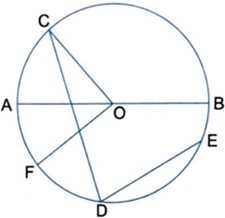
i. all the radii
Step 1: Identify the center of the circle, which is point O.
Step 2: List all line segments connecting center O to any point on the boundary.
Answer: OA, OB, OC and OF
ii. all the diameters
Step 1: Identify a line segment that passes through the center O and has both endpoints on the circle.
Answer: AB
iii. all the chords
Step 1: Identify all line segments whose endpoints lie on the circle’s circumference.
Step 2: Note that the diameter is also the longest chord.
Answer: AB, CD, and DE
iv. a minor arc
Step 1: Identify a part of the circumference that is less than a semi-circle (measure < 180°).
Answer: Arc AD
v. a major arc
Step 1: Identify a part of the circumference that is greater than a semi-circle (measure > 180°).
Answer: Arc CBD
vi. a minor segment
Step 1: Identify the region bounded by a chord and its corresponding minor arc.
Answer: CADC
vii. a major segment
Step 1: Identify the larger region bounded by a chord and its corresponding major arc.
Answer: CBDC
viii. a minor sector
Step 1: Identify the region enclosed by two radii and a minor arc.
Answer: OCAFO
ix. a major sector
Step 1: Identify the larger region enclosed by two radii and a major arc.
Answer: OCBFO
Q8: Find the length of the tangent drawn to a circle of radius 12 cm from a point distant 23 cm from the centre.
i. Given Information
Step 1: Radius of the circle (\r\) = \(12\) cm.
Step 2: Distance of point P from centre O (\d\) = \(23\) cm.
Step 3: Let the point of contact on the circle be T. Then, \(OT = 12\) cm and \(\angle OTP = 90^\circ\).
ii. Calculation using Pythagoras Theorem
Step 1: In right-angled triangle \(\triangle OTP\), by Pythagoras Theorem:
\(OP^2 = OT^2 + PT^2\)
Step 2: Substitute the given values:
\(23^2 = 12^2 + PT^2\)
\(529 = 144 + PT^2\)
Step 3: Solve for PT:
\(PT^2 = 529 – 144\)
\(PT^2 = 385\)
\(PT = \sqrt{385} \approx 19.62\) cm
Answer: The length of the tangent is approximately 19.62 cm.
Q9: In each of the following figures, O is the centre of the circle. Find the measure of the angle marked x.
i.
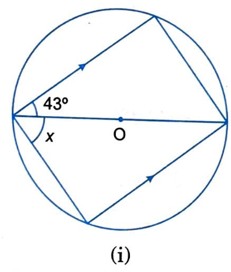
Step 1: Identify that the angle in a semi-circle is a right angle, which is equal to \(90^{\circ}\).
Step 2: In the given triangle, the sum of the two acute angles must be \(90^{\circ}\).
Step 3: Form the equation: \(x + 43^{\circ} = 90^{\circ}\)
Step 4: Solve for x: \(x = 90^{\circ} – 43^{\circ}\)
Answer: x = 47°
ii.
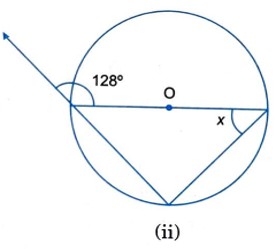
Step 1: Observe that the radius is perpendicular to the tangent at the point of contact, creating a \(90^{\circ}\) angle.
Step 2: Use the property that the exterior angle (\(128^{\circ}\)) is the sum of the interior right angle and angle x.
Step 3: Form the equation: \(x + 90^{\circ} = 128^{\circ}\)
Step 4: Solve for x: \(x = 128^{\circ} – 90^{\circ}\)
Answer: x = 38°
iii.
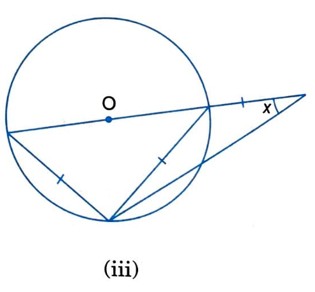
Step 1: Note the equal sides marked, indicating isosceles triangle properties within the circle geometry.
Step 2: Apply the theorem that the angle subtended by an arc at the center is double the angle at the circumference.
Step 3: Based on the geometric construction and given markings, calculate \(x = 45^{\circ} / 2\).
Answer: x = 22\(\frac{1}{2}\)°
iv.
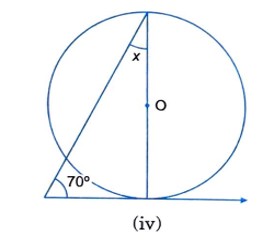
Step 1: Identify the right-angled triangle formed between the tangent and the diameter at the point of contact.
Step 2: In the larger triangle, use the angle sum property where the base angle is \(70^{\circ}\) and the tangent angle is \(90^{\circ}\).
Step 3: Calculate the remaining angle: \(180^{\circ} – (90^{\circ} + 70^{\circ}) = 20^{\circ}\).
Answer: x = 20°
v.
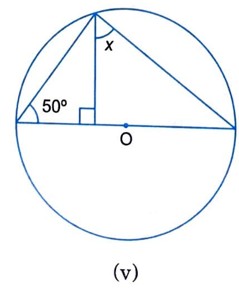
Step 1: Apply the Alternate Segment Theorem, which states the angle between a tangent and a chord is equal to the angle in the alternate segment.
Step 2: Observe that the angle given in the alternate segment is \(50^{\circ}\).
Step 3: Therefore, the angle x must be equal to this corresponding angle.
Answer: x = 50°
Leave a Comment