

Test Yourself
Q1: Multiple Choice Type:
i. Each side of a triangle is doubled, the ratio of areas of the original triangle to the new (resulting) triangle is:
Step 1: Let the sides of the original triangle be \(a, b, c\).
Step 2: If each side is doubled, the new sides become:
\[
2a,\; 2b,\; 2c
\]Step 3: When the sides of a triangle are multiplied by a factor \(k\), the area of the triangle is multiplied by \(k^2\).
Here,\[
k = 2
\]Therefore,\[
\text{New Area} = 2^2 \times \text{Original Area} \\
= 4 \times \text{Original Area}
\]Step 4: Ratio of areas.
\[
\text{Original Area : New Area} = 1 : 4
\]Answer: c. 1 : 4
ii. The perimeter of a rectangle is equal to the perimeter of a square. If each side of the square is 30 cm and length of the rectangle is 40 cm; the breadth of the rectangle is:
Step 1: Perimeter of square:
\[
P = 4 \times 30 = 120 \text{ cm}
\]Step 2: Let the breadth of rectangle be \(b\) cm.
Perimeter of rectangle:
\[
2(l + b) = 120 \\
2(40 + b) = 120 \\
\Rightarrow 40 + b = 60 \\
\Rightarrow b = 20 \text{ cm}
\]Answer: d. 20 cm
iii. The area of a trapezium is 80 square units. If its two parallel sides are 6 units and 14 units; the distance between parallel sides is:
Step 1: Area of trapezium formula:
\[
\text{Area} = \frac{1}{2} \times (a + b) \times h
\]
Where \(a = 6\), \(b = 14\), \(h\) is the distance.
\[
80 = \frac{1}{2} \times (6 + 14) \times h = 10h \\
h = \frac{80}{10} = 8 \text{ units}
\]Answer: b. 8 units
iv. The external and internal radii of a ring shaped metal sheet are 10 cm and 8 cm respectively. The area of its one face, in terms of π is:
Step 1: Area of ring = Area of outer circle – Area of inner circle:
\[
A = \pi R^2 – \pi r^2 = \pi (R^2 – r^2) \\
= \pi (10^2 – 8^2) = \pi (100 – 64) = 36 \pi \text{ cm}^2
\]Answer: a. 36π cm²
v. The adjacent sides of a rectangle are 20 cm and 24 cm. If its perimeter is equal to the circumference of a circle, the radius of the circle is:
Step 1: Perimeter of rectangle:
\[
P = 2(20 + 24) = 2 \times 44 = 88 \text{ cm}
\]Step 2: Circumference of circle = perimeter of rectangle:
\[
2 \pi r = 88 \\
\Rightarrow r = \frac{88}{2 \pi} = \frac{44}{\pi} = \frac{44}{\frac{22}{7}} = \frac{44 \times 7}{22} = 14 \text{ cm}
\]Answer: a. 14 cm
vi. Statement 1: ABCD is a parallelogram. Base AB = 12 cm, perpendicular dropped from B to AD is 9 cm, area of the parallelogram ABCD = 54 cm².
Statement 2: The area of parallelogram = Base × Height.
Which of the following options is correct?
Step 1: Calculate area using base and height:
\[
\text{Area} = \text{Base} \times \text{Height} = 12 \times 9 = 108 \text{ cm}^2
\]Step 2: Given area is 54 cm², but calculation shows 108 cm².
Therefore,
Statement 1 is false, Statement 2 is true.
Answer: d. Statement 1 is false, and statement 2 is true.
vii. Assertion (A): The diagonal of a rectangle is 17 m and its breadth is 8 m. Half of the area of the rectangle is 120 m².
Reason (R): The diagonal of every rectangle divides it into two congruent right-triangles.
Step 1: Calculate length using Pythagoras theorem:
\[
d^2 = l^2 + b^2 \\
\Rightarrow 17^2 = l^2 + 8^2 \\
\Rightarrow 289 = l^2 + 64 \\
\Rightarrow l^2 = 225 \\
\Rightarrow l = 15 \text{ m}
\]Step 2: Calculate area:
\[
\text{Area} = l \times b = 15 \times 8 = 120 \text{ m}^2
\]
Half of area = \(\frac{120}{2} = 60 \neq 120\), so Assertion is false.
Reason is true (diagonal divides rectangle into two congruent right triangles).
Answer: d. A is false, but R is true.
viii. Assertion (A): The area of an equilateral triangle of height \(2\sqrt{3}\) cm is \(4\sqrt{3}\) cm².
Reason (R): The area of an equilateral triangle = \(\frac{1}{\sqrt{3}}\) × (Height)².
Step 1: Calculate area using height:
\[
\text{Area} = \frac{1}{\sqrt{3}} \times (2\sqrt{3})^2 = \frac{1}{\sqrt{3}} \times 4 \times 3 = \frac{12}{\sqrt{3}} = 4 \sqrt{3} \text{ cm}^2
\]Both Assertion and Reason are true, and Reason explains Assertion.
Answer: a. Both A and R are correct, and R is the correct explanation for A.
ix. Assertion (A): The diagonal of a square is \(9\sqrt{2}\) cm. Its area = 81 cm².
Reason (R): The area of a square = \(\frac{1}{2} \times d^2\), where \(d\) is the length of the diagonal.
Step 1: Calculate area using diagonal:
\[
\text{Area} = \frac{1}{2} \times (9\sqrt{2})^2 = \frac{1}{2} \times 81 \times 2 = \frac{1}{2} \times 162 = 81 \text{ cm}^2
\]Both Assertion and Reason are true, and Reason explains Assertion.
Answer: a. Both A and R are correct, and R is the correct explanation for A.
x. Assertion (A): The area of trapezium with base 10 cm, height 5 cm and the side parallel to the given base being 6 cm is 40 cm².
Reason (R): The area of trapezium = \(\frac{1}{2} \times\) (Sum of non-parallel sides) \(\times\) height.
Step 1: Calculate area of trapezium:
\[
\text{Area} = \frac{1}{2} \times (10 + 6) \times 5 = \frac{1}{2} \times 16 \times 5 = 40 \text{ cm}^2
\]
So, Assertion is true.
Step 2: Reason states area uses sum of non-parallel sides, which is incorrect; it should be sum of parallel sides.
So, Reason is false.
Answer: c. A is true, but R is false.
Q2: The perimeter of a trapezium is 52 cm. If its non-parallel sides are 10 cm each and its altitude is 8 cm, find the area of the trapezium.
Step 1: Let the lengths of the two parallel sides be \(a\) and \(b\) cm.
Given non-parallel sides = 10 cm each.
Perimeter \(P\) of trapezium = sum of all sides:
\[
P = a + b + 10 + 10 = a + b + 20 = 52 \\
a + b = 52 – 20 = 32 \text{ cm}
\]Step 2: Given altitude (height) \(h = 8\) cm.
Area of trapezium formula:
\[
A = \frac{1}{2} \times (a + b) \times h = \frac{1}{2} \times 32 \times 8 = 16 \times 8 = 128 \text{ cm}^2
\]Answer: Area of the trapezium = 128 cm²
Q3: The shape of a garden is rectangular in the middle and semicircular at each end as shown in the figure. Find the area and the perimeter of the garden.
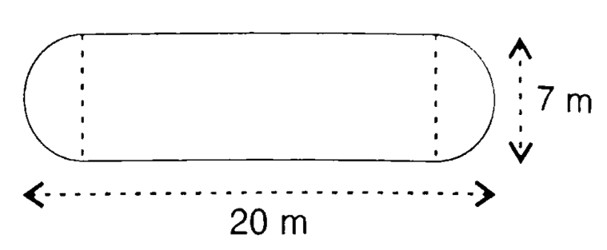
i. Finding the area of the garden
Step 1:
From the figure:
Length of rectangular part = 20 – 7 = 13 m
Breadth of rectangle = diameter of semicircle = 7 m
Radius of each semicircle:
\[
r = \frac{7}{2} = 3.5\text{ m}
\]Step 2:
Area of rectangular part:
\[
= 13 \times 7 = 91\text{ m}^2
\]Step 3:
The two semicircles together form one complete circle.
Area of circular part:
\[
= \pi r^2 = \pi \times (3.5)^2 \\
= \pi \times 12.25
\]Using \(\pi = \frac{22}{7}\):
\[
= \frac{22}{7} \times 12.25 = 38.5\text{ m}^2
\]Step 4:
Total area of the garden:
\[
= 91 + 38.5 \\
= 129.5\text{ m}^2
\]Answer: Area of the garden = 129.5 m²
ii. Finding the perimeter of the garden
Step 1:
Perimeter consists of:
• Two straight lengths of the rectangle
• Curved portions of two semicircles (i.e., one full circle)
Step 2:
Length of straight portions:
\[
= 2 \times 13 = 26\text{ m}
\]Step 3:
Circumference of the circular part:
\[
= 2\pi r \\
= 2 \times \frac{22}{7} \times 3.5 \\
= 22\text{ m}
\]Step 4:
Total perimeter of the garden:
\[
= 26 + 22 \\
= 48\text{ m}
\]Answer: Perimeter of the garden = 48 m
Q4: Each side of rhombus is 13 cm and one of its diagonals is 10 cm. Find:
i. The length of its other diagonal
Step 1: In a rhombus, the diagonals bisect each other at right angles.
Let the other diagonal be \(d_2\) cm.
Half of the given diagonal \(d_1 = 10\) cm is \(5\) cm.
Half of the other diagonal \(d_2\) is \(\frac{d_2}{2}\) cm.
Using Pythagoras theorem for one right triangle formed by half diagonals and side:
\[
\left(\frac{d_1}{2}\right)^2 + \left(\frac{d_2}{2}\right)^2 = \text{side}^2 \\
5^2 + \left(\frac{d_2}{2}\right)^2 = 13^2 \\
25 + \frac{d_2^2}{4} = 169 \\
\frac{d_2^2}{4} = 169 – 25 = 144 \\
d_2^2 = 144 \times 4 = 576 \\
d_2 = \sqrt{576} = 24 \text{ cm}
\]
Answer: Other diagonal = 24 cm
ii. Its area
Step 2: Area of rhombus formula:
\[
\text{Area} = \frac{1}{2} \times d_1 \times d_2 = \frac{1}{2} \times 10 \times 24 = 5 \times 24 = 120 \text{ cm}^2
\]Answer: Area = 120 cm²
Q5: The given figure shows a rectangle ABCD and a right triangle BOC. Find the area of the shaded portion.
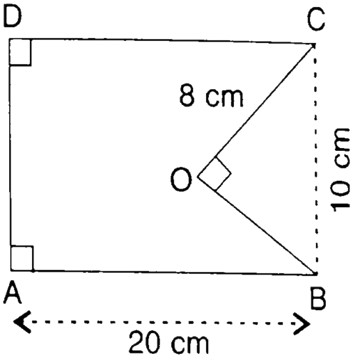
Step 1:
From the figure, ABCD is a rectangle.
Given:
\[
AB = 20\text{ cm}, \quad BC = 10\text{ cm}
\]Area of rectangle ABCD:
\[
= 20 \times 10 = 200\text{ cm}^2
\]Step 2:
Triangle BOC is a right-angled triangle at O.
Given from the figure:
\[
BC = 10\text{ cm}, \quad OC = 8\text{ cm}
\]Step 3: Using Pythagoras theorem:
\[
BC^2 = OC^2 + OB^2 \\
10^2 = 8^2 + OB^2 \\
100 = 64 + OB^2 \\
OB^2 = 100 – 64 = 36 \\
OB = 6
\]
Step 4: Area of right triangle BOC:
\[
= \frac{1}{2} \times OB \times OC \\
= \frac{1}{2} \times 6 \times 8 \\
= 24\text{ cm}^2
\]Step 5: The shaded portion is the rectangle minus the triangular cut-out.
\[
\text{Shaded Area} = 200 – 24 \\
= 176\text{ cm}^2
\]Answer: Area of the shaded portion = 176 cm²
Q6:
i. Find the area of the circle whose circumference is 264 cm.
Step 1: Use the circumference formula:
\[
C = 2\pi r = 264 \\
r = \frac{264}{2\pi} = \frac{264}{2 \times \frac{22}{7}} = \frac{264 \times 7}{44} = 42 \text{ cm}
\]Step 2: Find the area:
\[
A = \pi r^2 = \frac{22}{7} \times 42^2 = \frac{22}{7} \times 1764 = 22 \times 252 = 5544 \text{ cm}^2
\]Answer: Area = 5544 cm²
ii. Find the circumference of a circle whose area is 1386 cm².
Step 1: Use the area formula:
\[
A = \pi r^2 = 1386 \\
r^2 = \frac{1386 \times 7}{22} = 441 \\
r = \sqrt{441} = 21 \text{ cm}
\]Step 2: Find the circumference:
\[
C = 2 \pi r = 2 \times \frac{22}{7} \times 21 = 132 \text{ cm}
\]Answer: Circumference = 132 cm
Q7: A copper wire when bent in the form of a square encloses an area of 484 cm². When the same wire is bent in the form of a circle, find the area of the circle formed.
Step 1: Find the side of the square.
\[
\text{Area of square} = \text{side}^2 = 484 \\
\text{side} = \sqrt{484} = 22 \text{ cm}
\]Step 2: Find the perimeter of the square (which is length of the wire).
\[
\text{Perimeter} = 4 \times \text{side} = 4 \times 22 = 88 \text{ cm}
\]Step 3: This wire is bent into a circle, so circumference \(C = 88\) cm.
Use circumference formula:
\[
C = 2 \pi r \\
\Rightarrow r = \frac{C}{2 \pi} = \frac{88}{2 \times \frac{22}{7}} = \frac{88 \times 7}{44} = 14 \text{ cm}
\]Step 4: Find the area of the circle:
\[
A = \pi r^2 = \frac{22}{7} \times 14^2 = \frac{22}{7} \times 196 = 22 \times 28 = 616 \text{ cm}^2
\]Answer:Area of the circle = 616 cm²
Q8: The perimeters of two squares are 120 cm and 64 cm. Find the perimeter of the square whose area is equal to the sum of the areas of these two squares.
Step 1: Find the side lengths of the two squares.
For first square:
\[
\text{Perimeter} = 4 \times \text{side}_1 = 120 \\
\Rightarrow \text{side}_1 = \frac{120}{4} = 30 \text{ cm}
\]
For second square:
\[
\text{Perimeter} = 4 \times \text{side}_2 = 64 \\
\Rightarrow \text{side}_2 = \frac{64}{4} = 16 \text{ cm}
\]Step 2: Find the areas of the two squares.
\[
\text{Area}_1 = 30^2 = 900 \text{ cm}^2 \\
\text{Area}_2 = 16^2 = 256 \text{ cm}^2
\]Step 3: Sum of the areas:
\[
\text{Area}_{\text{new}} = 900 + 256 = 1156 \text{ cm}^2
\]Step 4: Find the side of the new square:
\[
\text{side}_{\text{new}} = \sqrt{1156} = 34 \text{ cm}
\]Step 5: Find the perimeter of the new square:
\[
\text{Perimeter}_{\text{new}} = 4 \times 34 = 136 \text{ cm}
\]Answer:The perimeter of the new square = 136 cm
Q9: Find the perimeter of a square whose area is equal to half the sum of areas of three squares with sides 3 cm, 4 cm and 5 cm.
Step 1: Find the areas of the three squares.
\[
\text{Area}_1 = 3^2 = 9 \text{ cm}^2 \\
\text{Area}_2 = 4^2 = 16 \text{ cm}^2 \\
\text{Area}_3 = 5^2 = 25 \text{ cm}^2
\]Step 2: Find the sum of areas:
\[
\text{Sum of areas} = 9 + 16 + 25 = 50 \text{ cm}^2
\]Step 3: Find half of the sum of areas:
\[
\text{Area of new square} = \frac{50}{2} = 25 \text{ cm}^2
\]Step 4: Find the side length of the new square:
\[
\text{side} = \sqrt{25} = 5 \text{ cm}
\]Step 5: Find the perimeter of the new square:
\[
\text{Perimeter} = 4 \times 5 = 20 \text{ cm}
\]Answer:Perimeter of the square = 20 cm
Q10: If the diameter of a car wheel is 28 cm, how many times will the wheel rotate in a journey of 11 km?
Step 1: Convert the journey distance into centimeters:
\[
11 \text{ km} = 11 \times 1000 \text{ m} = 11000 \text{ m} = 11000 \times 100 \text{ cm} = 1,100,000 \text{ cm}
\]Step 2: Find the circumference of the wheel (distance covered in one rotation):
\[
\text{Diameter} = 28 \text{ cm} \\
\Rightarrow r = \frac{28}{2} = 14 \text{ cm} \\
\text{Circumference} = 2\pi r = 2 \times \frac{22}{7} \times 14 = 2 \times 22 \times 2 = 88 \text{ cm}
\]Step 3: Find the number of rotations:
\[
\text{Number of rotations} = \frac{\text{Total distance}}{\text{Circumference}} = \frac{1,100,000}{88} = 12500
\]Answer:The wheel will rotate 12,500 times during the journey.
Leave a Comment