

Exercise: 22-D
Q1: Multiple Choice Type:
i. The circumference of a circle is numerically same as its area; then its radius is:
Step 1: Let the radius of the circle be \(r\) units.
Circumference of circle:
\[
C = 2 \pi r
\]
Area of circle:
\[
A = \pi r^2
\]Step 2: Given \(C = A\), so:
\[
2 \pi r = \pi r^2
\]Step 3: Divide both sides by \(\pi\) (assuming \(r \neq 0\)):
\[
2r = r^2 \\
r^2 – 2r = 0 \\
r(r – 2) = 0
\]Step 4: Solutions:
\[
r = 0 \quad \text{or} \quad r = 2
\]
Radius cannot be zero, so radius \(r = 2\) units.
Answer: b. 2 units
ii. The perimeter of a square of side 11 cm is equal to circumference of a circle; then the diameter of the circle is:
Step 1: Perimeter of square:
\[
P = 4 \times 11 = 44 \text{ cm}
\]
Circumference of circle \(C = 2 \pi r\). Given:
\[
C = P = 44 \\
2 \pi r = 44 \\
\Rightarrow r = \frac{44}{2 \pi} = \frac{22}{\pi}
\]Step 2: Diameter of circle:
\[
d = 2r = 2 \times \frac{22}{\pi} = \frac{44}{\pi} = \frac{44 \times 7}{22} = 14 \text{ cm}
\]Answer: c. 14 cm
iii. The circumference of a circle is equal to the sum of the circumferences of two circles with radii 10 cm and 12 cm. The radius of circle formed is:
Step 1: Circumferences of two circles:
\[
C_1 = 2 \pi \times 10 = 20 \pi \\
C_2 = 2 \pi \times 12 = 24 \pi
\]
Sum of circumferences:
\[
C = C_1 + C_2 = 20 \pi + 24 \pi = 44 \pi
\]Step 2: Let radius of new circle be \(r\):
\[
2 \pi r = 44 \pi \\
\Rightarrow r = 22 \text{ cm}
\]Answer: c. 22 cm
iv. The diameter of a circular wheel is 56 cm. The distance moved by it in 100 rounds is:
Step 1: Diameter \(d = 56\) cm, so radius \(r = \frac{56}{2} = 28\) cm.
Circumference of wheel:
\[
C = 2 \pi r = 2 \pi \times 28 = 56 \pi \text{ cm}
\]Step 2: Distance moved in 100 rounds:
\[
D = 100 \times 56 \pi = 5600 \pi = 5600 \times \frac{22}{7} = 17600 \text{ cm}
\]Answer: b. 17600 cm
v. A circular wheel of radius 3.5 cm makes 600 rounds in 48 seconds, its speed is:
Step 1: Circumference of wheel:
\[
C = 2 \pi r = 2 \pi \times 3.5 = 7 \pi \text{ cm}
\]Step 2: Distance moved in 600 rounds:
\[
D = 600 \times 7 \pi = 4200 \pi \approx 4200 \times \frac{22}{7} = 13200 \text{ cm}
\]Step 3: Speed in cm/s:
\[
\text{Speed} = \frac{\text{distance}}{\text{time}} = \frac{13200}{48} = 275 \text{ cm/s}
\]Answer: a. 275 cm/s
Q2: Find the radius and area of a circle, whose circumference is:
i. 132 cm
Step 1: Circumference formula:
\[
C = 2 \pi r
\]
Given \(C = 132\) cm,
\[
132 = 2 \pi r \\
\Rightarrow r = \frac{132}{2 \pi} = \frac{66}{\pi} \\
r \approx \frac{66 \times 7}{22} = 21 \text{ cm}
\]Step 2: Calculate area:
\[
A = \pi r^2 = \pi \times 21^2 = \pi \times 441 = \frac{22}{7} \times 441 = 1386 \text{ cm}^2
\]Answer: Radius = 21 cm, Area ≈ 1386 cm²
ii. 22 m
Step 1: Given circumference \(C = 22\) m,
\[
22 = 2 \pi r \\
\Rightarrow r = \frac{22}{2 \pi} = \frac{11}{\pi} \\
r \approx \frac{11 \times 7}{22} = 3.5 \text{ m}
\]Step 2: Calculate area:
\[
A = \pi r^2 = \pi \times (3.5)^2 = \pi \times 12.25 = \frac{22}{7} \times 12.25 = 38.50 \text{ m}^2
\]Answer: Radius = 3.5 m, Area = 38.50 m²
Q3: Find the radius and circumference of a circle, whose area is:
i. 154 cm²
Step 1: Write the formula for area of a circle:
\[
\text{Area} = \pi r^2
\]Step 2: Substitute given values ( \(\pi = \frac{22}{7}\) ):
\[
\frac{22}{7} \times r^2 = 154
\]Step 3: Solve for \(r^2\):
\[
r^2 = \frac{154 \times 7}{22} = 49
\]Step 4: Find radius:
\[
r = \sqrt{49} = 7 \text{ cm}
\]Step 5: Find circumference:
\[
\text{Circumference} = 2\pi r = 2 \times \frac{22}{7} \times 7 = 44 \text{ cm}
\]Answer:
Radius = 7 cm, Circumference = 44 cm
ii. 6.16 m²
Step 1: Use the area formula:
\[
\pi r^2 = 6.16
\]Step 2: Substitute value of \(\pi\):
\[
\frac{22}{7} \times r^2 = 6.16
\]Step 3: Solve for \(r^2\):
\[
r^2 = \frac{6.16 \times 7}{22} = 1.96
\]Step 4: Find radius:
\[
r = \sqrt{1.96} = 1.4 \text{ m}
\]Step 5: Find circumference:
\[
\text{Circumference} = 2\pi r = 2 \times \frac{22}{7} \times 1.4 = 8.8 \text{ m}
\]Answer:
Radius = 1.4 m, Circumference = 8.8 m
Q4: The circumference of a circular table is 88 m. Find its area.
Step 1: Write the formula for circumference of a circle:
\[
\text{Circumference} = 2\pi r
\]Step 2: Substitute the given value (take \(\pi = \frac{22}{7}\)):
\[
2 \times \frac{22}{7} \times r = 88
\]Step 3: Solve for radius \(r\):
\[
r = \frac{88 \times 7}{44} = 14 \text{ m}
\]Step 4: Write the formula for area of a circle:
\[
\text{Area} = \pi r^2
\]Step 5: Substitute the value of radius:
\[
\text{Area} = \frac{22}{7} \times 14^2
\]Step 6: Simplify:
\[
\text{Area} = \frac{22}{7} \times 196 = 616 \text{ m}^2
\]Answer:The area of the circular table is 616 m².
Q5: The area of a circle is 1386 sq. cm, find its circumference.
Step 1: Write the formula for area of a circle:
\[
\text{Area} = \pi r^2
\]Step 2: Substitute the given values (take \(\pi = \frac{22}{7}\)):
\[
\frac{22}{7} \times r^2 = 1386
\]Step 3: Solve for \(r^2\):
\[
r^2 = \frac{1386 \times 7}{22} = 441
\]Step 4: Find the radius:
\[
r = \sqrt{441} = 21 \text{ cm}
\]Step 5: Write the formula for circumference of a circle:
\[
\text{Circumference} = 2\pi r
\]Step 6: Substitute the value of radius:
\[
\text{Circumference} = 2 \times \frac{22}{7} \times 21
\]Step 7: Simplify:
\[
\text{Circumference} = 132 \text{ cm}
\]Answer:The circumference of the circle is 132 cm.
Q6: Find the area of a flat circular ring formed by two concentric circles (circles with same centre) whose radii are 9 cm and 5 cm.
Step 1: Write the formula for area of a circular ring:
\[
\text{Area of ring} = \pi (R^2 – r^2)
\]Step 2: Substitute the given values (take \(\pi = \frac{22}{7}\)):
\[
\text{Area} = \frac{22}{7} (9^2 – 5^2)
\]Step 3: Simplify the squares:
\[
\text{Area} = \frac{22}{7} (81 – 25)
\]Step 4: Simplify further:
\[
\text{Area} = \frac{22}{7} \times 56
\]Step 5: Final calculation:
\[
\text{Area} = 176 \text{ cm}^2
\]Answer:The area of the circular ring is 176 cm².
Q7: The radii of the inner and outer circumferences of a circular running track are 63 m and 70 m respectively. Find:
i. the area of the track
Step 1: Write the formula for area of a circular track (ring):
\[
\text{Area} = \pi (R^2 – r^2)
\]Step 2: Substitute the given values (take \(\pi = \frac{22}{7}\)):
\[
\text{Area} = \frac{22}{7} (70^2 – 63^2)
\]Step 3: Evaluate the squares:
\[
\text{Area} = \frac{22}{7} (4900 – 3969)
\]Step 4: Simplify:
\[
\text{Area} = \frac{22}{7} \times 931
\]Step 5: Final calculation:
\[
\text{Area} = 2926 \text{ m}^2
\]Answer:
Area of the track = 2926 m²
ii. the difference between the lengths of the two circumferences of the track
Step 1: Write the formula for circumference of a circle:
\[
\text{Circumference} = 2\pi r
\]Step 2: Find the outer circumference:
\[
C_1 = 2 \times \frac{22}{7} \times 70 = 440 \text{ m}
\]Step 3: Find the inner circumference:
\[
C_2 = 2 \times \frac{22}{7} \times 63 = 396 \text{ m}
\]Step 4: Find the difference:
\[
\text{Difference} = 440 – 396 = 44 \text{ m}
\]Answer:
Difference between the two circumferences = 44 m
Q8: A circular field of radius 105 m has a circular path of uniform width of 5 m along and inside its boundary. Find the area of the path.
Step 1: Understand the figure:
The circular path lies inside the field.
Outer radius \(R = 105\) m
Inner radius \(r = 105 – 5 = 100\) m
Step 2: Write the formula for area of a circular path (ring):
\[
\text{Area of path} = \pi (R^2 – r^2)
\]Step 3: Substitute the values (take \(\pi = \frac{22}{7}\)):
\[
\text{Area} = \frac{22}{7} (105^2 – 100^2)
\]Step 4: Evaluate the squares:
\[
\text{Area} = \frac{22}{7} (11025 – 10000)
\]Step 5: Simplify:
\[
\text{Area} = \frac{22}{7} \times 1025
\]Step 6: Final calculation:
\[
\text{Area} = 3221 \frac{3}{7} \text{ m}^2
\]Answer:
The area of the circular path is \(3221 \frac{3}{7}\) m².
Q9: A wire, when bent in the form of a square, encloses an area of 484 cm². Find:
i. One side of the square
Step 1: Write the formula for area of a square:
\[
\text{Area} = (\text{side})^2
\]Step 2: Substitute the given area:
\[
(\text{side})^2 = 484
\]Step 3: Find the side:
\[
\text{side} = \sqrt{484} = 22 \text{ cm}
\]Answer: Side of the square = 22 cm
ii. Length of the wire
Step 1: The wire forms the perimeter of the square:
\[
\text{Perimeter of square} = 4 \times \text{side}
\]Step 2: Substitute the value of side:
\[
\text{Length of wire} = 4 \times 22 = 88 \text{ cm}
\]Answer: Length of the wire = 88 cm
iii. The largest area enclosed when the same wire is bent to form a circle
Step 1: The length of the wire becomes the circumference of the circle:
\[
2\pi r = 88
\]Step 2: Substitute \(\pi = \frac{22}{7}\):
\[
2 \times \frac{22}{7} \times r = 88
\]Step 3: Solve for radius \(r\):
\[
r = \frac{88 \times 7}{44} = 14 \text{ cm}
\]Step 4: Write the formula for area of a circle:
\[
\text{Area} = \pi r^2
\]Step 5: Substitute the value of radius:
\[
\text{Area} = \frac{22}{7} \times 14^2 = 616 \text{ cm}^2
\]Answer:Largest area enclosed = 616 cm²
Q10: A wire, when bent in the form of a square, encloses an area of 196 cm². If the same wire is bent to form a circle, find the area of the circle.
Step 1: Find the side and perimeter of the square. Given: Area of the square = \( 196\text{ cm}^{2} \)
Formula: \( \text{Area} = \text{side}^{2} \)
\[
\text{side} = \sqrt{196} \\
\text{side} = 14\text{ cm}
\]
Length of wire = Perimeter of square
\[
\text{Length} = 4 \times \text{side} \\
\text{Length} = 4 \times 14 = 56\text{ cm}
\]Step 2: Find the radius of the circle. The length of the wire is now the circumference of the circle.
Circumference (\( C \)) = \( 56\text{ cm} \)
Formula: \( C = 2\pi r \)
\[
2 \times \frac{22}{7} \times r = 56 \\
\frac{44}{7} \times r = 56 \\
r = \frac{56 \times 7}{44} \\
r = \frac{14 \times 7}{11} = \frac{98}{11}\text{ cm}
\]Step 3: Calculate the area of the circle. Formula: \[
\text{Area} = \pi r^{2} \\
\text{Area} = \frac{22}{7} \times \frac{98}{11} \times \frac{98}{11} \\
\text{Area} = \frac{2 \times 14 \times 98}{11} \\
\text{Area} = \frac{2744}{11} \\
\text{Area} \approx 249.45\text{ cm}^{2}
\]Answer: The area of the circle is \( 249.45\text{ cm}^{2} \).
Q11: The radius of a circular wheel is 42 cm. Find the distance travelled by it in:
i. 1 revolution
Step 1: Distance travelled in one revolution = Circumference of the wheel
\[
\text{Circumference} = 2\pi r
\]Step 2: Substitute the values:
\[
2 \times \frac{22}{7} \times 42
\]Step 3: Simplify:
\[
= 264 \text{ cm}
\]Answer: Distance in 1 revolution = 264 cm
ii. 50 revolutions
Step 1: Distance in 1 revolution = 264 cm
Step 2: Distance in 50 revolutions:
\[
264 \times 50
\]Step 3: Calculate:
\[
= 13200 \text{ cm}
\]Answer: Distance in 50 revolutions = 13,200 cm
iii. 200 revolutions
Step 1: Distance in 1 revolution = 264 cm
Step 2: Distance in 200 revolutions:
\[
264 \times 200
\]Step 3: Calculate:
\[
= 52800 \text{ cm}
\]Answer: Distance in 200 revolutions = 52,800 cm
Q12: The diameter of a wheel is 0.70 m. Find the distance covered by it in 500 revolutions. If the wheel takes 5 minutes to make 500 revolutions, find its speed in:
Distance covered in 500 revolutions
Step 1:Diameter of the wheel \(= 0.70\,m\)
Step 2:Radius of the wheel
\[
r = \frac{\text{Diameter}}{2} \\
r = \frac{0.70}{2} = 0.35\,m
\]Step 3:Circumference of the wheel
\[
C = 2\pi r \\
C = 2 \times \frac{22}{7} \times 0.35 \\
C = 2.2\,m
\]Step 4:Distance covered in \(500\) revolutions
\[
\text{Distance} = 500 \times C \\
\text{Distance} = 500 \times 2.2 = 1100\,m
\]Answer: Distance covered \(= 1100\,m\)
i. Speed of the wheel in m/s
Step 1:Time taken
\[
5\,\text{minutes} = 5 \times 60 = 300\,\text{seconds}
\]Step 2:Speed
\[
\text{Speed} = \frac{\text{Distance}}{\text{Time}} \\
\text{Speed} = \frac{1100}{300} = \frac{11}{3}\,m/s \\
\text{Speed} = 3 \frac{2}{3}\,m/s
\]Answer: Speed \(= 3 \frac{2}{3}\,m/s\)
ii. Speed of the wheel in km/hr
Step 1:Conversion formula
\[
1\,m/s = 3.6\,km/hr
\]Step 2:\[
\text{Speed in km/hr} = 3.67 \times 3.6 \\
\text{Speed} = 13.2\,km/hr
\]Answer: Speed \(= 13.2\,km/hr\)
Q13: A bicycle wheel, diameter 56 cm, is making 45 revolutions in every 10 seconds. At what speed, in kilometre per hour, is the bicycle travelling?
Step 1: Find the circumference of the wheel.
\[
\text{Diameter} = 56 \text{ cm} \\
\Rightarrow r = \frac{56}{2} = 28 \text{ cm} \\
\text{Circumference} = 2\pi r = 2 \times \frac{22}{7} \times 28 = 2 \times 22 \times 4 = 176 \text{ cm}
\]Step 2: Find the distance travelled in 10 seconds.
\[
\text{Distance} = \text{Circumference} \times \text{Number of revolutions} = 176 \times 45 = 7920 \text{ cm}
\]Step 3: Convert distance to meters.
\[
7920 \text{ cm} = \frac{7920}{100} = 79.2 \text{ m}
\]Step 4: Find speed in meters per second.
\[
\text{Speed} = \frac{79.2 \text{ m}}{10 \text{ s}} = 7.92 \text{ m/s}
\]Step 5: Convert speed to km/h.
\[
7.92 \times \frac{18}{5} = 28.512 \text{ km/h}
\]Answer: The speed of the bicycle is 28.512 km/h.
Q14: A roller has a diameter of 1.4 m. Find:
i. its circumference
Step 1: Given diameter \(d = 1.4\, m\), radius \(r = \frac{d}{2} = \frac{1.4}{2} = 0.7\, m\).
Step 2: Calculate the circumference \(C\):
\[
C = 2\pi r = 2 \times \frac{22}{7} \times 0.7 = 2 \times \frac{22}{7} \times \frac{7}{10} = 2 \times \frac{22}{10} = \frac{44}{10} = 4.4\, m
\]Answer: The circumference of the roller is 4.4 m.
ii. the number of revolutions it makes while travelling 61.6 m.
Step 1: Total distance travelled = 61.6 m.
Step 2: Number of revolutions \(n = \frac{\text{distance}}{\text{circumference}} = \frac{61.6}{4.4} = 14\).
Answer: The roller makes 14 revolutions while travelling 61.6 m.
Q15: Find the area of the circle, length of whose circumference is equal to the sum of the lengths of the circumferences with radii 15 cm and 13 cm.
Step 1: Calculate the circumference of the two circles.
\[
C_1 = 2\pi \times 15 = 2 \times \frac{22}{7} \times 15 = \frac{660}{7} \text{ cm} \\
C_2 = 2\pi \times 13 = 2 \times \frac{22}{7} \times 13 = \frac{572}{7} \text{ cm}
\]Step 2: Find the sum of the circumferences.
\[
C = C_1 + C_2 = \frac{660}{7} + \frac{572}{7} = \frac{1232}{7} \text{ cm}
\]Step 3: Let the radius of the required circle be \(r\). Its circumference is equal to \(C\), so:
\[
2\pi r = \frac{1232}{7} \\
2 \times \frac{22}{7} \times r = \frac{1232}{7} \\
\frac{44}{7} r = \frac{1232}{7} \\
r = \frac{1232}{7} \times \frac{7}{44} = \frac{1232}{44} = 28 \text{ cm}
\]Step 4: Find the area of the circle:
\[
\text{Area} = \pi r^2 = \frac{22}{7} \times 28^2 = \frac{22}{7} \times 784 = 22 \times 112 = 2464 \text{ cm}^2
\]Answer: The area of the circle is 2464 cm².
Q16: A piece of wire of length 108 cm is bent to form a semicircular arc bounded by its diameter. Find its radius and area enclosed.
Step 1: Let the radius of the semicircle be \(r\).
Step 2: The length of the wire forms the perimeter of the semicircle, which consists of the semicircular arc plus the diameter:
\[
\text{Perimeter} = \pi r + 2r = r(\pi + 2)
\]
Given,
\[
r(\pi + 2) = 108
\]
Substitute \(\pi = \frac{22}{7}\):
\[
r \left( \frac{22}{7} + 2 \right) = 108 \\
r \left( \frac{22}{7} + \frac{14}{7} \right) = 108 \\
r \times \frac{36}{7} = 108 \\
r = \frac{108 \times 7}{36} = \frac{756}{36} = 21 \text{ cm}
\]Step 3: Calculate the area enclosed by the semicircle:
\[
\text{Area} = \frac{1}{2} \pi r^2 = \frac{1}{2} \times \frac{22}{7} \times 21^2 = \frac{1}{2} \times \frac{22}{7} \times 441 \\
= \frac{1}{2} \times 22 \times 63 = 11 \times 63 = 693 \text{ cm}^2
\]Answer: Radius of the semicircle is 21 cm and the area enclosed is 693 cm².
Q17: In the following figure, a rectangle ABCD encloses three circles. If BC = 14 cm, find the area of the shaded portion.
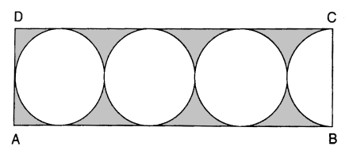
Step 1: Length of rectangle = diameter of 3 circles + diameter of one semi-circle
\[
l = 14 + 14 + 14 + \frac{14}{2} \\
l = 14 + 14 + 14 + 7 = 49 \text{ cm}
\]Breadth of rectangle = BC = 14 cm
Area of rectangle:
\[
Area = l \times b = 49 \times 14 = 686 \text{ cm}^2
\]Step 2: There are 3 identical circles and one semi-circle placed side by side
Area of one circle:
\[
= \pi r^2 = \pi \times 7^2 = 49\pi
\]Area of three and half circles:
\[
= 3.5 \times 49\pi = 171.5\pi
\]Using \(\pi = \frac{22}{7}\):
\[
171.5\pi = 171.5 \times \frac{22}{7} = 539\text{ cm}^2
\]Step 3: Area of shaded portion:
\[
= \text{Area of rectangle} – \text{Area of circles} \\
= 686 – 539 \\
= 147\text{ cm}^2
\]Answer: Area of the shaded portion = 147 cm²
Leave a Comment