

Exercise: 22-C
Q1: Multiple Choice Type:
i. The parallel sides of a trapezium are 12 cm and 10 cm. If the distance between the parallel sides is 10 cm; the area of the trapezium is:
Step 1: Use the formula for area of trapezium:
\[
\text{Area} = \frac{1}{2} \times (a + b) \times h
\]
where \(a = 12\) cm, \(b = 10\) cm, \(h = 10\) cm.
Step 2: Calculate area:
\[
\text{Area} = \frac{1}{2} \times (12 + 10) \times 10 = \frac{1}{2} \times 22 \times 10 = 11 \times 10 = 110 \text{ cm}^2
\]Answer: b. 110 cm²
ii. Two parallel sides of a trapezium are in the ratio 2 : 3 and the distance between them is 12 cm. If the area of the trapezium is 240 cm²; the length of its larger parallel side is:
Step 1: Let the sides be \(2x\) and \(3x\), height \(h = 12\) cm.
Step 2: Use area formula:
\[
\text{Area} = \frac{1}{2} \times (2x + 3x) \times 12 = \frac{1}{2} \times 5x \times 12 = 30x
\]
Given area = 240 cm², so:
\[
30x = 240 \\
\Rightarrow x = \frac{240}{30} = 8
\]Step 3: Length of larger parallel side:
\[
3x = 3 \times 8 = 24 \text{ cm}
\]Answer: c. 24 cm
iii. The adjacent sides of a parallelogram are 12 cm and 9 cm. The distance between longer sides is 6 cm; the distance between shorter sides is:
Step 1: Let sides be \(l = 12\) cm and \(b = 9\) cm.
Height corresponding to longer side \(h_l = 6\) cm.
Step 2: Area of parallelogram:
\[
A = l \times h_l = 12 \times 6 = 72 \text{ cm}^2
\]Step 3: Height corresponding to shorter side \(h_b\) is:
\[
h_b = \frac{A}{b} = \frac{72}{9} = 8 \text{ cm}
\]Answer: c. 8 cm
iv. Each side of a rhombus is 9 cm and the distance between its sides is 6 cm. The area of the rhombus is:
Step 1: Area of rhombus:
\[
A = \text{side} \times \text{distance between sides} = 9 \times 6 = 54 \text{ cm}^2
\]Answer: a. 54 cm²
v. The diagonal of a rhombus is 15 cm and its area is 60 cm²; the other diagonal of the rhombus is:
Step 1: Let the other diagonal be \(d\) cm.
Area of rhombus:
\[
A = \frac{1}{2} \times d_1 \times d_2 = \frac{1}{2} \times 15 \times d = 60
\]Step 2: Solve for \(d\):
\[
\frac{15d}{2} = 60 \\
\Rightarrow 15d = 120 \\
\Rightarrow d = \frac{120}{15} = 8
\]Answer: b. 8 cm
Q2: The following figure shows the cross-section ABCD of a swimming pool which is a trapezium in shape.
If the width DC of the swimming pool is 6.4 m, depth (AD) at the shallow end is 80 cm and depth (BC) at the deepest end is 2.4 m, find its area of cross-section.
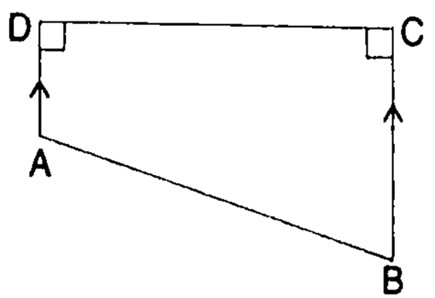
Step 1: Identify the parallel sides of trapezium ABCD:
– \(AD = 80\) cm = 0.8 m (depth at shallow end)
– \(BC = 2.4\) m (depth at deepest end)
– \(DC = 6.4\) m (width of the pool, distance between parallel sides)
Since \(AD\) and \(BC\) are the two parallel sides (depths), and \(DC\) is the distance (height) between them.
Step 2: Use the formula for area of trapezium:
\[
\text{Area} = \frac{1}{2} \times ( \text{sum of parallel sides} ) \times \text{distance between them}
\]
Here, parallel sides are depths \(AD\) and \(BC\), distance between them is width \(DC\). So:
\[
\text{Area} = \frac{1}{2} \times (0.8 + 2.4) \times 6.4
\]Step 3: Calculate:
\[
= \frac{1}{2} \times 3.2 \times 6.4 = 1.6 \times 6.4 = 10.24 \text{ m}^2
\]Answer: Area of the cross-section = 10.24 m²
Q3: The parallel sides of a trapezium are in the ratio 3 : 4. If the distance between the parallel sides is 9 dm and its area is 126 dm², find the lengths of its parallel sides.
Step 1: Let the lengths of the parallel sides be \(3x\) dm and \(4x\) dm.
Distance between the parallel sides (height), \(h = 9\) dm.
Area of trapezium, \(A = 126\) dm².
Step 2: Use the formula for area of trapezium:
\[
A = \frac{1}{2} \times ( \text{sum of parallel sides} ) \times h = \frac{1}{2} \times (3x + 4x) \times 9 = \frac{1}{2} \times 7x \times 9 = \frac{63x}{2}
\]Step 3: Set the area equal to 126 dm² and solve for \(x\):
\[
\frac{63x}{2} = 126 \\
\Rightarrow 63x = 252 \\
\Rightarrow x = \frac{252}{63} = 4
\]Step 4: Calculate the lengths of the parallel sides:
\[
3x = 3 \times 4 = 12 \text{ dm} \\
4x = 4 \times 4 = 16 \text{ dm}
\]Answer: Lengths of parallel sides are 12 dm and 16 dm
Q4: The two parallel sides and the distance between them are in the ratio 3 : 4 : 2. If the area of trapezium is 175 cm², find its height.
Step 1: Let the two parallel sides be \(3x\) cm and \(4x\) cm, and the distance between them (height) be \(2x\) cm.
Area of trapezium \(A = 175\) cm².
Step 2: Use the formula for area of trapezium:
\[
A = \frac{1}{2} \times ( \text{sum of parallel sides} ) \times \text{height} = \frac{1}{2} \times (3x + 4x) \times 2x = \frac{1}{2} \times 7x \times 2x = 7x^2
\]Step 3: Set the area equal to 175 and solve for \(x\):
\[
7x^2 = 175 \\
\Rightarrow x^2 = \frac{175}{7} = 25 \\
\Rightarrow x = \sqrt{25} = 5
\]Step 4: Calculate the height:
\[
\text{Height} = 2x = 2 \times 5 = 10 \text{ cm}
\]Answer: Height = 10 cm
Q5: The adjacent sides of a parallelogram are 21 cm and 28 cm. If its one diagonals is 35 cm, find the area of the parallelogram.
Step 1: The diagonal divides the parallelogram into two congruent triangles.
So first find the area of one triangle having sides:
\[
a = 21 \text{ cm}, \quad b = 28 \text{ cm}, \quad c = 35 \text{ cm}
\]Step 2: Find the semi-perimeter using Heron’s formula.
\[
s = \frac{a+b+c}{2} \\
s = \frac{21+28+35}{2} \\
s = \frac{84}{2} = 42
\]Step 3: Apply Heron’s formula to find the area of the triangle.
\[
\text{Area} = \sqrt{s(s-a)(s-b)(s-c)} \\
= \sqrt{42(42-21)(42-28)(42-35)} \\
= \sqrt{42 \times 21 \times 14 \times 7} \\
= \sqrt{86436} \\
= 294 \text{ cm}^2
\]Step 4: The diagonal divides the parallelogram into two equal triangles.
\[
\text{Area of parallelogram} = 2 \times 294 \\
= 588 \text{ cm}^2
\]Answer: Area of the parallelogram = 588 cm²
Q6: The diagonals of a rhombus are 18 cm and 24 cm. Find:
i. Its area
Step 1: Use the formula for area of rhombus:
\[
\text{Area} = \frac{1}{2} \times d_1 \times d_2
\]
Given \(d_1 = 18\) cm and \(d_2 = 24\) cm.
Step 2: Calculate area:
\[
\text{Area} = \frac{1}{2} \times 18 \times 24 = 9 \times 24 = 216 \text{ cm}^2
\]Answer: 216 cm²
ii. Length of its sides
Step 1: In a rhombus, diagonals bisect each other at right angles.
Half diagonals are:
\[
\frac{d_1}{2} = \frac{18}{2} = 9 \text{ cm}, \quad \frac{d_2}{2} = \frac{24}{2} = 12 \text{ cm}
\]Step 2: Use Pythagoras theorem to find the side length \(s\):
\[
s = \sqrt{\left(\frac{d_1}{2}\right)^2 + \left(\frac{d_2}{2}\right)^2} = \sqrt{9^2 + 12^2} = \sqrt{81 + 144} = \sqrt{225} = 15 \text{ cm}
\]Answer: 15 cm
iii. Its perimeter
Step 1: Perimeter of rhombus:
\[
P = 4 \times s = 4 \times 15 = 60 \text{ cm}
\]Answer: 60 cm
Q7: The perimeter of a rhombus is 40 cm. If one diagonal is 16 cm, find:
i. Its other diagonal
Step 1: Find the length of one side of the rhombus:
\[
\text{Perimeter} = 4 \times \text{side} \\
\Rightarrow 40 = 4s \\
\Rightarrow s = \frac{40}{4} = 10 \text{ cm}
\]Step 2: Let the other diagonal be \(d\) cm.
Diagonals bisect each other at right angles, so half diagonals form a right triangle:
\[
\left(\frac{16}{2}\right)^2 + \left(\frac{d}{2}\right)^2 = s^2 \\
8^2 + \left(\frac{d}{2}\right)^2 = 10^2 \\
\Rightarrow 64 + \frac{d^2}{4} = 100
\]Step 3: Solve for \(d\):
\[
\frac{d^2}{4} = 100 – 64 = 36 \\
\Rightarrow d^2 = 144 \\
\Rightarrow d = \sqrt{144} = 12 \text{ cm}
\]Answer: Other diagonal = 12 cm
ii. Its area
Step 1: Use the formula for area of a rhombus:
\[
\text{Area} = \frac{1}{2} \times d_1 \times d_2 = \frac{1}{2} \times 16 \times 12 = 8 \times 12 = 96 \text{ cm}^2
\]Answer: Area = 96 cm²
Q8: The length of the diagonals of a rhombus is in ratio 4 : 3. If its area is 384 cm², find its side.
Step 1: Let the diagonals be \(4x\) cm and \(3x\) cm.
Area of rhombus \(A = 384\) cm².
Step 2: Use the area formula of a rhombus:
\[
A = \frac{1}{2} \times d_1 \times d_2 = \frac{1}{2} \times 4x \times 3x = 6x^2
\]Step 3: Set the area equal to 384 and solve for \(x\):
\[
6x^2 = 384 \\
\Rightarrow x^2 = \frac{384}{6} = 64 \\
\Rightarrow x = \sqrt{64} = 8
\]Step 4: Calculate the lengths of diagonals:
\[
d_1 = 4x = 4 \times 8 = 32 \text{ cm}, \quad d_2 = 3x = 3 \times 8 = 24 \text{ cm}
\]Step 5: Use the diagonals to find the side length \(s\) of the rhombus.
Diagonals bisect each other at right angles, so half diagonals are:
\[
\frac{d_1}{2} = 16 \text{ cm}, \quad \frac{d_2}{2} = 12 \text{ cm}
\]
Using Pythagoras theorem:
\[
s = \sqrt{\left(\frac{d_1}{2}\right)^2 + \left(\frac{d_2}{2}\right)^2} = \sqrt{16^2 + 12^2} = \sqrt{256 + 144} = \sqrt{400} = 20 \text{ cm}
\]Answer: Side of the rhombus = 20 cm
Q9: A thin metal iron-sheet is a rhombus in shape, with each side 10 m. If one of its diagonals is 16 m, find the cost of painting its both sides at the rate of ₹6 per m².
Also, find the distance between the sides of this rhombus.
i. Cost of painting both sides
Step 1: Let the sides of the rhombus be \(s = 10\) m, and one diagonal \(d_1 = 16\) m.
Let the other diagonal be \(d_2\) m.
Step 2: Using Pythagoras theorem on half diagonals:
\[
\left(\frac{d_1}{2}\right)^2 + \left(\frac{d_2}{2}\right)^2 = s^2 \\
\left(\frac{16}{2}\right)^2 + \left(\frac{d_2}{2}\right)^2 = 10^2 \\
8^2 + \frac{d_2^2}{4} = 100 \\
64 + \frac{d_2^2}{4} = 100 \\
\frac{d_2^2}{4} = 36 \\
\Rightarrow d_2^2 = 144 \\
\Rightarrow d_2 = 12 \text{ m}
\]Step 3: Calculate area of the rhombus:
\[
\text{Area} = \frac{1}{2} \times d_1 \times d_2 = \frac{1}{2} \times 16 \times 12 = 8 \times 12 = 96 \text{ m}^2
\]Step 4: Area of both sides:
\[
2 \times 96 = 192 \text{ m}^2
\]Step 5: Cost of painting both sides at ₹6 per m²:
\[
192 \times 6 = ₹1152
\]Answer: Cost of painting both sides = ₹1152
ii. Distance between the sides
Step 1: Distance between sides (height) of rhombus is:
\[
\text{Height} = \frac{\text{Area}}{\text{side}} = \frac{96}{10} = 9.6 \text{ m}
\]Answer: Distance between the sides = 9.6 m
Q10: The area of a trapezium is 279 sq. cm and the distance between its two parallel sides is 18 cm. If one of its parallel sides is longer than the other side by 5 cm, find the lengths of its parallel sides.
Step 1: Let the shorter parallel side be \(x\) cm.
Then the longer parallel side = \(x + 5\) cm.
Distance between parallel sides (height) = 18 cm.
Area \(A = 279\) cm².
Step 2: Use the area formula of trapezium:
\[
A = \frac{1}{2} \times ( \text{sum of parallel sides} ) \times \text{height} = \frac{1}{2} \times (x + (x + 5)) \times 18
\]
Simplify:
\[
279 = \frac{1}{2} \times (2x + 5) \times 18 = 9 \times (2x + 5) = 18x + 45
\]Step 3: Solve for \(x\):
\[
18x + 45 = 279 \\
\Rightarrow 18x = 279 – 45 = 234 \\
\Rightarrow x = \frac{234}{18} = 13
\]Step 4: Calculate the longer parallel side:
\[
x + 5 = 13 + 5 = 18 \text{ cm}
\]Answer: The lengths of the parallel sides are 13 cm and 18 cm.
Q11: The area of a rhombus is equal to the area of a triangle. If the base of the triangle is 24 cm, its corresponding altitude is 16 cm, and one of the diagonals of the rhombus is 19.2 cm, find its other diagonal.
Base of the triangle \( (b) = 24 \text{ cm} \)
Altitude of the triangle \( (h) = 16 \text{ cm} \)
One diagonal of the rhombus \( (d_1) = 19.2 \text{ cm} \)
Area of Rhombus = Area of Triangle
Step 1: Calculate Area of the Triangle
We know that,
\[
\text{Area of Triangle} = \frac{1}{2} \times \text{base} \times \text{altitude} \\ \text{Area} = \frac{1}{2} \times 24 \times 16 \\
\text{Area} = 12 \times 16 \\
\text{Area} = 192 \text{ cm}^2
\]Step 2: Apply the Area of Rhombus Formula
As per the question:
\[
\text{Area of Rhombus} = \text{Area of Triangle} \\
\text{Area of Rhombus} = 192 \text{ cm}^2
\]The formula for Area of Rhombus is:
\[
\text{Area} = \frac{1}{2} \times d_1 \times d_2 \\
192 = \frac{1}{2} \times 19.2 \times d_2
\]Step 3: Solve for the other diagonal \( (d_2) \)
\[
192 = 9.6 \times d_2 \\
d_2 = \frac{192}{9.6}
\]
Multiply numerator and denominator by 10 to remove decimal:
\[
d_2 = \frac{1920}{96} \\
d_2 = 20 \text{ cm}
\]Answer: The other diagonal of the rhombus is 20 cm.
Q12: Find the area of the trapezium ABCD where \(AB \parallel DC\), \(AB = 18 \text{ cm}\), \(\angle B = \angle C = 90^\circ\), \(CD = 12 \text{ cm}\), and \(AD = 10 \text{ cm}\).
Step 1: Draw a perpendicular from A to DC meeting it at point E.
Since ∠B = 90° and ∠C = 90°, BC is perpendicular to both AB and DC.
Hence BC represents the height of the trapezium.
Step 2: Find the difference of the parallel sides.
\[
AB – DC = 18 – 12 \\
= 6 \text{ cm}
\]This difference forms the base of right triangle \( \triangle ADE \).
Step 3: In right triangle \( \triangle ADE \), apply Pythagoras theorem.
\[
AD^2 = AE^2 + DE^2
\]Here
\[
AD = 10 \text{ cm}, \quad DE = 6 \text{ cm} \\
10^2 = AE^2 + 6^2 \\
100 = AE^2 + 36 \\
AE^2 = 64 \\
AE = 8 \text{ cm}
\]So the height of the trapezium = 8 cm.
Step 4: Use the formula for area of trapezium.
\[
\text{Area} = \frac{1}{2} (AB + DC) \times \text{height} \\
= \frac{1}{2} (18 + 12) \times 8 \\
= \frac{1}{2} \times 30 \times 8 \\
= 15 \times 8 \\
= 120 \text{ cm}^2
\]Answer: The area of the quadrilateral ABCD is 120 cm².
Leave a Comment