

Exercise: 22-A
Q1. Multiple Choice Type
i. Two sides of a triangle are 12 cm and 15 cm. If the height of the triangle corresponding to 12 cm side is 10 cm, find the height corresponding to 15 cm side:
Step 1: Area of a triangle remains same for all bases and corresponding heights.
Step 2: Area using base \(12\) cm:
\[
\text{Area} = \frac{1}{2} \times 12 \times 10 \\
\text{Area} = 60 \text{ cm}^2
\]Step 3: Let the required height corresponding to base \(15\) cm be \(h\).
Step 4: Using area formula:
\[
60 = \frac{1}{2} \times 15 \times h
\]Step 5: Solve for \(h\):
\[
h = \frac{60 \times 2}{15} \\
h = 8 \text{ cm}
\]Answer: c. \(8\) cm
ii. The base of a right-angled triangle is 8 cm and its hypotenuse is 10 cm. Find the area of the triangle:
Step 1: Use Pythagoras theorem to find the height.
\[
\text{Height}^2 = 10^2 – 8^2
\]Step 2: Calculate:
\[
\text{Height}^2 = 100 – 64 = 36 \\
\text{Height} = 6 \text{ cm}
\]Step 3: Area of the triangle:
\[
\text{Area} = \frac{1}{2} \times 8 \times 6 \\
\text{Area} = 24 \text{ cm}^2
\]Answer: d. \(24 \text{ cm}^2\)
iii. The area of a triangle with sides 3 cm, 4 cm and 5 cm is:
Step 1: Write the given sides of the triangle.
\[
a = 4 \text{ cm}, \quad b = 3 \text{ cm}, \quad c = 5 \text{ cm}
\]Step 2: Find the semi-perimeter using Heron’s formula.
\[
s = \frac{a + b + c}{2} \\
s = \frac{4 + 3 + 5}{2} \\
s = \frac{12}{2} = 6 \text{ cm}
\]Step 3: Apply Heron’s formula for area.
\[
\text{Area} = \sqrt{s(s-a)(s-b)(s-c)} \\
= \sqrt{6(6-4)(6-3)(6-5)} \\
= \sqrt{6 \times 2 \times 3 \times 1} \\
= \sqrt{36} \\
= 6 \text{ cm}^2
\]Answer: d. \(6 \text{ cm}^2\)
iv. The altitude of an isosceles triangle is 4 cm and its base is 2 cm more than its height. The area of the triangle is:
Step 1: Height \(= 4\) cm
Base \(= 4 + 2 = 6\) cm
Step 2: Area of triangle:
\[
\text{Area} = \frac{1}{2} \times 6 \times 4 \\
\text{Area} = 12 \text{ cm}^2
\]Answer: b. \(12 \text{ cm}^2\)
v. Area of an equilateral triangle with each side 6 cm is:
Step 1: Formula for area of an equilateral triangle:
\[
\text{Area} = \frac{\sqrt{3}}{4} a^2
\]Step 2: Substitute \(a = 6\) cm:
\[
\text{Area} = \frac{\sqrt{3}}{4} \times 36 \\
\text{Area} = 9\sqrt{3} \text{ cm}^2
\]Answer: b. \(9\sqrt{3} \text{ cm}^2\)
Q2. Find the area of a triangle whose sides are: 10 cm, 24 cm and 26 cm.
Step 1: Write the given sides of the triangle.
\[
a = 10 \text{ cm}, \quad b = 24 \text{ cm}, \quad c = 26 \text{ cm}
\]Step 2: Find the semi-perimeter of the triangle.
\[
s = \frac{a + b + c}{2} \\
s = \frac{10 + 24 + 26}{2} \\
s = \frac{60}{2} = 30 \text{ cm}
\]Step 3: Apply Heron’s Formula to find the area.
\[
\text{Area} = \sqrt{s(s-a)(s-b)(s-c)} \\
= \sqrt{30(30-10)(30-24)(30-26)} \\
= \sqrt{30 \times 20 \times 6 \times 4} \\
= \sqrt{14400} \\
= 120 \text{ cm}^2
\]Answer: \(120 \text{ cm}^2\)
Q3. Two sides of a triangle are 6 cm and 8 cm. If the height of the triangle corresponding to 6 cm side is 4 cm, find:
i. Area of the triangle
Step 1: Formula for area of a triangle:
\[
\text{Area} = \frac{1}{2} \times \text{base} \times \text{height}
\]Step 2: Substitute the given values:
\[
\text{Base} = 6 \text{ cm}, \quad \text{Height} = 4 \text{ cm}
\]Step 3: Calculate the area:
\[
\text{Area} = \frac{1}{2} \times 6 \times 4 \\
\text{Area} = 12 \text{ cm}^2
\]Answer: Area of the triangle = \(12 \text{ cm}^2\)
ii. Height of the triangle corresponding to 8 cm side
Step 1: Area of a triangle remains same for all bases and corresponding heights.
Step 2: Let the required height corresponding to base 8 cm be \(h\).
Step 3: Using the area formula:
\[
\text{Area} = \frac{1}{2} \times \text{base} \times \text{height}
\]Step 4: Substitute known values:
\[
12 = \frac{1}{2} \times 8 \times h
\]Step 5: Solve for \(h\):
\[
h = \frac{12 \times 2}{8} \\
h = 3 \text{ cm}
\]Answer: Height corresponding to 8 cm side = \(3 \text{ cm}\)
Q4. The sides of a triangle are 16 cm, 12 cm and 20 cm. Find:
Step 1: Write the given sides of the triangle. \[ a = 16 \text{ cm}, \quad b = 12 \text{ cm}, \quad c = 20 \text{ cm} \]Step 2: Find the semi-perimeter of the triangle. \[ s = \frac{a+b+c}{2} \\ s = \frac{16+12+20}{2} \\ s = \frac{48}{2} = 24 \text{ cm} \]
i. area of the triangle
Step 3: Apply Heron’s Formula.
\[
\text{Area} = \sqrt{s(s-a)(s-b)(s-c)} \\
= \sqrt{24(24-16)(24-12)(24-20)} \\
= \sqrt{24 \times 8 \times 12 \times 4} \\
= \sqrt{9216} \\
= 96 \text{ cm}^2
\]Answer:Area of the triangle = 96 cm²
ii. height of triangle corresponding to the largest side
Step 4: The largest side is 20 cm.
Area of triangle formula:
\[
\text{Area} = \frac{1}{2} \times \text{base} \times \text{height} \\
96 = \frac{1}{2} \times 20 \times h \\
96 = 10h \\
h = \frac{96}{10} = 9.6 \text{ cm}
\]Answer:Height corresponding to the largest side = 9.6 cm
iii. height of the triangle corresponding to the smallest side.
Step 5: The smallest side is 12 cm.
\[
\text{Area} = \frac{1}{2} \times 12 \times h \\
96 = 6h \\
h = \frac{96}{6} \\
h = 16 \text{ cm}
\]Answer:Height corresponding to the smallest side = 16 cm
Q5. The base and the height of a triangle are in the ratio 4 : 5. If the area of the triangle is 40 m², find its base and height.
Step 1: Let the base and height of the triangle be in the given ratio.
Let base \(= 4x\) m and height \(= 5x\) m
Step 2: Write the formula for area of a triangle.
\[
\text{Area} = \frac{1}{2} \times \text{base} \times \text{height}
\]Step 3: Substitute the given values.
\[
40 = \frac{1}{2} \times 4x \times 5x
\]Step 4: Simplify the equation.
\[
40 = 10x^2
\]Step 5: Solve for \(x\).
\[
x^2 = 4 \\
x = 2 \quad (\text{taking positive value})
\]Step 6: Find base and height.
Base \(= 4x = 4 \times 2 = 8\) m
Height \(= 5x = 5 \times 2 = 10\) m
Answer: Base = \(8\) m and Height = \(10\) m
Q6. The base and the height of a triangle are in the ratio 5 : 3. If the area of the triangle is 67.5 m², find its base and height.
Step 1: Let the base and height of the triangle be in the given ratio.
Let base \(= 5x\) m and height \(= 3x\) m
Step 2: Write the formula for area of a triangle.
\[
\text{Area} = \frac{1}{2} \times \text{base} \times \text{height}
\]Step 3: Substitute the given values.
\[
67.5 = \frac{1}{2} \times 5x \times 3x
\]Step 4: Simplify the equation.
\[
67.5 = \frac{15}{2} x^2
\]Step 5: Solve for \(x\).
\[
x^2 = \frac{67.5 \times 2}{15} \\
x^2 = 9 \\
x = 3 \quad (\text{taking positive value})
\]Step 6: Find base and height.
Base \(= 5x = 5 \times 3 = 15\) m
Height \(= 3x = 3 \times 3 = 9\) m
Answer: Base = \(15\) m and Height = \(9\) m
Q7. The area of an equilateral triangle is \(144\sqrt{3}\) cm²; find its perimeter.
Step 1: Write the formula for the area of an equilateral triangle.
\[
\text{Area} = \frac{\sqrt{3}}{4} a^2
\]Step 2: Substitute the given area value.
\[
144\sqrt{3} = \frac{\sqrt{3}}{4} a^2
\]Step 3: Multiply both sides by \(4\) to simplify.
\[
576\sqrt{3} = \sqrt{3}\, a^2
\]Step 4: Divide both sides by \(\sqrt{3}\).
\[
a^2 = 576
\]Step 5: Take square root of both sides.
\[
a = 24 \text{ cm}
\]Step 6: Write the formula for perimeter of an equilateral triangle.
\[
\text{Perimeter} = 3a
\]Step 7: Substitute the value of \(a\).
\[
\text{Perimeter} = 3 \times 24 = 72 \text{ cm}
\]Answer: Perimeter of the equilateral triangle = \(72\) cm
Q8. The area of an equilateral triangle is numerically equal to its perimeter. Find its perimeter correct to 2 decimal places.
Step 1: Let the side of the equilateral triangle be \(a\) cm.
Step 2: Write the formulae for area and perimeter of an equilateral triangle.
\[
\text{Area} = \frac{\sqrt{3}}{4} a^2 \\
\text{Perimeter} = 3a
\]Step 3: Given that area is numerically equal to perimeter.
\[
\frac{\sqrt{3}}{4} a^2 = 3a
\]Step 4: Simplify the equation by dividing both sides by \(a\) \((a \neq 0)\).
\[
\frac{\sqrt{3}}{4} a = 3
\]Step 5: Solve for \(a\).
\[
a = \frac{12}{\sqrt{3}} \\
a = 4\sqrt{3}
\]Step 6: Find the perimeter of the triangle.
\[
\text{Perimeter} = 3a = 3 \times 4\sqrt{3} = 12\sqrt{3}
\]Step 7: Convert into decimal form.
\[
\sqrt{3} \approx 1.732 \\
\text{Perimeter} = 12 \times 1.732 = 20.784
\]Step 8: Correct to two decimal places.
\[
\text{Perimeter} \approx 20.78 \text{ cm}
\]Answer: Perimeter of the equilateral triangle = \(20.78\) cm (correct to 2 decimal places)
Q9. A field is in the shape of a quadrilateral ABCD in which AB = 18 m, side AD = 24 m, side BC = 40 m, DC = 50 m and angle A = 90°. Find the area of the field.
Step 1: Draw diagonal \(BD\) to divide the quadrilateral into two triangles \( \triangle ABD \) and \( \triangle BCD \).
Step 2: In \( \triangle ABD \), angle \(A = 90^\circ\), so it is a right-angled triangle.
Step 3: Find the length of diagonal \(BD\) using Pythagoras theorem.
\[
BD^2 = AB^2 + AD^2 \\
BD^2 = 18^2 + 24^2 = 324 + 576 = 900 \\
BD = 30 \text{ m}
\]Step 4: Find the area of \( \triangle ABD \).
\[
\text{Area of } \triangle ABD = \frac{1}{2} \times 18 \times 24 \\
\text{Area of } \triangle ABD = 216 \text{ m}^2
\]Step 5: Now consider \( \triangle BCD \) with sides \(40\) m, \(50\) m and \(30\) m.
Step 6: Find the semi-perimeter using Heron’s formula.
\[
s = \frac{40 + 50 + 30}{2} = 60
\]Step 7: Apply Heron’s formula to find the area of \( \triangle BCD \).
\[
\text{Area} = \sqrt{s(s-a)(s-b)(s-c)} \\
\text{Area} = \sqrt{60(60-40)(60-50)(60-30)} \\
\text{Area} = \sqrt{60 \times 20 \times 10 \times 30} \\
\text{Area} = \sqrt{360000} = 600 \text{ m}^2
\]Step 8: Find the total area of the field.
\[
\text{Total Area} = 216 + 600 = 816 \text{ m}^2
\]Answer: Area of the field = \(816 \text{ m}^2\)
Q10. The lengths of the sides of a triangle are in the ratio 4 : 5 : 3 and its perimeter is 96 cm. Find its area.
Step 1: Let the sides of the triangle be in the given ratio.
Let sides \(= 4x,\; 5x,\; 3x\) cm
Step 2: Write the expression for perimeter.
\[
4x + 5x + 3x = 12x
\]Step 3: Given perimeter \(= 96\) cm.
\[
12x = 96 \\
x = 8
\]Step 4: Find the actual lengths of the sides.
\[
4x = 32 \text{ cm}, \quad 5x = 40 \text{ cm}, \quad 3x = 24 \text{ cm}
\]Step 5: Find the semi-perimeter using Heron’s formula.
\[
s = \frac{32 + 40 + 24}{2} = \frac{96}{2} = 48
\]Step 6: Apply Heron’s formula for area of a triangle.
\[
\text{Area} = \sqrt{s(s-a)(s-b)(s-c)}
\]Step 7: Substitute the values.
\[
\text{Area} = \sqrt{48(48-32)(48-40)(48-24)} \\
\text{Area} = \sqrt{48 \times 16 \times 8 \times 24}
\]Step 8: Simplify.
\[
\text{Area} = \sqrt{147456} = 384 \text{ cm}^2
\]Answer: Area of the triangle = \(384 \text{ cm}^2\)
Q11. One of the equal sides of an isosceles triangle is 13 cm and its perimeter is 50 cm. Find the area of the triangle.
Step 1: Let the equal sides of the isosceles triangle be \(13\) cm each.
Step 2: Find the base using the given perimeter.
\[
\text{Perimeter} = 50 \text{ cm} \\
\text{Base} = 50 – (13 + 13) = 24 \text{ cm}
\]Step 3: Draw a perpendicular from the vertex opposite the base.
This perpendicular bisects the base into two equal parts.
Step 4: Length of each half of the base:
\[
\frac{24}{2} = 12 \text{ cm}
\]Step 5: Use Pythagoras theorem to find the height \(h\).
\[
h^2 = 13^2 – 12^2 \\
h^2 = 169 – 144 = 25 \\
h = 5 \text{ cm}
\]Step 6: Find the area of the triangle.
\[
\text{Area} = \frac{1}{2} \times \text{base} \times \text{height} \\
\text{Area} = \frac{1}{2} \times 24 \times 5 \\
\text{Area} = 60 \text{ cm}^2
\]Answer: Area of the isosceles triangle = \(60 \text{ cm}^2\)
Q12. The altitude and the base of a triangular field are in the ratio 6 : 5. If its cost is ₹49,57,200 at the rate of ₹36,720 per hectare and 1 hectare = 10,000 sq. m, find (in metre) the dimensions of the field.
Step 1: Find the area of the field in hectares using cost and rate.
\[
\text{Area (in hectares)} = \frac{49,57,200}{36,720} \\
\text{Area} = 135 \text{ hectares}
\]Step 2: Convert area into square metres.
\[
1 \text{ hectare} = 10,000 \text{ m}^2 \\
\text{Area} = 135 \times 10,000 = 13,50,000 \text{ m}^2
\]Step 3: Let the altitude and base be in the given ratio.
Altitude \(= 6x\) m
Base \(= 5x\) m
Step 4: Write the formula for area of a triangle.
\[
\text{Area} = \frac{1}{2} \times \text{base} \times \text{altitude}
\]Step 5: Substitute the values.
\[
13,50,000 = \frac{1}{2} \times 5x \times 6x \\
13,50,000 = 15x^2
\]Step 6: Solve for \(x\).
\[
x^2 = 90,000 \\
x = 300
\]Step 7: Find the dimensions of the field.
Base \(= 5x = 5 \times 300 = 1500\) m
Altitude \(= 6x = 6 \times 300 = 1800\) m
Answer: Base = \(1500\) m and Altitude = \(1800\) m
Q13: Find the area of right-angled triangle with hypotenuse 40 cm and one of the other two sides 24 cm.
Step 1: Identify the sides:
Hypotenuse \(c = 40\) cm, one side \(a = 24\) cm, let the other side be \(b\).
Step 2: Use Pythagoras theorem to find \(b\):
\[
b = \sqrt{c^2 – a^2} = \sqrt{40^2 – 24^2} = \sqrt{1600 – 576} = \sqrt{1024} = 32
\]Step 3: Calculate area of right-angled triangle:
\[
\text{Area} = \frac{1}{2} \times a \times b = \frac{1}{2} \times 24 \times 32 = 384
\]Answer: 384 cm²
Q14: Use the information given in the figure to find:
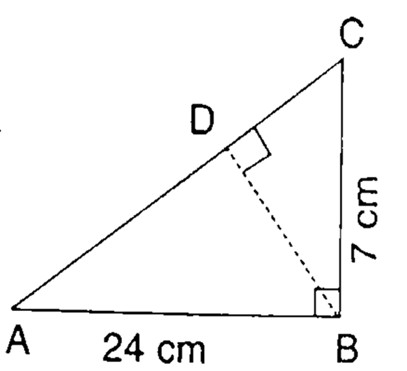
i. the length of AC
Step 1:
From the figure, ΔABC is right-angled at B.
Given:
\[
AB = 24\text{ cm}, \quad BC = 7\text{ cm}
\]Step 2:
By Pythagoras theorem:
\[
AC^2 = AB^2 + BC^2
\]\[
AC^2 = 24^2 + 7^2 \\
= 576 + 49 \\
= 625
\]\[
AC = \sqrt{625} = 25\text{ cm}
\]Answer: AC = 25 cm
ii. the area of ΔABC
Step 1:
Area of a right-angled triangle:
\[
= \frac{1}{2} \times \text{base} \times \text{height}
\]Here,
Base = AB = 24 cm
Height = BC = 7 cm
\[
\text{Area} = \frac{1}{2} \times 24 \times 7 \\
= 84\text{ cm}^2
\]Answer: Area of ΔABC = 84 cm²
iii. the length of BD, correct to one decimal place.
Step 1:
BD is perpendicular to AC.
So, BD is the altitude from the right angle to the hypotenuse.
Formula:
\[
Area = \frac{1}{2} \times Base \times Height
\]Step 2:
Substitute the values:
\[
84 = \frac{1}{2} \times AC \times BD \\
84 = \frac{1}{2} \times 25 \times BD \\
168 = 25 \times BD \\
BD = \frac{168}{25} = 6.72 \text{ cm}
\]Answer: BD = 6.7 cm
Leave a Comment