

Case Study based Questions
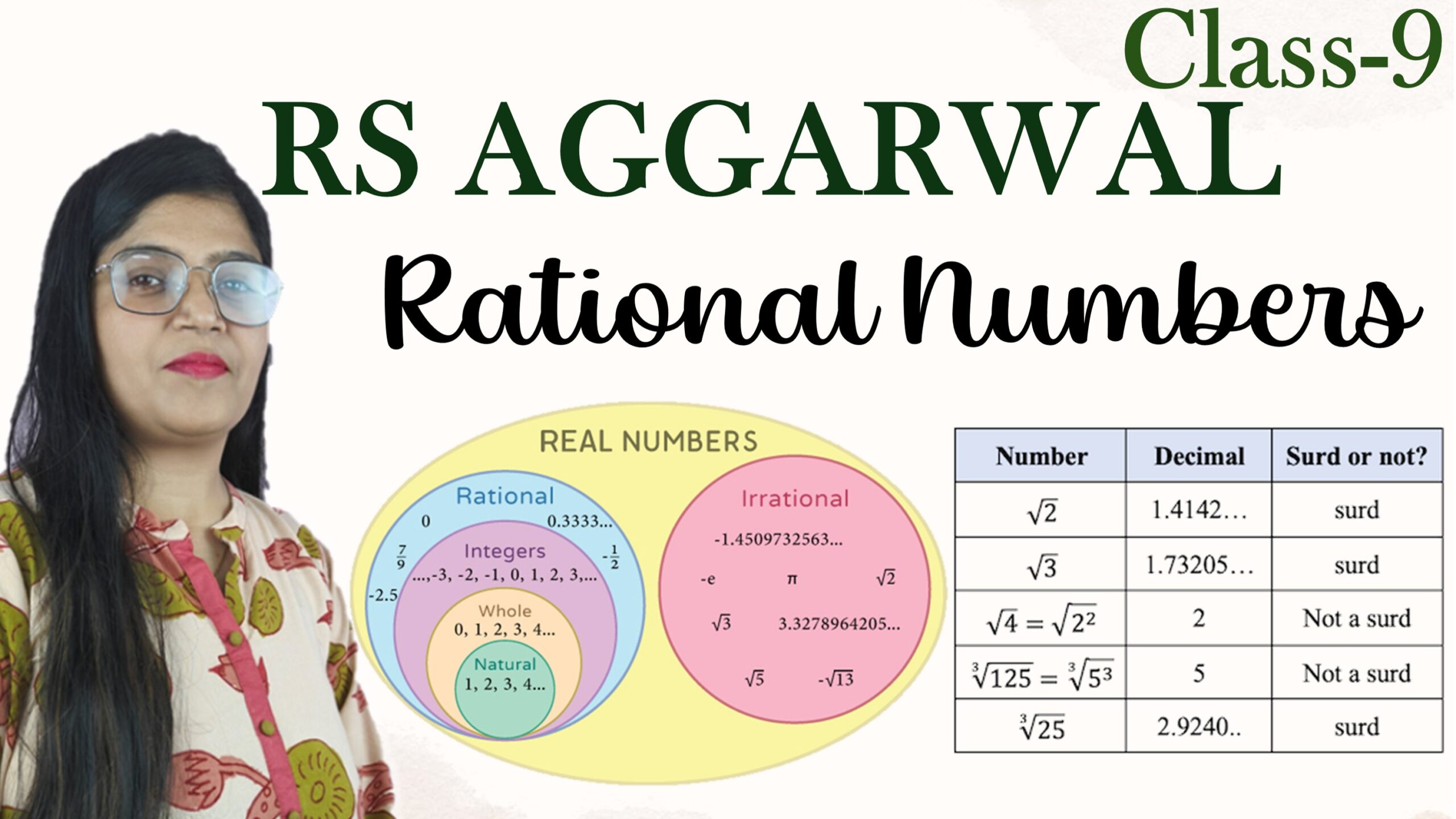
Case Study 1: The union of the set of rational numbers (Q) and irrational numbers (P) form the set of real numbers (R), Rational numbers are the set of numbers which can be written in the form \(\frac{a}{b}\), where a and b are integers and b ≠ 0. The decimal expansion of a rational number is either terminating or non-terminating repeating. The number which cannot be expressed in the form \(\frac{a}{b}\) are called irrational numbers. The decimal expansion of irrational numbers is non- terminating non-repeating.
Based on the above information, answer the following questions:
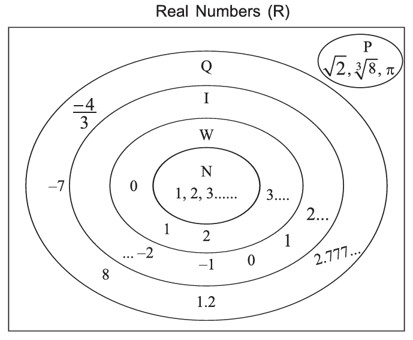
Q1: Every rational number is:
Step 1: Rational numbers (\(Q\)) include integers, fractions, and decimals.
Step 2: All these numbers are part of the larger set of Real Numbers (\(R\)).
Answer: d. a real number
Q2: Every real number is:
Step 1: By definition, Real numbers are formed by combining all rational and irrational numbers.
Step 2: Therefore, any point on the real line must be one of these two types.
Answer: d. either a rational number or an irrational number.
Q3: The sum of two irrationals is:
Step 1: Consider \(\sqrt{3} + \sqrt{3} = 2\sqrt{3}\) (Irrational).
Step 2: Consider \(\sqrt{3} + (-\sqrt{3}) = 0\) (Rational).
Step 3: Since the result can be either, we cannot fix one type.
Answer: c. either rational or irrational
Q4: The product of a rational and an irrational number is:
Step 1: If the rational number is non-zero (e.g., 2), \(2 \times \sqrt{3} = 2\sqrt{3}\) (Irrational).
Step 2: If the rational number is zero, \(0 \times \sqrt{3} = 0\) (Rational).
Answer: c. either a rational number or an irrational number
Q5: The number of irrational numbers is:
Step 1: Between any two numbers, there are countless irrational values.
Step 2: There is no end to the set of irrational numbers.
Answer: b. infinite
Case Study II: Ms Mehta teaches maths in a school. One day after teaching the lesson of number system, she wanted to check the understanding of the students of her class. So, she wrote two numbers, \(\frac{3}{11}\) and \(0.\overline{52}\) on the blackboard and asked few questions based on them. You please try to answer the following questions asked by Ms Mehta.
Q1: The decimal expansion of \(\frac{3}{11}\) is:
Step 1: Examine the denominator of the fraction \(\frac{3}{11}\).
Step 2: The denominator is 11, which is not in the form of \(2^n \times 5^m\).
Step 3: Therefore, the decimal expansion must be non-terminating and repeating.
Answer: d. non-terminating repeating
Q2: \(0.\overline{52}\) is:
Step 1: The bar over ’52’ indicates that these digits repeat infinitely.
Step 2: Any number with a bar is a non-terminating repeating decimal.
Answer: b. non-terminating repeating
Q3: The decimal form of \(\frac{3}{11}\) is:
Step 1: Divide 3 by 11 using long division.
Step 2: 3 ÷ 11 = 0.272727…
Step 3: Represent the repeating block ’27’ with a bar.
Answer: c. \(0.\overline{27}\)
Q4: \(0.\overline{52}\) as a vulgar fraction becomes:
Step 1: Let \(x = 0.5252…\)
Step 2: Multiply by 100: \(100x = 52.5252…\)
Step 3: Subtracting gives \(99x = 52\), which means \(x = \frac{52}{99}\).
Answer: a. \(\frac{52}{99}\)
Q5: The sum of \(0.\overline{52}\) and \(\frac{3}{11}\) is:
Step 1: From Q3 and Q4, we have the fractions \(\frac{52}{99}\) and \(\frac{3}{11}\).
Step 2: Convert \(\frac{3}{11}\) to have a denominator of 99: \(\frac{3 \times 9}{11 \times 9} = \frac{27}{99}\).
Step 3: Add the fractions: \(\frac{52}{99} + \frac{27}{99} = \frac{79}{99}\).
Answer: a. \(\frac{79}{99}\)
Leave a Comment