

Case-Study Based Question
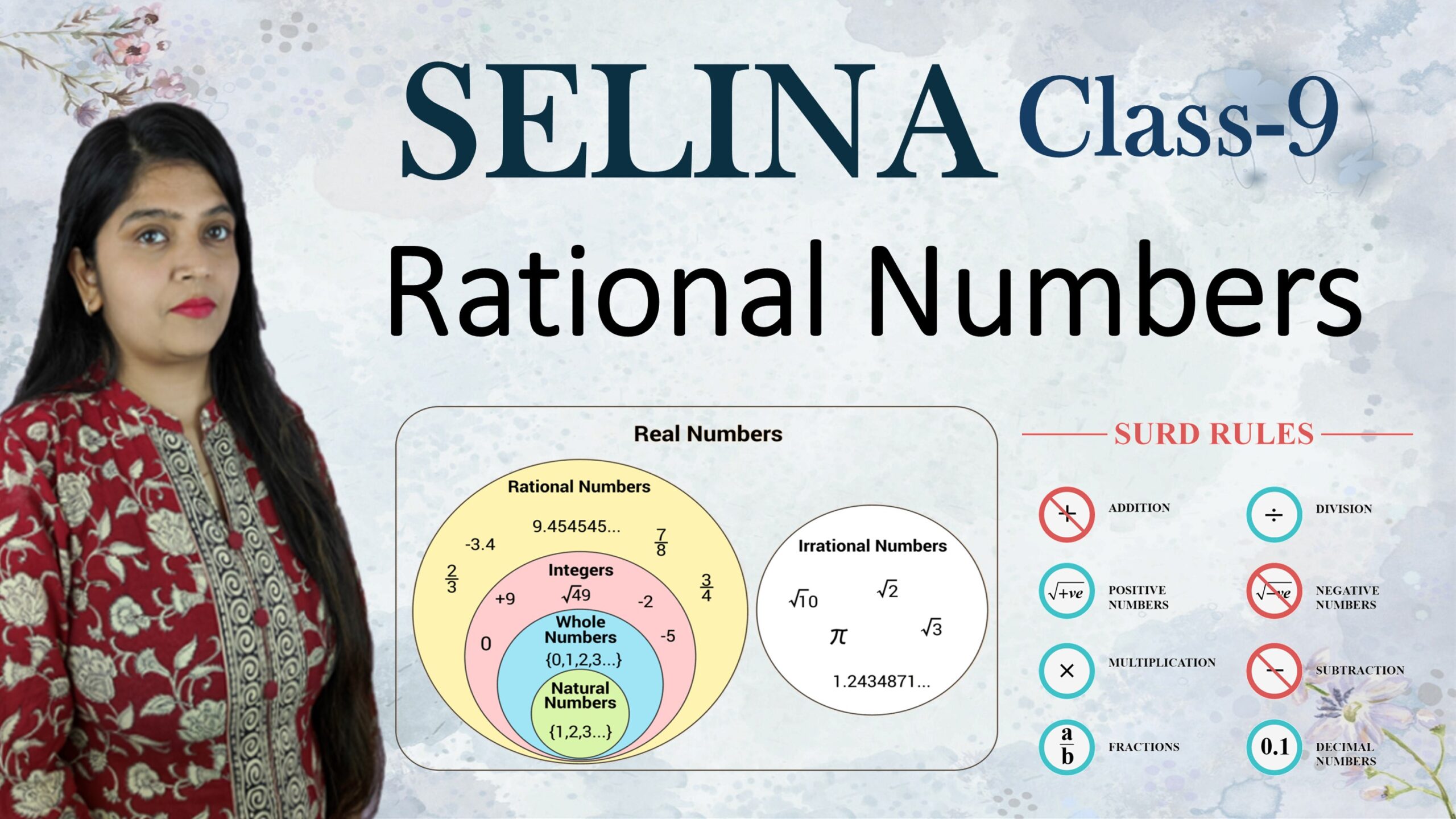
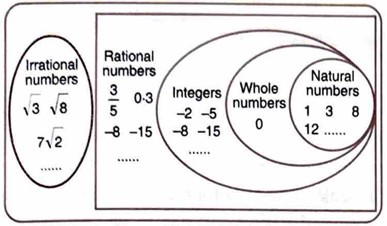
i. Real numbers are numbers which include both rational and irrational numbers.
ii. Every rational number can be expressed as \(\frac{p}{q}\), where p and q are integers and q ≠ 0.
iii. Irrational numbers cannot be expressed as \(\frac{p}{q}\), where p and q are integers and q ≠ 0.
a. Is the difference between a rational number and an irrational number always rational?
Step 1: Let us take a rational number, say \( 5 \), and an irrational number, say \( \sqrt{2} \).
Step 2: The difference is represented as \( 5 – \sqrt{2} \).
Step 3: Since \( \sqrt{2} \) has a non-terminating and non-repeating decimal expansion, subtracting it from a rational number will also result in a non-terminating, non-repeating decimal.
Step 4: Therefore, the difference between a rational and an irrational number is always irrational, not rational.
Answer: No, it is always irrational.
b. Is \( 0.5555\dots \) a rational number?
Step 1: Observe the decimal expansion \( 0.5555\dots \). Here, the digit 5 is repeating infinitely.
Step 2: Any decimal that is non-terminating but “repeating” (recurring) can always be expressed in the form \( \frac{p}{q} \).
Step 3: Let \( x = 0.5555\dots \). Then \( 10x = 5.5555\dots \). Subtracting gives \( 9x = 5 \), so \( x = \frac{5}{9} \).
Step 4: Since it can be written as a fraction, it is a rational number.
Answer: Yes, it is a rational number.
c. Is \( 0.505005\dots \) a rational number?
Step 1: Look at the pattern of the digits: 50, then 500, then 5000, and so on.
Step 2: Although there is a visible pattern, the same block of digits does not repeat periodically. This is a “non-terminating and non-repeating” decimal.
Step 3: By definition, numbers that are non-terminating and non-repeating are irrational numbers.
Answer: No, it is an irrational number.
d. Is the product of irrational number \( (3-\sqrt{7}) \) and its rationalising factor a rational number?
Step 1: Identify the rationalising factor of \( (3-\sqrt{7}) \). The factor is \( (3+\sqrt{7}) \).
Step 2: Find the product: \( (3-\sqrt{7}) \times (3+\sqrt{7}) \).
Step 3: Use the algebraic identity \( (a-b)(a+b) = a^2 – b^2 \).
Step 4: Calculate: \( 3^2 – (\sqrt{7})^2 = 9 – 7 = 2 \).
Step 5: Since 2 is an integer, it is a rational number.
Answer: Yes, the product is a rational number (2).
Q2: According to Taruner Swapna Scheme of West Bengal Government, backward/economically disadvantaged students of West Bengal can receive financial aid and devices like Smartphones/Tablets for digital learning, bridging the digital gap and supporting online studies.
Rohan who resides in Purulia district of West Bengal received a tablet and he decided to complete his education through e-learning. One day he was studying number system, where he learnt about rational and irrational numbers, etc. He was particularly interested in irrational numbers like \(7+4\sqrt3\).
Based on the above information, answer the following:

i. What is the rationalising factor of \( 7+4\sqrt{3} \)?
Step 1: Identify the given irrational number, which is in the form \( a + b\sqrt{c} \). Here, \( a = 7 \) and \( b\sqrt{c} = 4\sqrt{3} \).
Step 2: To rationalise an expression of the form \( a + \sqrt{b} \), we multiply it by its conjugate, which is \( a – \sqrt{b} \).
Step 3: By changing the sign between the two terms, we get \( 7 – 4\sqrt{3} \).
Step 4: Check by multiplying: \( (7+4\sqrt{3})(7-4\sqrt{3}) = 7^2 – (4\sqrt{3})^2 = 49 – 48 = 1 \). Since 1 is a rational number, our factor is correct.
Answer: The rationalising factor is \( 7-4\sqrt{3} \).
ii. What is the reciprocal of \( 7+4\sqrt{3} \)? Are rationalising factor and reciprocal same?
Step 1: The reciprocal of any number \( x \) is \( \frac{1}{x} \). So, the reciprocal is \( \frac{1}{7+4\sqrt{3}} \).
Step 2: Rationalise the reciprocal by multiplying the numerator and denominator by the conjugate \( 7-4\sqrt{3} \):
\( \frac{1}{7+4\sqrt{3}} \times \frac{7-4\sqrt{3}}{7-4\sqrt{3}} = \frac{7-4\sqrt{3}}{49-48} = 7-4\sqrt{3} \).
Step 3: Compare the results. The rationalising factor found in part (i) was \( 7-4\sqrt{3} \), and the simplified reciprocal is also \( 7-4\sqrt{3} \).
Answer: The reciprocal is \( 7-4\sqrt{3} \). Yes, in this case, the rationalising factor and the reciprocal are the same.
iii. If \( x=7+4\sqrt{3} \), then find the value of \( \left(x+\frac{1}{x}\right) \).
Step 1: We are given \( x = 7+4\sqrt{3} \).
Step 2: From the previous part, we know the reciprocal \( \frac{1}{x} = \frac{1}{7+4\sqrt{3}} \), which simplifies to \( 7-4\sqrt{3} \).
Step 3: Now, add \( x \) and \( \frac{1}{x} \):
\( (7+4\sqrt{3}) + (7-4\sqrt{3}) \).
Step 4: The irrational terms \( +4\sqrt{3} \) and \( -4\sqrt{3} \) cancel each other out.
Step 5: The remaining rational parts are \( 7 + 7 = 14 \).
Answer: The value of \( x+\frac{1}{x} \) is 14.
Leave a Comment