

Competency Focused Questions
Q1: An election has 6 candidates. The probability that a voter will vote for candidate number 3 is \(\frac{1}{6}\). The statement is:
Step 1: Total number of candidates \( n = 6 \).
Step 2: Assuming that the voter is equally likely to vote for any candidate, the probability of voting for any one candidate is:
\[
P(\text{candidate 3}) = \frac{1}{6}
\]Step 3: Therefore, the given statement is correct.
Answer: a. True
Q2: The probability of getting an odd number on spinning the wheel is \(\frac{1}{2}\) and that of a prime number is \(\frac{2}{3}\). The missing number on the wheel could be:
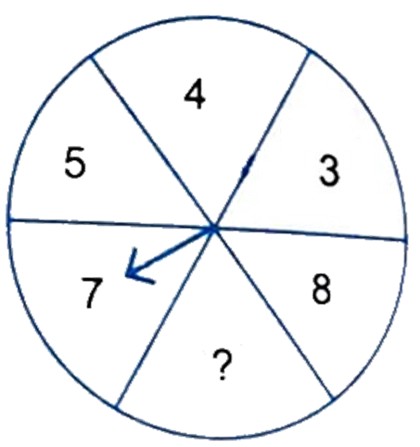
Step 1: Identify the total number of outcomes and given numbers.
The numbers visible in the relevant sections are 4, 3, 8, ?, 7, 5.
There are \(6\) relevant sections in total.
Total possible outcomes \(n(S) = 6\).
Step 2: Use the probability of getting an odd number to constrain the missing number.
The probability of getting an odd number is \(\frac{1}{2}\).
\(P(\text{Odd}) = \frac{\text{Number of odd numbers}}{n(S)} = \frac{1}{2}\)
\(\frac{\text{Number of odd numbers}}{6} = \frac{1}{2}\)
Number of odd numbers = \(\frac{1}{2} \times 6 = 3\).
The known odd numbers on the wheel are 3, 7, and 5 (3 total).
This means the missing number must be an **even** number.
Step 3: Use the probability of getting a prime number to find the exact number.
The probability of getting a prime number is \(\frac{2}{3}\).
\(P(\text{Prime}) = \frac{\text{Number of prime numbers}}{n(S)} = \frac{2}{3}\)
\(\frac{\text{Number of prime numbers}}{6} = \frac{2}{3}\)
Number of prime numbers = \(\frac{2}{3} \times 6 = 4\).
The known prime numbers on the wheel are 3, 7, and 5 (3 total).
This means the missing number must be a **prime** number.
Step 4: Determine the number that satisfies both conditions.
The missing number must be both **even** and **prime**.
From the options (1, 4, 9, 2), only 2 is both even and prime.
Answer: d. 2
Q3: Which of the following cannot be the probability of an event?
Step 1: Recall that the probability of any event \( P(E) \) must satisfy:
\[
0 \leq P(E) \leq 1
\]
That means probability cannot be less than 0 or greater than 1.
Step 2: Evaluate each option:
a. \(5\%\) = 0.05 which lies between 0 and 1 → Possible probability.
b. 0.5 which lies between 0 and 1 → Possible probability.
c. \(\frac{1}{0.5} = 2\) which is greater than 1 → Not possible probability.
d. \(\frac{1}{5} = 0.2\) which lies between 0 and 1 → Possible probability.
Answer: c. \(\frac{1}{0.5}\) cannot be the probability of an event.
Q4: A bag contains some red and some green balls. The probability of drawing a red ball from the bag is 0.4. The bag may contain:
Step 1: Probability of drawing a red ball \( P(\text{red}) = 0.4 = \frac{2}{5} \).
Step 2: Let number of red balls = \( r \) and number of green balls = \( g \). Total balls = \( r + g \).
Step 3: Using the probability formula:
\[
P(\text{red}) = \frac{r}{r + g} = \frac{2}{5}
\]
Cross-multiplied:
\[
5r = 2(r + g) \\
\rightarrow 5r = 2r + 2g \\
\rightarrow 3r = 2g \\
\rightarrow \frac{r}{g} = \frac{2}{3}
\]Step 4: So, the ratio of red balls to green balls is \( 2 : 3 \).
Step 5: Check given options:
– (a) 4 red and 6 green balls → ratio \( \frac{4}{6} = \frac{2}{3} \) → valid.
– (b) 6 red and 9 green balls → ratio \( \frac{6}{9} = \frac{2}{3} \) → valid.
Step 6: Both options satisfy the condition.
Answer: c. both (a) and (b)
Q5: Look at the following experiment “Taking 1 crayon from a box containing 1 red, 1 yellow, 1 blue, 1 brown, 1 black and 1 green crayon.” How many possible outcomes are there the alme experiment?
Step 1: Count the total crayons in the box.
\[
\text{Number of crayons} = 6 \quad (\text{red, yellow, blue, brown, black, green})
\]Step 2: Each crayon is a possible outcome when one is chosen.
Step 3: Therefore, total number of possible outcomes \( n(S) = 6 \).
Answer: b. 6
Q6: If you bought 10 lottery tickets and a total of 400 were sold, what is the probability, that you win the first prize?
Step 1: Identify the total number of possible outcomes.
A total of \(400\) lottery tickets were sold.
Total possible outcomes \(n(S) = 400\).
Step 2: Count the number of favorable outcomes.
You bought \(10\) tickets, each of which could potentially win the first prize.
Number of favorable outcomes \(n(E) = 10\).
Step 3: Calculate the probability.
Probability \(P(\text{Win}) = \frac{\text{Number of favorable outcomes}}{\text{Total number of possible outcomes}}\)
\(P(\text{Win}) = \frac{10}{400}\)
This simplifies to \(\frac{1}{40}\).
Step 4: Determine the correct option.
The calculated probability is \(\frac{10}{400}\). Option (c) is the correct answer.
Answer: c. \(\frac{10}{400}\)
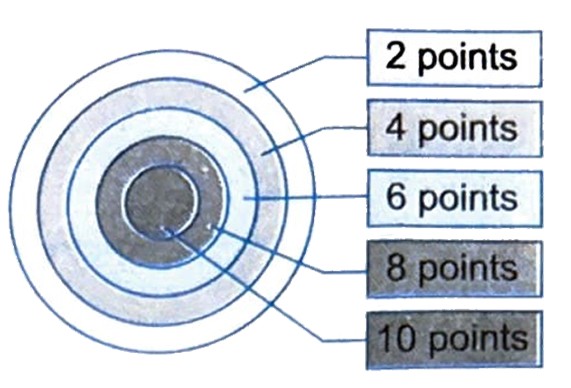
Q7: In an archery game, the points awarded for hitting a circular region on the board is shown in the figure below. No point is given when an arrow misses the board. What is the probability of getting 6 points in a single shot?
Step 1: Identify the total number of distinct scoring regions.
The circular board is divided into \(5\) distinct circular regions that award points (2, 4, 6, 8, and 10 points).
Assuming the arrow hits one of these regions (and doesn’t miss the entire board), the total number of possible outcomes is \(n(S) = 5\).
Step 2: Count the number of favorable outcomes.
The event is getting \(6\) points.
There is only one region that awards exactly \(6\) points.
Number of favorable outcomes \(n(E) = 1\).
Step 3: Calculate the probability.
Probability \(P(\text{6 points}) = \frac{\text{Number of favorable outcomes}}{\text{Total number of possible outcomes}}\)
\(P(\text{6 points}) = \frac{1}{5}\)
Step 4: Determine the correct option.
The calculated probability is \(\frac{1}{5}\). Option (a) is the correct answer.
Answer: a. \(\frac{1}{5}\)
Leave a Comment