

Competency Focused Questions
Q1: The sum of length, breadth and depth of a cuboid is 19 cm and its diagonal is \(5\sqrt{5}\) cm. Surface area of the cuboid is:
Step 1: Let length = \(l\), breadth = \(b\), and depth (height) = \(h\). Given:
\[
l + b + h = 19 \quad \text{cm}
\]
Diagonal \(d = 5\sqrt{5} \, cm\)
Step 2: Use the formula for diagonal of cuboid:
\[
d^2 = l^2 + b^2 + h^2
\]
Calculate \(d^2\):
\[
d^2 = (5\sqrt{5})^2 = 25 \times 5 = 125
\]
So,
\[
l^2 + b^2 + h^2 = 125
\]Step 3: Use identity:
\[
(l + b + h)^2 = l^2 + b^2 + h^2 + 2(lb + bh + hl)
\]
Substitute values:
\[
19^2 = 125 + 2(lb + bh + hl) \\
361 = 125 + 2(lb + bh + hl) \\
2(lb + bh + hl) = 361 – 125 = 236 \\
lb + bh + hl = \frac{236}{2} = 118
\]Step 4: Surface area \(S\) of cuboid:
\[
S = 2(lb + bh + hl) = 2 \times 118 = 236 \, cm^2
\]Answer: b. 236 cm²
Q2: The radius of a wire is decreased to one-third. If volume remains the same, length will increase:
Step 1: Let the original radius be \(r\) and the original length be \(L\).
Volume of the wire:
\[
V = \pi r^2 L
\]Step 2: New radius = \(\frac{r}{3}\), new length = \(L’\).
Volume remains the same:
\[
\pi r^2 L = \pi \left(\frac{r}{3}\right)^2 L’ = \pi \frac{r^2}{9} L’
\]
Cancel \(\pi r^2\) on both sides:
\[
L = \frac{1}{9} L’ \\
L’ = 9L
\]Step 3: The length increases by 9 times.
Answer: d. 9 times
Q3: Two friends Kabir and Manjeet were solving a problem on cylinder. Kabir calculated its volume and Manjeet calculated its curved surface area. Interestingly, their answers were numerically same. It is possible:
Step 1: Let the radius of the cylinder be \(r\) and height be \(h\).
Volume \(V = \pi r^2 h\)
Curved surface area (CSA) \(= 2 \pi r h\)
Step 2: Given that volume and CSA are numerically equal:
\[
\pi r^2 h = 2 \pi r h
\]
Divide both sides by \(\pi r h\) (assuming \(r, h \neq 0\)):
\[
r = 2
\]Step 3: From the above, radius must be 2 units.
Height \(h\) can be any value.
Answer: b. for any height of the cylinder, but its radius should be 2 units.
Q4: A swimming pool is 200 m by 50 m and has an average depth of 2 m. By the end of a summer day, the water level drops by 2 cm. Volume of water used on that day is:
Step 1: Given:
Length \(l = 200\, m\)
Breadth \(b = 50\, m\)
Drop in water level \(h = 2\, cm = 0.02\, m\) (converted to meters)
Step 2: Volume of water used = area of surface × drop in height:
\[
V = l \times b \times h = 200 \times 50 \times 0.02 = 200\, m^3
\]Answer: a. 200 m³
Q5: From the pipe of inner radius 0.75 cm, water flows at the rate of 7 m per second. The volume of water delivered by the pipe in 1 hour is:
Step 1: Given:
Radius \(r = 0.75\, cm = 0.0075\, m\) (converted to meters)
Speed of water flow \(v = 7\, m/s\)
Time \(t = 1\, hour = 3600\, seconds\)
Step 2: Volume of water delivered is the volume of cylinder formed by water flow:
\[
V = \text{Area of cross-section} \times \text{length of water flow}
\]
Length of water flow in 1 hour:
\[
L = v \times t = 7 \times 3600 = 25200\, m
\]
Cross-sectional area:
\[
A = \pi r^2 = \pi \times (0.0075)^2 = \pi \times 0.00005625 \approx 0.0001767\, m^2
\]
Volume:
\[
V = A \times L = 0.0001767 \times 25200 \approx 4.45\, m^3
\]Step 3: Convert volume from cubic meters to litres:
\[
1\, m^3 = 1000\, litres \\
V = 4.45 \times 1000 = 4455\, litres
\]Answer: d. 4455 litres
Q6: A sheet of paper of dimensions l × b is folded along its length to get a hollow cylinder. Lateral surface area of the cylinder so formed is:
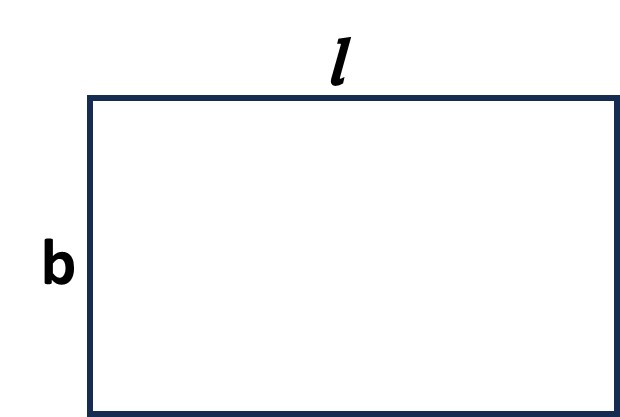
Step 1: When the sheet is folded along its length, the length becomes the circumference of the base of the cylinder.
\[
\text{Circumference of base} = l
\]Step 2: Height of the cylinder is equal to the breadth of the sheet.
\[
\text{Height} = b
\]Step 3: Formula for lateral surface area of a cylinder:
\[
\text{Lateral Surface Area} = \text{Circumference} \times \text{Height}
\]Step 4: Substitute the values:
\[
\text{Lateral Surface Area} = l \times b
\]Answer: c. \(lb\)
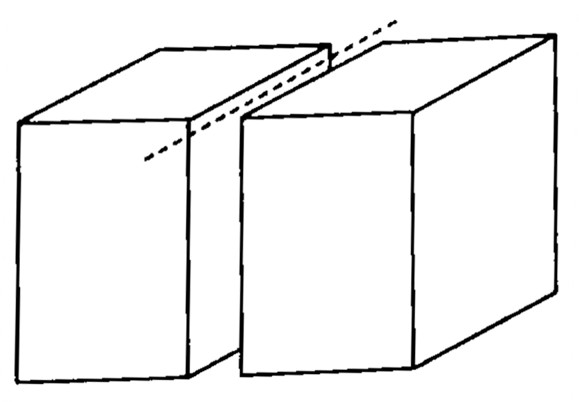
Q7: A cube of side length a is cut into two equal halves as shown. What will be the total surface area of each half when compared with the original cube?
Step 1: Surface area of the original cube of side a:
\[
\text{Surface Area} = 6a^2
\]Step 2: The cube is cut into two equal halves by a plane parallel to one of its faces.
This cut creates two new faces, one on each half.
Area of each new face:
\[
= a^2
\]Step 3: Surface area of each half:
Each half originally had half of the surface area of the cube:
\[
= \frac{6a^2}{2} = 3a^2
\]Adding the area of the new face created by cutting:
\[
\text{Surface Area of each half} = 3a^2 + a^2 = 4a^2
\]Step 4: Compare with half of the original cube’s surface area:
\[
\frac{6a^2}{2} = 3a^2
\]
Since
\[
4a^2 > 3a^2
\]
the surface area of each half is more than half of the original cube’s surface area.
Answer: c. Surface area of each part will be more than half of the original cube.
Q8: A cuboid is shown in the figure. The area of the rectangle ABCD is given as x square units. The surface area of the cuboid in terms of x is:
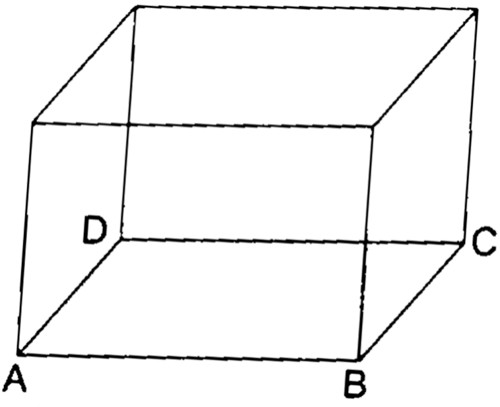
Step 1: Rectangle ABCD is one face of the cuboid.
Given:
\[
\text{Area of rectangle ABCD} = x
\]Step 2: Let the dimensions of rectangle ABCD be:
Length = \(l\)
Breadth = \(b\)
Then,
\[
lb = x
\]Step 3: Surface area of a cuboid is given by:
\[
2(lb + bh + hl)
\]Step 4: Here, only one face area \(lb = x\) is known.
The height \(h\) of the cuboid is not given.
So, values of \(bh\) and \(hl\) cannot be determined.
Step 5: Hence, the total surface area of the cuboid cannot be expressed uniquely in terms of \(x\) alone.
Answer: d. Data not sufficient
Leave a Comment