

Exercise: 23C
Q1: Multiple Choice Type – Cylinder
i. The curved surface area of a cylinder, with length 10 cm and radius 7 cm, is:
Step 1: Curved Surface Area (CSA) of cylinder:
\[
\text{CSA} = 2\pi r h
\]
Given radius \(r = 7\) cm, height \(h = 10\) cm.
Step 2: Calculate CSA:
\[
2 \times \pi \times 7 \times 10 = 140\pi \approx 140 \times 3.14 = 439.6 \, \text{cm}^2
\]Answer: d. 440 cm² (approximate)
ii. Radius of the base of a solid cylinder is 1 cm and its length is 7 cm. Its volume is:
Step 1: Volume of cylinder:
\[
V = \pi r^2 h
\]
Given \(r = 1\) cm, \(h = 7\) cm.
Step 2: Calculate volume:
\[
\pi \times 1^2 \times 7 = 7\pi \approx 7 \times 3.14 = 21.98 \, \text{cm}^3
\]Answer: b. 22 cm³ (approximate)
iii. The radius and the length of a cylindrical rod are 5 cm and 10 cm respectively. Its lateral surface area is:
Step 1: Lateral Surface Area (LSA) of cylinder = Curved Surface Area:
\[
LSA = 2\pi r h
\]
Given \(r = 5\) cm, \(h = 10\) cm.
Step 2: Calculate LSA:
\[
2 \times \pi \times 5 \times 10 = 100\pi \approx 314 \, \text{cm}^2
\]Answer: d. none of these
iv. The formula for the volume of the given cylindrical pipe is:
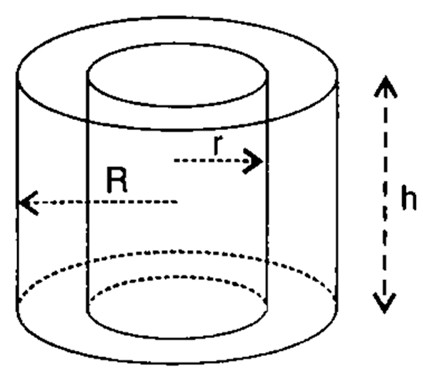
Step 1: The given figure represents a hollow cylinder (cylindrical pipe).
Outer radius = R
Inner radius = r
Height = h
Step 2: Volume of a solid cylinder of radius R and height h is:
\[
\pi R^2 h
\]Volume of the inner hollow cylinder of radius r and height h is:
\[
\pi r^2 h
\]Step 3: Volume of the cylindrical pipe:
\[
= \text{Volume of outer cylinder} – \text{Volume of inner cylinder} \\
= \pi R^2 h – \pi r^2 h \\
= \pi (R^2 – r^2)h
\]Answer: d. \(\pi(R^2 – r^2)h\)
v. A rectangular piece of paper 10 cm by 8 cm is rolled along its width to get the cylinder of largest size. The curved surface area of the cylinder formed is:
Step 1: When rolled along the width (8 cm), circumference = 8 cm.
So, radius \(r = \frac{8}{2\pi} = \frac{8}{2 \times 3.14} \approx 1.273\) cm.
Step 2: Height \(h =\) length of paper = 10 cm.
Step 3: Curved surface area:
\[
CSA = 2\pi r h = 2 \times 3.14 \times 1.273 \times 10 = 80 \, \text{cm}^2 \text{ (approx.)}
\]Answer: c. 80 cm²
Q2: Find the height of the cylinder whose radius is 7 cm and the total surface area is 1100 cm².
Step 1: Given:
Radius of the cylinder, \(r = 7\, cm\)
Total Surface Area (TSA) = 1100 cm²
\(\pi = \frac{22}{7}\)
Step 2: Write the formula for Total Surface Area of a cylinder:
\[
TSA = 2\pi r (h + r)
\]Step 3: Substitute the given values:
\[
1100 = 2 \times \frac{22}{7} \times 7 \times (h + 7)
\]Simplify:
\[
1100 = 44 (h + 7)
\]Step 4: Solve for \(h\):
\[
h + 7 = \frac{1100}{44} = 25 \\
h = 25 – 7 = 18\, cm
\]Answer: The height of the cylinder is 18 cm.
Q3: The ratio between the curved surface area and the total surface area of a cylinder is 1 : 2. Find the ratio between the height and the radius of the cylinder.
Step 1: Let radius be \(r\) and height be \(h\).
Step 2: Curved Surface Area (CSA) of cylinder:
\[
CSA = 2\pi r h
\]Step 3: Total Surface Area (TSA) of cylinder:
\[
TSA = 2\pi r (h + r)
\]Step 4: Given ratio:
\[
\frac{CSA}{TSA} = \frac{1}{2}
\]
Substitute formulas:
\[
\frac{2\pi r h}{2\pi r (h + r)} = \frac{1}{2}
\]
Simplify:
\[
\frac{h}{h + r} = \frac{1}{2}
\]Step 5: Cross multiply:
\[
2h = h + r \\
2h – h = r \\
h = r
\]Answer: The ratio between height and radius is 1 : 1.
Q4: The total surface area of a cylinder is 6512 cm² and the circumference of its base is 88 cm. Find:
i. Its radius
Step 1: Given:
Total Surface Area (TSA) = 6512 cm²
Circumference of base = 88 cm
\(\pi = \frac{22}{7}\)
Step 2: Use the formula for circumference of base:
\[
2\pi r = 88
\]Substitute value of \(\pi\):
\[
2 \times \frac{22}{7} \times r = 88 \\
\frac{44}{7} r = 88 \\
r = \frac{88 \times 7}{44} = 14 \text{ cm}
\]Answer: Radius = 14 cm
ii. Its volume
Step 3: Write the formula for Total Surface Area of a cylinder:
\[
TSA = 2\pi r (h + r)
\]Substitute the given values:
\[
6512 = 2 \times \frac{22}{7} \times 14 \times (h + 14)
\]Simplify:
\[
6512 = 88 (h + 14) \\
h + 14 = \frac{6512}{88} = 74 \\
h = 74 – 14 = 60 \text{ cm}
\]Step 4: Write the formula for Volume of a cylinder:
\[
V = \pi r^2 h
\]Substitute the values:
\[
V = \frac{22}{7} \times 14^2 \times 60 \\
V = \frac{22}{7} \times 196 \times 60 \\
V = 22 \times 28 \times 60 = 36960 \text{ cm}^3
\]Answer: Volume = 36,960 cm³
Q5: The sum of the radius and the height of a cylinder is 37 cm and the total surface area of the cylinder is 1628 cm². Find the height and the volume of the cylinder.
Step 1: Given:
Let radius = r cm
Height = h cm
r + h = 37 …… (1)
Total Surface Area (TSA) = 1628 cm²
\(\pi = \frac{22}{7}\)
Step 2: Formula for total surface area of a cylinder:
\[
TSA = 2\pi r (r + h)
\]Substitute given values:
\[
1628 = 2 \times \frac{22}{7} \times r \times 37 \\
1628 = \frac{44}{7} \times 37 \times r \\
1628 = \frac{1628}{7} \times r \\
r = 7 \text{ cm}
\]Step 3: Find the height using equation (1):
\[
h = 37 – r = 37 – 7 = 30 \text{ cm}
\]Step 4: Formula for volume of a cylinder:
\[
V = \pi r^2 h
\]Substitute the values:
\[
V = \frac{22}{7} \times 7^2 \times 30 \\
V = \frac{22}{7} \times 49 \times 30 \\
V = 22 \times 7 \times 30 = 4620 \text{ cm}^3
\]Answer: Height = 30 cm and Volume = 4620 cm³
Q6: A cylindrical pillar has radius 21 cm and height 4 m. Find:
i. The curved surface area of the pillar
Step 1: Convert all dimensions into the same unit.
Radius = 21 cm = 0.21 m
Height = 4 m
\(\pi = \frac{22}{7}\)
Step 2: Formula for curved surface area (CSA) of a cylinder:
\[
CSA = 2\pi rh
\]Substitute the values:
\[
CSA = 2 \times \frac{22}{7} \times 0.21 \times 4 \\
CSA = \frac{44}{7} \times 0.84 \\
CSA = 5.28 \text{ m}^2
\]Answer: Curved surface area of one pillar = 5.28 m²
ii. The cost of polishing 36 such pillars at the rate of ₹12 per m²
Step 3: Curved surface area of 36 such pillars:
\[
= 36 \times 5.28 = 190.08 \text{ m}^2
\]Step 4: Cost of polishing at ₹12 per m²:
\[
\text{Cost} = 190.08 \times 12 \\
\text{Cost} = ₹2280.96
\]Answer: Cost of polishing 36 pillars = ₹2280.96
Q7: If the radii of two cylinders are in the ratio 4 : 3 and their heights are in the ratio 5 : 6, find the ratio of their curved surfaces.
Step 1: Let the radii of the two cylinders be \(r_1 = 4x\) and \(r_2 = 3x\).
Let the heights be \(h_1 = 5y\) and \(h_2 = 6y\).
Step 2: Curved Surface Area (CSA) of a cylinder is:
\[
CSA = 2\pi r h
\]Step 3: Calculate the ratio of their curved surface areas:
\[
\frac{CSA_1}{CSA_2} = \frac{2\pi r_1 h_1}{2\pi r_2 h_2} = \frac{r_1 h_1}{r_2 h_2} = \frac{4x \times 5y}{3x \times 6y} = \frac{20xy}{18xy} = \frac{20}{18} = \frac{10}{9}
\]Answer: The ratio of their curved surfaces is 10 : 9.
Q8: A thin rectangular cardboard has dimensions 44 cm × 22 cm. It is rolled along its length to get a hollow cylinder of largest size. Find the volume of the cylinder formed.
Step 1: Understand how the cylinder is formed.
Rolled along its length (44 cm), so:
Circumference of base = 44 cm
Height of cylinder = 22 cm
Step 2: Find the radius of the base.
\[
2\pi r = 44
\]
Using \(\pi = \frac{22}{7}\):
\[
2 \times \frac{22}{7} \times r = 44 \\
r = 7 \text{ cm}
\]Step 3: Write the formula for volume of a cylinder:
\[
V = \pi r^2 h
\]Step 4: Substitute the values:
\[
V = \frac{22}{7} \times 7^2 \times 22 \\
V = \frac{22}{7} \times 49 \times 22 \\
V = 3388 \text{ cm}^3
\]Answer:
Volume of the cylinder formed = 3388 cm³
Q9: The ratio between the curved surface area and the total surface area of a right circular cylinder is 3 : 5. Find the ratio between the height and the radius of the cylinder.
Step 1: Let radius = \(r\) and height = \(h\).
Step 2: Curved Surface Area (CSA) of cylinder:
\[
CSA = 2\pi r h
\]Step 3: Total Surface Area (TSA) of cylinder:
\[
TSA = 2\pi r (h + r)
\]Step 4: Given ratio:
\[
\frac{CSA}{TSA} = \frac{3}{5}
\]
Substitute formulas:
\[
\frac{2\pi r h}{2\pi r (h + r)} = \frac{3}{5}
\]
Simplify:
\[
\frac{h}{h + r} = \frac{3}{5}
\]Step 5: Cross multiply:
\[
5h = 3(h + r) \\
5h = 3h + 3r \\
5h – 3h = 3r \\
2h = 3r
\]Step 6: Find ratio \( \frac{h}{r} \):
\[
\frac{h}{r} = \frac{3}{2}
\]Answer: The ratio between the height and radius of the cylinder is 3 : 2.
Q10: If radii of two circular cylinders are in ratio 3 : 4 and their heights are in the ratio 6 : 5, find the ratio of their curved surface areas.
Step 1: Let the radii of the two cylinders be \(r_1 = 3x\) and \(r_2 = 4x\).
Let the heights be \(h_1 = 6y\) and \(h_2 = 5y\).
Step 2: Curved Surface Area (CSA) of cylinder:
\[
CSA = 2\pi r h
\]Step 3: Ratio of curved surface areas:
\[
\frac{CSA_1}{CSA_2} = \frac{2\pi r_1 h_1}{2\pi r_2 h_2} = \frac{r_1 h_1}{r_2 h_2} = \frac{3x \times 6y}{4x \times 5y} = \frac{18xy}{20xy} = \frac{18}{20} = \frac{9}{10}
\]Answer: The ratio of their curved surface areas is 9 : 10.
Leave a Comment