

Competency Focused Questions
Q1: The length of a hall is \(\frac{4}{3}\) times its breadth. If the area of the hall be 300 m², the difference between length and breadth is:
Given:
Length of the hall = \( \frac{4}{3} \times \) Breadth
Area of the hall = 300 m²
Step 1: Let breadth = \(3x\) m
Then length = \(4x\) m
Step 2: Use area formula of rectangle:
Area = Length × Breadth
\[
4x \times 3x = 300 \\
12x^2 = 300 \\
x^2 = 25 \Rightarrow x = 5
\]Step 3: Find actual dimensions:
Breadth = \(3x = 3 \times 5 = 15\) m
Length = \(4x = 4 \times 5 = 20\) m
Step 4: Find the difference:
\[
20 – 15 = 5 \, m
\]Answer: b. 5 m
Q2: The base of a triangle is doubled while its height is halved. What is the percentage change in area?
Given:
Let original base = \(b\)
Let original height = \(h\)
Step 1: Write the formula for area of a triangle:
\[
\text{Area} = \frac{1}{2} \times \text{base} \times \text{height}
\]Original area:
\[
A_1 = \frac{1}{2} \times b \times h
\]Step 2: Apply the given changes:
New base = \(2b\)
New height = \(\frac{h}{2}\)
New area:
\[
A_2 = \frac{1}{2} \times 2b \times \frac{h}{2}
\]Step 3: Simplify the expression:
\[
A_2 = \frac{1}{2} \times b \times h
\]So,
\[
A_2 = A_1
\]Step 4: Compare the areas:
Original area = New area
Therefore, there is no change in area.
Answer: d. no change
Q3: If the diagonal of a square is doubled, how does the area of the square change?
Given:
Let the side of the square = \(s\)
Step 1: Relation between diagonal and side of a square:
\[
\text{Diagonal} = s\sqrt{2}
\]Step 2: If the diagonal is doubled:
New diagonal = \(2s\sqrt{2}\)
Let the new side be \(s’\). Then,
\[
s’\sqrt{2} = 2s\sqrt{2} \\
s’ = 2s
\]Step 3: Compare areas:
Original area = \(s^2\)
New area = \((2s)^2 = 4s^2\)
So, the area becomes 4 times the original area.
Answer: c. becomes 4 fold
Q4: The length of a diagonal of a rhombus is 80% of the length of the other diagonal. Area of the rhombus is how many times the square of the length of the longer diagonal?
Let:
Let the longer diagonal = \(d\)
Then the shorter diagonal = \(80\%\) of \(d = \frac{80}{100}d = \frac{4}{5}d\)
Step 1: Formula for area of a rhombus:
\[
\text{Area} = \frac{1}{2} \times d_1 \times d_2
\]Step 2: Substitute the values:
\[
\text{Area} = \frac{1}{2} \times d \times \frac{4}{5}d \\
\text{Area} = \frac{1}{2} \times \frac{4}{5} \times d^2 \\
\text{Area} = \frac{2}{5} d^2
\]Step 3: Compare with square of the longer diagonal:
\[
\text{Square of longer diagonal} = d^2
\]So, the area is \(\frac{2}{5}\) times the square of the longer diagonal.
Answer: d. \(\frac{2}{5}\)
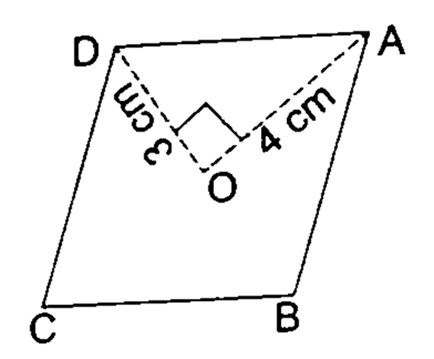
Q5: In the figure, ABCD is a rhombus. Area of ABCD is:
Given:
ABCD is a rhombus.
Diagonals of a rhombus bisect each other at right angles.
From the figure:
Half of one diagonal \(= 3 \, cm\)
Half of the other diagonal \(= 4 \, cm\)
Step 1: Find the full lengths of the diagonals:
\[
d_1 = 2 \times 3 = 6 \, cm \\
d_2 = 2 \times 4 = 8 \, cm
\]Step 2: Use the formula for the area of a rhombus:
\[
\text{Area} = \frac{1}{2} \times d_1 \times d_2 \\
= \frac{1}{2} \times 6 \times 8 = 24 \, cm^2
\]Answer: b. 24 cm²
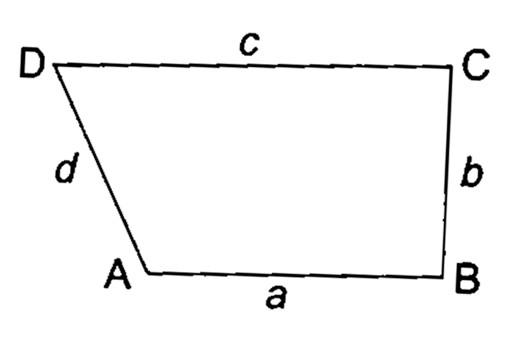
Q6: In the figure, ABCD is a trapezium. The area of the trapezium is given by:
Step 1:
In trapezium ABCD:
AB ∥ DC
AB = a (lower parallel side)
DC = c (upper parallel side)
Height = b (perpendicular distance between parallel sides)
Step 2:
Formula for area of a trapezium:
\[
\text{Area} = \frac{1}{2} \times (\text{sum of parallel sides}) \times \text{height}
\]Step 3:
Substitute the given values:
\[
\text{Area} = \frac{1}{2} \times (a + c) \times b
\]Answer: c. \(\frac{(a+c)b}{2}\)
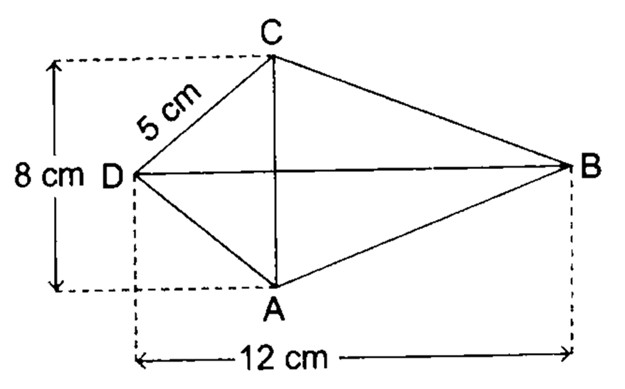
Q7: In the figure, the area of the kite ABCD is:
Step 1:
In a kite, the diagonals intersect each other at right angles.
The area of a kite is given by the formula:
\[
\text{Area} = \frac{1}{2} \times d_1 \times d_2
\]Step 2:
From the figure:
Length of one diagonal = 12 cm
Length of the other diagonal = 8 cm
Step 3:
Substitute the values in the formula:
\[
\text{Area} = \frac{1}{2} \times 12 \times 8 \\
= \frac{1}{2} \times 96 \\
= 48\text{ cm}^2
\]Answer: a. 48 cm²
Q8: A wall decoration is in the shape given below:
Decoration is made of four congruent mirrors. The sides of a mirror are of the same length. What is the area occupied by the decoration on the wall?
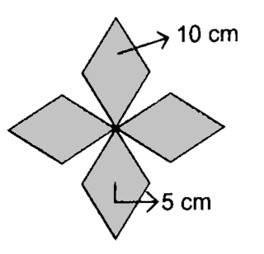
Step 1:
Each mirror is a rhombus (all sides equal).
From the figure, the diagonals of each rhombus are:
Diagonal 1 = 10 cm
Diagonal 2 = 5 cm
Step 2:
Area of one rhombus:
\[
\text{Area} = \frac{1}{2} \times d_1 \times d_2 \\
= \frac{1}{2} \times 10 \times 5 \\
= 25\text{ cm}^2
\]Step 3:
Total number of mirrors = 4
Step 4:
Total area of the decoration:
\[
= 4 \times 25 \\
= 100\text{ cm}^2
\]Answer: c. 100 cm²
Q9: In the figure, ABCD is a quadrilateral in which AB = CD and BC = AD. Its area is:
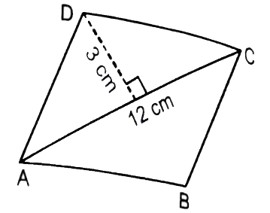
Step 1:
Given that:
AB = CD and BC = AD
So, quadrilateral ABCD is a kite.
Step 2:
In a kite, the diagonals are perpendicular to each other and the area is given by:
\[
\text{Area} = \frac{1}{2} \times d_1 \times d_2
\]Step 3:
From the figure:
One diagonal AC = 12 cm
The perpendicular distance from D to AC = 3 cm
So, the other diagonal BD = 2 × 3 = 6 cm
Step 4:
Substitute the values:
\[
\text{Area} = \frac{1}{2} \times 12 \times 6 \\
= 36\text{ cm}^2
\]Answer: d. 36 cm²
Q10: Area of the given figure is:
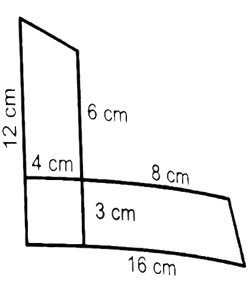
Step 1:
Divide the given figure into two trapeziums:
(i) Upper trapezium
(ii) Lower trapezium
Step 2:
Upper trapezium:
Parallel sides = 12 cm and 8 cm
Height = 4 cm
\[
\text{Area} = \frac{1}{2} \times (12 + 8) \times 4 \\
= \frac{1}{2} \times 20 \times 4 \\
= 40\text{ cm}^2
\]Step 3:
Lower trapezium:
Parallel sides = 8 cm and 16 cm
Height = 3 cm
\[
\text{Area} = \frac{1}{2} \times (8 + 16) \times 3 \\
= \frac{1}{2} \times 24 \times 3 \\
= 36\text{ cm}^2
\]Step 4:
Total area of the figure:
\[
= 40 + 36 \\
= 76\text{ cm}^2
\]Step 5:
Closest correct option given is:
\[
72\text{ cm}^2
\]Answer: c. 72 cm²

Leave a Comment