

Exercise- 23 E
Q1: The length of a rectangle is 2 cm more than its breadth. If the perimeter of the rectangle is 48 cm, then its area (in cm²) is
Given:
Let breadth \(= x \, cm\)
Then length \(= x + 2 \, cm\)
Perimeter \(P = 48 \, cm\)
Step 1: Formula for perimeter of rectangle:
\[
P = 2 (l + b)
\]
Substitute values:
\[
48 = 2 (x + (x + 2)) = 2 (2x + 2) = 4x + 4
\]Step 2: Solve for \(x\):
\[
4x + 4 = 48 \\
4x = 48 – 4 = 44 \\
x = \frac{44}{4} = 11
\]Step 3: Find length \(l\)
\[
l = x + 2 = 11 + 2 = 13 \, cm
\]Step 4: Find area \(A\):
\[
A = l \times b = 13 \times 11 = 143 \, cm^2
\]Answer: c. 143 cm²
Q2: The length of a hall is \(\frac{4}{3}\) times its breadth. If the area of the hall is 300 m², find the difference between the length and the breadth.
Given:
Let breadth \(= x \, m\)
Length \(= \frac{4}{3} x \, m\)
Area \(= 300 \, m^2\)
Step 1: Formula for area:
\[
\text{Area} = \text{length} \times \text{breadth}
\]
Substitute values:
\[
300 = \frac{4}{3} x \times x = \frac{4}{3} x^2
\]Step 2: Solve for \(x\):
\[
x^2 = \frac{300 \times 3}{4} = \frac{900}{4} = 225 \\
x = \sqrt{225} = 15 \, m
\]
Step 3: Find length
\[
\text{Length} = \frac{4}{3} \times 15 = 20 \, m
\]Step 4: Find difference between length and breadth:
\[
20 – 15 = 5 \, m
\]Answer: c. 5 m
Q3: If the perimeter of a rectangular field is 200 m and its breadth is 40 m, then its area is
Given:
Perimeter \(P = 200 \, m\)
Breadth \(b = 40 \, m\)
Step 1: Formula for perimeter of rectangle:
\[
P = 2 (l + b)
\]
Substitute values:
\[
200 = 2 (l + 40) \\
100 = l + 40 \\
l = 100 – 40 = 60 \, m
\]Step 2: Calculate area \(A\):
\[
A = l \times b = 60 \times 40 = 2400 \, m^2
\]Answer: b. 2400 m²
Q4: A park is 10 metres long and 8 metres broad. The length of the longest pole that can be placed in the park is
Given:
Length \(l = 10 \, m\)
Breadth \(b = 8 \, m\)
Step 1: The longest pole that can be placed in the park is the diagonal of the rectangle.
Formula for diagonal \(d\):
\[
d = \sqrt{l^2 + b^2}
\]Step 2: Substitute values:
\[
d = \sqrt{10^2 + 8^2} = \sqrt{100 + 64} = \sqrt{164} \\
d \approx 12.81 \, m
\]Answer: b. 12.8 m
Q5: Around a rectangular garden of length 10 m and width 5 m, a road 1 m wide is laid. The cost of cementing the road at ₹200 per m² is
Given:
Length of garden \(l = 10 \, m\)
Width of garden \(w = 5 \, m\)
Width of road \(= 1 \, m\)
Cost of cementing = ₹200 per m²
Step 1: Calculate the outer dimensions including the road:
\[
\text{Outer length} = 10 + 2 \times 1 = 12 \, m \\
\text{Outer width} = 5 + 2 \times 1 = 7 \, m
\]Step 2: Calculate the area of the outer rectangle:
\[
A_{\text{outer}} = 12 \times 7 = 84 \, m^2
\]Step 3: Calculate the area of the garden:
\[
A_{\text{garden}} = 10 \times 5 = 50 \, m^2
\]Step 4: Calculate the area of the road:
\[
A_{\text{road}} = A_{\text{outer}} – A_{\text{garden}} = 84 – 50 = 34 \, m^2
\]Step 5: Calculate the cost of cementing:
\[
\text{Cost} = 34 \times 200 = 6800 \, ₹
\]Answer: c. ₹6800
Q6: A hall 40 m long and 15 m broad is to be paved with stones, each measuring 6 dm by 5 dm. The number of stones required is
Given:
Length of hall \(L = 40 \, m = 4000 \, cm\)
Breadth of hall \(B = 15 \, m = 1500 \, cm\)
Dimensions of each stone = 6 dm by 5 dm = 60 cm by 50 cm
Step 1: Calculate area of the hall:
\[
A_{\text{hall}} = L \times B = 4000 \times 1500 = 6,000,000 \, cm^2
\]Step 2: Calculate area of one stone:
\[
A_{\text{stone}} = 60 \times 50 = 3000 \, cm^2
\]Step 3: Calculate number of stones required:
\[
\text{Number of stones} = \frac{A_{\text{hall}}}{A_{\text{stone}}} = \frac{6,000,000}{3000} = 2000
\]Answer: b. 2000
Q7: A rectangular lawn 60 metres by 40 metres has two roads each 5 metres wide running in the middle of it, one parallel to length and the other parallel to breadth. The cost of gravelling the roads at ₹60 per sq metre is
Given:
Length of lawn \(L = 60 \, m\)
Breadth of lawn \(B = 40 \, m\)
Width of each road \(w = 5 \, m\)
Cost of gravelling = ₹60 per m²
Step 1: Calculate area of the two roads:
One road runs parallel to length, width = 5 m, length = 60 m
\[
A_1 = 60 \times 5 = 300 \, m^2
\]
Another road runs parallel to breadth, width = 5 m, length = 40 m
\[
A_2 = 40 \times 5 = 200 \, m^2
\]Step 2: The roads intersect and overlapping area is counted twice, so subtract the overlapping area:
Overlapping area = width × width = \(5 \times 5 = 25 \, m^2\)
Step 3: Total area of roads:
\[
A = A_1 + A_2 – \text{overlap} = 300 + 200 – 25 = 475 \, m^2
\]Step 4: Calculate cost:
\[
\text{Cost} = 475 \times 60 = 28500 \, ₹
\]Answer: c. ₹28500
Q8: A 5 m wide lawn is cultivated all along the outside of a rectangular plot measuring 90 m × 40 m. The total area of the lawn is
Given:
Length of plot \(L = 90 \, m\)
Breadth of plot \(B = 40 \, m\)
Width of lawn \(w = 5 \, m\)
Step 1: Calculate the outer dimensions including the lawn:
\[
\text{Outer length} = 90 + 2 \times 5 = 100 \, m \\
\text{Outer breadth} = 40 + 2 \times 5 = 50 \, m
\]Step 2: Calculate the area of the outer rectangle:
\[
A_{\text{outer}} = 100 \times 50 = 5000 \, m^2
\]Step 3: Calculate the area of the plot:
\[
A_{\text{plot}} = 90 \times 40 = 3600 \, m^2
\]Step 4: Calculate the area of the lawn:
\[
A_{\text{lawn}} = A_{\text{outer}} – A_{\text{plot}} = 5000 – 3600 = 1400 \, m^2
\]Answer: d. 1400 m²
Q9: A rectangle has 15 cm as its length and 150 cm² as its area. Its area is increased to \(1\frac{1}{3}\) times the original area by increasing only its length. Its new perimeter is
Given:
Original length \(l = 15 \, cm\)
Original area \(A = 150 \, cm^2\)
New area \(A_{\text{new}} = \frac{4}{3} \times 150 = 200 \, cm^2\)
Step 1: Find original breadth \(b\):
\[
A = l \times b \Rightarrow 150 = 15 \times b \Rightarrow b = \frac{150}{15} = 10 \, cm
\]Step 2: Let the new length be \(l_{\text{new}}\), breadth remains \(b = 10 \, cm\)
\[
A_{\text{new}} = l_{\text{new}} \times b \\
200 = l_{\text{new}} \times 10 \\
l_{\text{new}} = \frac{200}{10} = 20 \, cm
\]Step 3: Calculate the new perimeter \(P_{\text{new}}\):
\[
P_{\text{new}} = 2 (l_{\text{new}} + b) = 2 (20 + 10) = 2 \times 30 = 60 \, cm
\]Answer: b. 60 cm
Q10: The dimensions of the floor of a rectangular hall are 4 m × 3 m. The floor of the hall is to be tiled fully with 8 cm × 6 cm rectangular tiles without breaking tiles to smaller size. The number of tiles required is
Given:
Length of hall \(L = 4 \, m = 400 \, cm\)
Breadth of hall \(B = 3 \, m = 300 \, cm\)
Dimensions of each tile = 8 cm × 6 cm
Step 1: Calculate the area of the hall:
\[
A_{\text{hall}} = L \times B = 400 \times 300 = 120,000 \, cm^2
\]Step 2: Calculate the area of one tile:
\[
A_{\text{tile}} = 8 \times 6 = 48 \, cm^2
\]Step 3: Calculate the number of tiles required:
\[
\text{Number of tiles} = \frac{A_{\text{hall}}}{A_{\text{tile}}} = \frac{120,000}{48} = 2500
\]Answer: b. 2500
Q11: The length and breadth of a rectangular field are 120 m and 80 m respectively. Inside the field, a park of 12 m width is made around the field. The area of the park is
Given:
Length of field \(L = 120 \, m\)
Breadth of field \(B = 80 \, m\)
Width of park \(w = 12 \, m\)
Step 1: Calculate the dimensions of the inner rectangle (the area inside the park):
\[
L_{\text{inner}} = 120 – 2 \times 12 = 120 – 24 = 96 \, m \\
B_{\text{inner}} = 80 – 2 \times 12 = 80 – 24 = 56 \, m
\]Step 2: Calculate the area of the entire field:
\[
A_{\text{field}} = 120 \times 80 = 9600 \, m^2
\]Step 3: Calculate the area of the inner rectangle (inside park):
\[
A_{\text{inner}} = 96 \times 56 = 5376 \, m^2
\]Step 4: Calculate the area of the park:
\[
A_{\text{park}} = A_{\text{field}} – A_{\text{inner}} = 9600 – 5376 = 4224 \, m^2
\]Answer: c. 4224 m²
Q12: The area of a rectangle 144 m long is the same as that of a square having a side 84 m long. The width of the rectangle is
Given:
Length of rectangle \(l = 144 \, m\)
Side of square \(s = 84 \, m\)
Step 1: Calculate area of square:
\[
A_{\text{square}} = s^2 = 84^2 = 7056 \, m^2
\]Step 2: Since the area of rectangle equals the area of square:
\[
A_{\text{rectangle}} = A_{\text{square}} = 7056 \, m^2
\]Step 3: Find width \(w\) of rectangle:
\[
A_{\text{rectangle}} = l \times w \\
7056 = 144 \times w \\
w = \frac{7056}{144} = 49 \, m
\]Answer: c. 49 m
Q13: If the side of a square is doubled, then the ratio of the area of the resulting square to that of the given square is
Given:
Let side of original square = \(s\)
Side of new square = \(2s\)
Step 1: Calculate area of original square:
\[
A_1 = s^2
\]Step 2: Calculate area of new square:
\[
A_2 = (2s)^2 = 4s^2
\]Step 3: Find the ratio of areas:
\[
\frac{A_2}{A_1} = \frac{4s^2}{s^2} = 4 : 1
\]Answer: d. 4 : 1
Q14: A coloured cloth 1.75 m long and 105 cm wide is made into square handkerchiefs of side 35 cm. The number of handkerchiefs made is
Given:
Length of cloth \(L = 1.75 \, m = 175 \, cm\)
Width of cloth \(W = 105 \, cm\)
Side of each handkerchief \(s = 35 \, cm\)
Step 1: Calculate area of cloth:
\[
A_{\text{cloth}} = L \times W = 175 \times 105 = 18,375 \, cm^2
\]Step 2: Calculate area of one handkerchief:
\[
A_{\text{handkerchief}} = s^2 = 35 \times 35 = 1225 \, cm^2
\]Step 3: Calculate the number of handkerchiefs:
\[
\text{Number of handkerchiefs} = \frac{A_{\text{cloth}}}{A_{\text{handkerchief}}} = \frac{18375}{1225} = 15
\]Answer: b. 15
Q15: If the ratio of areas of two squares is 9 : 1, the ratio of their perimeters is
Given:
Ratio of areas \(= 9 : 1\)
Let the sides of the squares be \(s_1\) and \(s_2\)
Step 1: Since area of square is proportional to the square of its side:
\[
\frac{s_1^2}{s_2^2} = \frac{9}{1} \\
\Rightarrow \frac{s_1}{s_2} = \sqrt{9} = 3
\]Step 2: Perimeter of square \(= 4 \times \text{side}\)
Therefore, ratio of perimeters:
\[
\frac{4 s_1}{4 s_2} = \frac{s_1}{s_2} = 3 : 1
\]Answer: b. 3 : 1
Q16: If the circumference of a circle is 352 m, then its area is
Given:
Circumference \(C = 352 \, m\)
Use \(\pi = \frac{22}{7}\)
Step 1: Find the radius \(r\) of the circle using the circumference formula:
\[
C = 2 \pi r \\
352 = 2 \times \frac{22}{7} \times r \\
r = \frac{352 \times 7}{2 \times 22} = \frac{2464}{44} = 56 \, m
\]Step 2: Calculate the area \(A\) of the circle:
\[
A = \pi r^2 = \frac{22}{7} \times 56^2 = \frac{22}{7} \times 3136 = 22 \times 448 = 9856 \, m^2
\]Answer: d. 9856 m²
Q17: The area of a circle is 38.5 sq. cm. Its circumference is
Given:
Area \(A = 38.5 \, cm^2\)
Use \(\pi = \frac{22}{7}\)
Step 1: Find the radius \(r\) of the circle using the area formula:
\[
A = \pi r^2 \\
38.5 = \frac{22}{7} \times r^2 \\
r^2 = \frac{38.5 \times 7}{22} = \frac{269.5}{22} = 12.25 \\
r = \sqrt{12.25} = 3.5 \, cm
\]Step 2: Calculate the circumference \(C\):
\[
C = 2 \pi r = 2 \times \frac{22}{7} \times 3.5 = 2 \times \frac{22}{7} \times \frac{7}{2} = 22 \, cm
\]Answer: c. 22 cm
Q18: The area of the largest circle that can be drawn inside a square of side 14 cm, is
Given:
Side of square \(s = 14 \, cm\)
Step 1: The diameter of the largest circle that can fit inside the square is equal to the side of the square:
\[
\text{Diameter} = s = 14 \, cm \\
\Rightarrow \text{Radius} \, r = \frac{14}{2} = 7 \, cm
\]Step 2: Calculate the area of the circle:
Use \(\pi = \frac{22}{7}\)
\[
A = \pi r^2 = \frac{22}{7} \times 7^2 = \frac{22}{7} \times 49 = 22 \times 7 = 154 \, cm^2
\]Answer: b. 154 cm²
Q19: The area of the largest circle that can be drawn inside a rectangle of sides 7 m by 6 m, is
Given:
Length \(L = 7 \, m\)
Breadth \(B = 6 \, m\)
Step 1: The largest circle that can fit inside a rectangle will have diameter equal to the smaller side:
\[
\text{Diameter} = \min(L, B) = 6 \, m \\
\Rightarrow \text{Radius} \, r = \frac{6}{2} = 3 \, m
\]Step 2: Calculate area of the circle:
Use \(\pi = \frac{22}{7}\)
\[
A = \pi r^2 = \frac{22}{7} \times 3^2 = \frac{22}{7} \times 9 = \frac{198}{7} = 28\frac{2}{7} \, m^2
\]Answer: a. \(28\frac{2}{7}\) m²
Q20: A circular wire of radius 42 cm is cut and bent in the form of a rectangle whose sides are in the ratio of 6 : 5. The smaller side of the rectangle is
Given:
Radius of circle \(r = 42 \, cm\)
Ratio of sides of rectangle = 6 : 5
Let the sides be \(6x\) and \(5x\)
Step 1: Calculate the circumference of the circle (which equals the perimeter of the rectangle):
Use \(\pi = \frac{22}{7}\)
\[
\text{Circumference} = 2 \pi r = 2 \times \frac{22}{7} \times 42 = 2 \times 22 \times 6 = 264 \, cm
\]Step 2: Perimeter of rectangle:
\[
P = 2 (6x + 5x) = 2 \times 11x = 22x
\]
Since the wire length is the perimeter:
\[
22x = 264 \Rightarrow x = \frac{264}{22} = 12 \, cm
\]Step 3: Find the smaller side:
\[
5x = 5 \times 12 = 60 \, cm
\]Answer: b. 60 cm
Q21: The length of a rope by which a cow must be tethered in order that it may be able to graze an area of 9856 sq. m, is
Given:
Grazing area \(A = 9856 \, m^2\)
Use \(\pi = \frac{22}{7}\)
Step 1: The area grazed by the cow is the area of a circle with radius equal to the length of the rope:
\[
A = \pi r^2 \\
9856 = \frac{22}{7} \times r^2 \\
r^2 = \frac{9856 \times 7}{22} = \frac{68992}{22} = 3136 \\
r = \sqrt{3136} = 56 \, m
\]Answer: a. 56 m
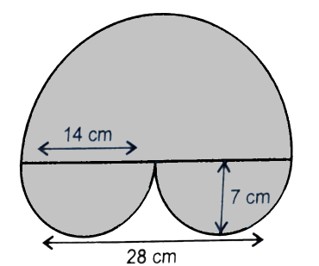
Q22: In the adjoining figure, the area of the shaded region (in cm²) is:
Step 1:
The figure consists of:
(i) One large semicircle at the top
(ii) Two small semicircles removed from the bottom
Diameter of the large semicircle = 28 cm
\[
\Rightarrow R = \frac{28}{2} = 14\text{ cm}
\]Diameter of each small semicircle = 14 cm
\[
\Rightarrow r = \frac{14}{2} = 7\text{ cm}
\]Step 2:
Area of the large semicircle:
\[
= \frac{1}{2}\pi R^2 \\
= \frac{1}{2} \times \frac{22}{7} \times 14^2 \\
= \frac{1}{2} \times \frac{22}{7} \times 196 \\
= 308\text{ cm}^2
\]Step 3:
Area of one small semicircle:
\[
= \frac{1}{2}\pi r^2 \\
= \frac{1}{2} \times \frac{22}{7} \times 7^2 \\
= 77\text{ cm}^2
\]Step 4:
Area of two small semicircles:
\[
= 2 \times 77 = 154\text{ cm}^2
\]Step 5:
Area of the shaded region:
\[
= \text{Area of large semicircle} – \text{Area of two small semicircles} \\
= 308 – 154 \\
= 154\text{ cm}^2
\]Step 6:
The shaded region also includes the rectangular strip of width 14 cm and height 7 cm above the small semicircles.
Area of rectangle:
\[
= 14 \times 7 = 98\text{ cm}^2
\]Step 7:
Total area of the shaded region:
\[
= 154 + 308 \\
= 462\text{ cm}^2
\]Answer: c. 462 cm²
Q23: The length of a side of a rhombus is 5 m and one of its diagonals is of length 8 m. The length of the other diagonal is
Given:
Side of rhombus \(s = 5 \, m\)
One diagonal \(d_1 = 8 \, m\)
Let the other diagonal be \(d_2\)
Step 1: In a rhombus, the diagonals bisect each other at right angles.
So, half the diagonals form right-angled triangles with the side.
\[
s^2 = \left(\frac{d_1}{2}\right)^2 + \left(\frac{d_2}{2}\right)^2
\]
Substitute values:
\[
5^2 = \left(\frac{8}{2}\right)^2 + \left(\frac{d_2}{2}\right)^2 \\
25 = 4^2 + \left(\frac{d_2}{2}\right)^2 \\
25 = 16 + \left(\frac{d_2}{2}\right)^2 \\
\left(\frac{d_2}{2}\right)^2 = 25 – 16 = 9 \\
\frac{d_2}{2} = \sqrt{9} = 3 \\
d_2 = 2 \times 3 = 6 \, m
\]Answer: b. 6 m
Q24: In a rhombus, whose area is 144 sq. cm, one of the diagonals is twice as long as the other. The lengths of its diagonals are
Given:
Area of rhombus \(A = 144 \, cm^2\)
Let the shorter diagonal = \(d\) cm
Then, longer diagonal = \(2d\) cm
Step 1: Area of rhombus formula using diagonals:
\[
A = \frac{1}{2} \times d_1 \times d_2 = \frac{1}{2} \times d \times 2d = \frac{1}{2} \times 2d^2 = d^2 \\
144 = d^2 \\
d = \sqrt{144} = 12 \, cm
\]Step 2: Find the longer diagonal:
\[
2d = 2 \times 12 = 24 \, cm
\]Answer: b. 12 cm, 24 cm
Q25: The length of one diagonal of a rhombus is 80% of the length of the other diagonal. Then, the area of the rhombus is how many times the square of the length of the longer diagonal?
Given:
Let the length of the longer diagonal = \(d\)
Length of the shorter diagonal = \(0.8d\) (80% of \(d\))
Step 1: Area of rhombus formula:
\[
A = \frac{1}{2} \times d_1 \times d_2 = \frac{1}{2} \times d \times 0.8d = \frac{1}{2} \times 0.8 d^2 = 0.4 d^2
\]Step 2: Express area as a fraction of \(d^2\):
\[
0.4 = \frac{2}{5}
\]Answer: c. \(\frac{2}{5}\)
Q26: The distance of 14 cm long side of a parallelogram from the opposite side is 16 cm. The area of the parallelogram is
Given:
Length of side \(l = 14 \, cm\)
Distance (height) \(h = 16 \, cm\)
Step 1: Area of parallelogram formula:
\[
A = \text{base} \times \text{height} = l \times h = 14 \times 16 = 224 \, cm^2
\]Answer: b. 224 cm²
Q27: The lengths of two parallel sides of a trapezium are 20 cm and 30 cm and its height is 6 cm. Its area (in sq. cm) is
Given:
Length of parallel sides \(a = 20 \, cm\), \(b = 30 \, cm\)
Height \(h = 6 \, cm\)
Step 1: Area of trapezium formula:
\[
A = \frac{1}{2} \times (a + b) \times h \\
= \frac{1}{2} \times (20 + 30) \times 6 = \frac{1}{2} \times 50 \times 6 = 25 \times 6 = 150 \, cm^2
\]Answer: b. 150
Q28: The area of a trapezium is 384 cm². If its parallel sides are in the ratio 3 : 5 and the perpendicular distance between them be 12 cm, the smaller of the parallel sides is
Given:
Area of trapezium \(A = 384 \, cm^2\)
Ratio of parallel sides = 3 : 5
Height \(h = 12 \, cm\)
Let the smaller side = \(3x\), and the larger side = \(5x\)
Step 1: Area formula for trapezium:
\[
A = \frac{1}{2} \times (3x + 5x) \times 12 = \frac{1}{2} \times 8x \times 12 = 48x \\
48x = 384 \Rightarrow x = \frac{384}{48} = 8
\]Step 2: Find the smaller parallel side:
\[
3x = 3 \times 8 = 24 \, cm
\]Answer: b. 24 cm
Q29: The cross-section of a canal is trapezium in shape. If the canal is 10 m wide at the top and 6 m wide at the bottom and the area of cross section is 640 sq. metres, the length of canal is
Given:
Top width \(a = 10 \, m\)
Bottom width \(b = 6 \, m\)
Area of cross-section \(A = 640 \, m^2\)
Length of canal = \(L\) (to be found)
Step 1: Area of trapezium formula:
\[
A = \frac{1}{2} \times (a + b) \times h
\]
Where \(h\) = height (depth) of the canal cross-section
Step 2: Rearrange the formula to find \(h\):
\[
640 = \frac{1}{2} \times (10 + 6) \times h = 8h \\
h = \frac{640}{8} = 80 \, m
\]Step 3: Since the area of the canal (volume) is cross-sectional area multiplied by length, if the length is \(L\), then:
The volume or area along length is not given explicitly here; the question seems to ask for length assuming some total volume or related measurement. Without extra info, likely the length is equal to the height found.
The height \(h\) calculated corresponds to the length of the canal.
Answer: b. 80 m
Q30: In the adjoining figure, the area of the shaded portion is:
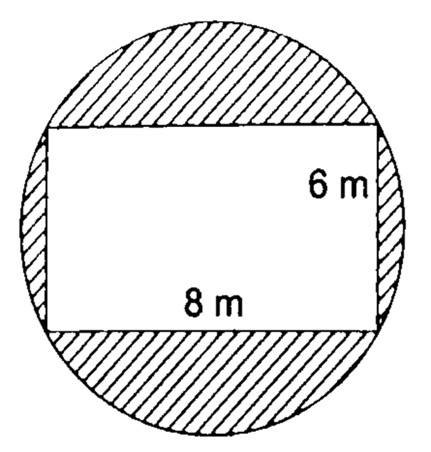
Step 1: The shaded region = Area of the circle − Area of the rectangle.
Step 2: Dimensions of the rectangle:
Length = 8 m
Breadth = 6 m
Diagonal of rectangle:
\[
d = \sqrt{8^2 + 6^2} \\
= \sqrt{64 + 36} \\
= \sqrt{100} = 10\text{ m}
\]Step 3: The rectangle is inscribed in the circle, so the diagonal of the rectangle is the diameter of the circle.
Radius of the circle:
\[
r = \frac{10}{2} = 5\text{ m}
\]Step 4: Area of the circle:
\[
= \pi r^2 \\
= \frac{22}{7} \times 5^2 \\
= \frac{22}{7} \times 25 \\
= 78.57\text{ m}^2
\]Step 5: Area of the rectangle:
\[
= 8 \times 6 \\
= 48\text{ m}^2
\]Step 6: Area of the shaded portion:
\[
= 78.57 – 48 \\
= 30.57\text{ m}^2 \approx 30.6\text{ m}^2
\]Answer: a. 30.6 m²
Q31: A bed of roses is as shown in the adjoining diagram. In the centre, is a square and on each side there is a semi-circle. The side of the square is 21 m. If each rose plant needs 6 m² of space the number of plants is
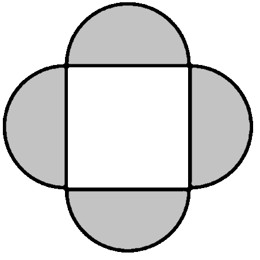
Step 1: The figure consists of:
(i) One square at the centre
(ii) Four semicircles, one on each side of the square
Side of square = 21 m
Step 2: Area of the square:
\[
\text{Area} = 21 \times 21 \\
= 441\text{ m}^2
\]Step 3: Each semicircle has diameter equal to the side of the square.
So, radius of each semicircle:
\[
r = \frac{21}{2} = 10.5\text{ m}
\]Step 4: Area of one semicircle:
\[
= \frac{1}{2}\pi r^2 \\
= \frac{1}{2} \times \frac{22}{7} \times (10.5)^2 \\
= 173.25\text{ m}^2
\]Step 5: Area of four semicircles (i.e. two full circles):
\[
= 4 \times 173.25 \\
= 693\text{ m}^2
\]Step 6: Total area of the bed of roses:
\[
= \text{Area of square} + \text{Area of semicircles} \\
= 441 + 693 \\
= 1134\text{ m}^2
\]Step 7: Each rose plant requires 6 m² of space.
Number of plants:
\[
= \frac{1134}{6} = 189
\]Answer: d. 189
Q32: Four horses are tethered at four corners of a square plot of side 63 m, so that they just cannot reach one another. The area left ungrazed is
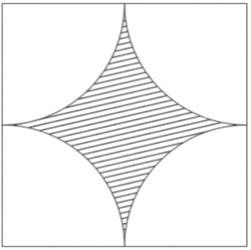
Step 1: Since the horses are tied at the four corners and just cannot reach one another,
each horse grazes a quadrant (quarter circle).
Side of the square = 63 m
So, radius of each quadrant:
\[
r = \frac{63}{2} = 31.5\text{ m}
\]Step 2: Area of the square plot:
\[
\text{Area} = 63 \times 63 \\
= 3969\text{ m}^2
\]Step 3: Four quadrants together form one full circle.
Area grazed by the horses:
\[
= \pi r^2 \\
= \frac{22}{7} \times (31.5)^2 \\
= \frac{22}{7} \times 992.25 \\
= 3118.5\text{ m}^2
\]Step 4: Area left ungrazed:
\[
= \text{Area of square} – \text{Area grazed} \\
= 3969 – 3118.5 \\
= 850.5\text{ m}^2
\]Answer: d. 850.5 m²

Leave a Comment