

Competency Focused Questions
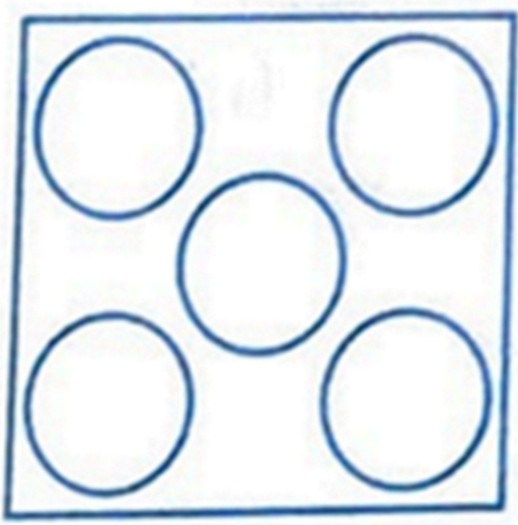
Q1: The order of rotational symmetry of the given figure is:
Step 1: Observe the given figure carefully.
It is a square with five identical circles arranged symmetrically (one at centre and four around it).
Step 2: Rotate the figure through 90°.
The figure fits exactly on itself.
Step 3: Rotate it further through 180° and 270°.
Each time, the figure again fits exactly on itself.
Step 4: In one full rotation (360°), the figure matches itself 4 times:
360° ÷ 4 = 90° each time.
Step 5: So, the order of rotational symmetry = 4.
Answer:
Correct option: (b) 4
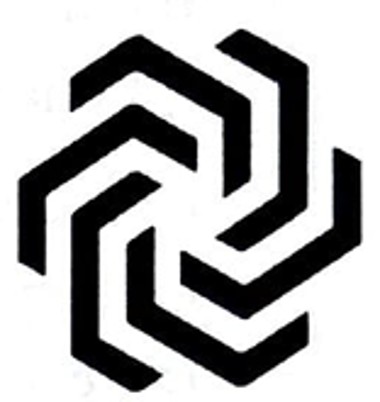
Q2: The order of rotational symmetry of the given figure is:
Step 1: Understand the figure’s composition.
The figure consists of six identical segments arranged around a central point.
Each segment is a rotational unit.
Step 2: Calculate the angle of rotation.
A full circle is \(360^{\circ}\). Since there are 6 segments, the angle for one rotation is \(360^{\circ} / 6 = 60^{\circ}\).
Step 3: Determine the order of symmetry.
The order of rotational symmetry is the number of times the figure looks identical during a \(360^{\circ}\) rotation.
Because it aligns every \(60^{\circ}\), the order is 6.
Answer: (b) 6
Q3: The given figure has:

Step 1: Let us first check whether the figure has any line of symmetry or not.
We imagine a vertical mirror line. The left part does not coincide with the right part. ❌
So, the figure has no vertical line of symmetry.
Step 2: Now imagine a horizontal mirror line.
The upper part of the figure does not match with the lower part. ❌
So, the figure has no horizontal line of symmetry.
Conclusion from Step 1 & 2: The figure has no line of symmetry.
Step 3: Now let us check for rotational symmetry.
Rotate the figure through 180° about its centre.
After rotation, the figure exactly matches its original position. ✅
Step 4: Since the figure matches itself only once in one full rotation (360°), the order of rotational symmetry is:
360° ÷ 180° = 2
Conclusion: The figure has rotational symmetry of order 2 and no line of symmetry.
Answer: c. No line of symmetry and rotational symmetry of order 2
Q4: A student claims that we can have a figure with rotational symmetry whose smallest angle of symmetry is 32°? His statement is:
Step 1: The smallest angle of rotational symmetry of a figure is given by:
Smallest angle = 360° ÷ n,
where n is a whole number greater than 1.
Verification of the claim
Step 2: Let the smallest angle of rotation = 32°.
Step 3: Then, 360° ÷ n = 32°
Step 4: n = 360 ÷ 32 = 11.25
Step 5: Since n must be a whole number,
the value n = 11.25 is not possible.
Step 6: Therefore, a figure cannot have 32° as its smallest angle of rotational symmetry.
Answer: b. Incorrect
Q5: The order of rotational symmetry of the symbol Ashok Chakra is:
Step 1: The Ashok Chakra has 24 equally spaced spokes.
Step 2: Order of rotational symmetry = number of times the figure coincides with itself in a full rotation of 360°.
Step 3: Since the Ashok Chakra has 24 identical spokes,
it coincides with itself 24 times during one full rotation.
Step 4: Hence, the order of rotational symmetry = 24.
Answer:d. 24
Q6: In the figure, which three more squares should be shaded so that the completed square grid has rotational symmetry of order 4? (Ignore the numbers put on the squares. These are only for counting purposes.)
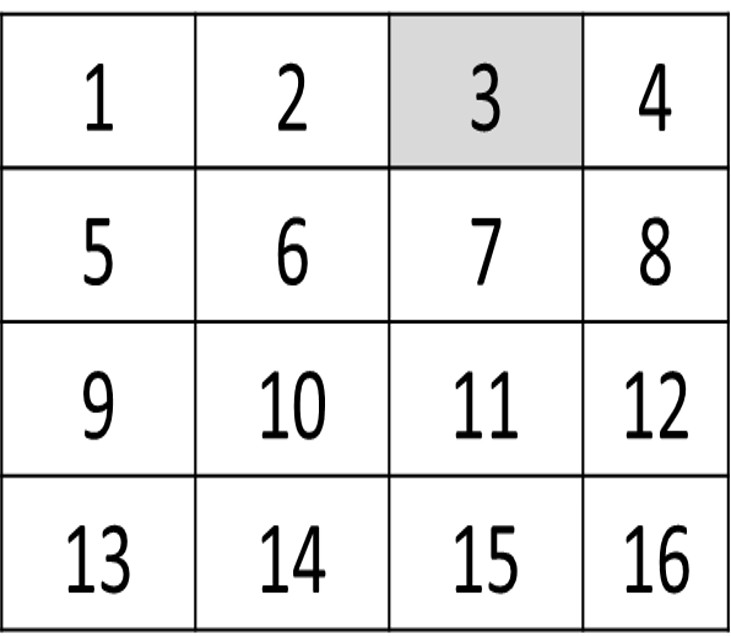
Step 1: The given figure is a 4 × 4 square grid containing 16 small squares.
Step 2: Rotational symmetry of order 4 means that the figure coincides with itself after rotations of:
90°, 180°, 270°, and 360°.
Step 3: Therefore, shaded squares must repeat their positions every 90° rotation about the centre of the grid.
Rotation mapping rule
Step 4: In a 4 × 4 grid, the positions that correspond under 90° rotation form a group of four squares.
Step 5: If one square in such a group is shaded, the remaining three corresponding squares must also be shaded to maintain rotational symmetry of order 4.
Checking the options
Step 6: Among the given options, only the set (5, 12, 14) lies exactly at the positions obtained by rotating a square through 90° each time about the centre of the grid.
Step 7: Shading squares 5, 12, and 14 completes a group of four rotationally symmetric squares.
Step 8: Option (d) is invalid because square 19 does not exist in a 4 × 4 grid.
Answer: c. 5, 12, 14
Q7: In the figure, which one more square should be shaded that the completed square gird has one line of symmetry? (Ignore the numbers put on the squares. These are only for counting purposes.)
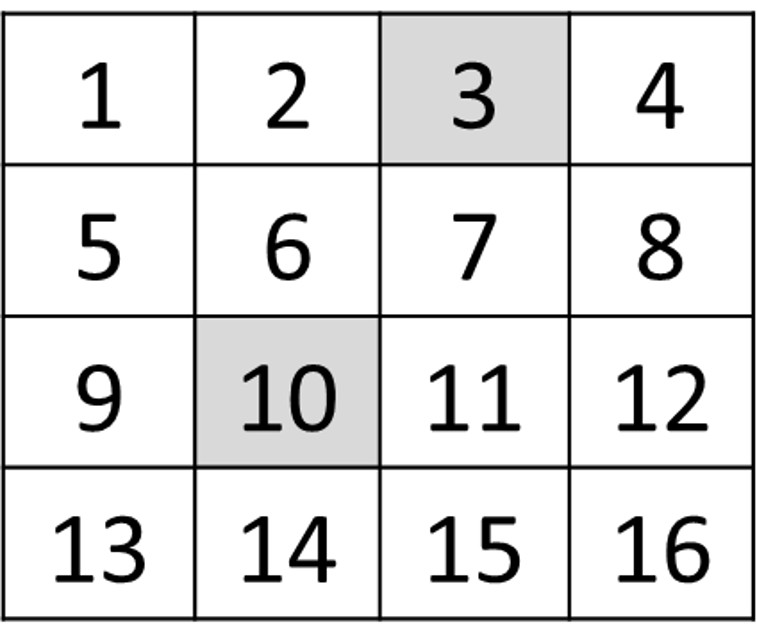
Step 1: The given figure is a 4 × 4 square grid consisting of 16 small squares.
Step 2: A figure with one line of symmetry must be divisible into two identical mirror images by a single straight line.
Step 3: The line of symmetry in the given grid is the vertical line passing through the centre of the grid. The line of symmetry will pass through points 4, 7, 10, 13.
Step 4: For this vertical line of symmetry,
each shaded square on the left side must have a corresponding shaded square at the same distance on the right side.
Step 5: Among the given options, square 8 lies exactly at the mirror position of the already shaded square 3 with respect to the line of symmetry.
Step 6: Shading square 9, 13, or 15 does not produce mirror images across a single straight line.
Step 7: Hence, only square 8 completes the figure with exactly one line of symmetry.
Answer: a. 8

Leave a Comment