

Exercise: 22-B
Q1: Multiple Choice Type
i. The length and the breadth of a rectangle are in the ratio 9 : 5. If its area is 180 m²; the length (longest side) of the rectangle is:
Step 1: Let length = \(9x\) and breadth = \(5x\). Area of rectangle is:
\[
\text{Area} = \text{length} \times \text{breadth} = 9x \times 5x = 45x^2
\]Step 2: Given area is 180 m², so:
\[
45x^2 = 180 \\
\Rightarrow x^2 = \frac{180}{45} = 4 \\
\Rightarrow x = 2
\]Step 3: Calculate length:
\[
\text{Length} = 9x = 9 \times 2 = 18 \text{ m}
\]Answer: d. 18 m
ii. The adjacent sides of a rectangle are 16 m and 9 m. The length of the square whose area is equal to the area of the rectangle is:
Step 1: Area of rectangle:
\[
\text{Area} = 16 \times 9 = 144 \text{ m}^2
\]Step 2: Let the side of the square be \(a\). Its area is equal to rectangle’s area:
\[
a^2 = 144 \\
\Rightarrow a = \sqrt{144} = 12
\]Answer: c. 12 m
iii. The area of a square, with perimeter 16 cm is:
Step 1: Let the side of square be \(a\). Perimeter \(P = 4a\), so:
\[
4a = 16 \\
\Rightarrow a = \frac{16}{4} = 4 \text{ cm}
\]Step 2: Area of square:
\[
a^2 = 4^2 = 16 \text{ cm}^2
\]Answer: a. 16 cm²
iv. The perimeter of square with area 169 m² is:
Step 1: Let side of square be \(a\). Area:
\[
a^2 = 169 \\
\Rightarrow a = \sqrt{169} = 13 \text{ m}
\]Step 2: Perimeter:
\[
P = 4a = 4 \times 13 = 52 \text{ m}
\]Answer: a. 52 m
v. The area of square with diagonal 10 cm is:
Step 1: Let side of square be \(a\). Diagonal \(d = 10\) cm.
Use relation between diagonal and side:
\[
d = a \sqrt{2} \\
\Rightarrow a = \frac{d}{\sqrt{2}} = \frac{10}{\sqrt{2}} = 5 \sqrt{2}
\]Step 2: Calculate area:
\[
\text{Area} = a^2 = (5 \sqrt{2})^2 = 25 \times 2 = 50 \text{ cm}^2
\]Answer: b. 50 cm²
Q2: Find the length and perimeter of a rectangle, whose area = 120 cm² and breadth = 8 cm.
Step 1: Given,
Area \(A = 120 \text{ cm}^2\), breadth \(b = 8 \text{ cm}\).
Step 2: Use formula for area of rectangle:
\[
A = \text{length} \times \text{breadth} \\
\Rightarrow 120 = l \times 8
\]Step 3: Solve for length \(l\):
\[
l = \frac{120}{8} = 15 \text{ cm}
\]Step 4: Calculate perimeter \(P\) of rectangle:
\[
P = 2 (l + b) = 2 (15 + 8) = 2 \times 23 = 46 \text{ cm}
\]Answer: Length = 15 cm, Perimeter = 46 cm
Q3: The perimeter of a rectangle is 46 m and its length is 15 m. Find its:
i. Breadth
Step 1: Given perimeter \(P = 46 \text{ m}\), length \(l = 15 \text{ m}\).
Formula for perimeter:
\[
P = 2(l + b)
\]Step 2: Substitute values and solve for breadth \(b\):
\[
46 = 2(15 + b) \\
\Rightarrow 23 = 15 + b \\
\Rightarrow b = 23 – 15 = 8 \text{ m}
\]Answer: Breadth = 8 m
ii. Area
Step 1: Area formula:
\[
\text{Area} = l \times b = 15 \times 8 = 120 \text{ m}^2
\]Answer: Area = 120 m²
iii. Diagonal
Step 1: Use Pythagoras theorem:
\[
\text{Diagonal} = d = \sqrt{l^2 + b^2} = \sqrt{15^2 + 8^2} = \sqrt{225 + 64} = \sqrt{289} = 17 \text{ m}
\]Answer: Diagonal = 17 m
Q4: The diagonal of a rectangle is 34 cm. If its breadth is 16 cm, find its:
i. Length
Step 1: Given diagonal \(d = 34\) cm, breadth \(b = 16\) cm.
Use Pythagoras theorem:
\[
d^2 = l^2 + b^2
\]Step 2: Substitute known values:
\[
34^2 = l^2 + 16^2 \\
\Rightarrow 1156 = l^2 + 256
\]Step 3: Solve for length \(l\):
\[
l^2 = 1156 – 256 = 900 \\
\Rightarrow l = \sqrt{900} = 30 \text{ cm}
\]Answer: Length = 30 cm
ii. Area
Step 1: Area of rectangle:
\[
\text{Area} = l \times b = 30 \times 16 = 480 \text{ cm}^2
\]Answer: Area = 480 cm²
Q5: The area of a small rectangular plot is 84 m². If the difference between its length and the breadth is 5 m, find its perimeter.
Step 1: Let length = \(l\) m and breadth = \(b\) m.
Given, difference between length and breadth:
\[
l – b = 5
\]Step 2: Given area:
\[
l \times b = 84
\]Step 3: From step 1, express length:
\[
l = b + 5
\]Step 4: Substitute \(l\) in area equation:
\[
(b + 5) \times b = 84 \\
\Rightarrow b^2 + 5b – 84 = 0
\]Step 5: Solve quadratic equation \(b^2 + 5b – 84 = 0\):
Discriminant \(\Delta = 5^2 – 4 \times 1 \times (-84) = 25 + 336 = 361\)
\[
b = \frac{-5 \pm \sqrt{361}}{2} = \frac{-5 \pm 19}{2}
\]Step 6: Possible values:
\[
b = \frac{-5 + 19}{2} = \frac{14}{2} = 7 \quad \text{(valid, since length and breadth are positive)}
\]
or
\[
b = \frac{-5 – 19}{2} = \frac{-24}{2} = -12 \quad \text{(not valid)}
\]Step 7: Find length:
\[
l = b + 5 = 7 + 5 = 12
\]Step 8: Calculate perimeter \(P\):
\[
P = 2(l + b) = 2(12 + 7) = 2 \times 19 = 38 \text{ m}
\]Answer: Perimeter = 38 m
Q6: The diagonal of a square is 15 m; find the length of its one side and perimeter.
Step 1: Let the side of the square be \(a\) m.
Given diagonal \(d = 15\) m.
Step 2: Use relation between diagonal and side of a square:
\[
d = a \sqrt{2} \\
\Rightarrow a = \frac{d}{\sqrt{2}} = \frac{15}{\sqrt{2}} = \frac{15 \sqrt{2}}{2}
\]Step 3: Calculate the length of one side:
\[
a = \frac{15 \sqrt{2}}{2} \approx \frac{15 \times 1.414}{2} = \frac{21.21}{2} = 10.605 \text{ m}
\]Step 4: Calculate perimeter \(P\) of the square:
\[
P = 4a = 4 \times 10.605 = 42.42 \text{ m}
\]Answer: Side length = \(\frac{15 \sqrt{2}}{2}\) m (approximately 10.61 m), Perimeter = 42.42 m
Q7: The length of a rectangle is 16 cm and its perimeter is equal to the perimeter of a square with side 12.5 cm. Find the area of the rectangle.
Step 1: Given length of rectangle \(l = 16\) cm.
Side of square \(a = 12.5\) cm.
Step 2: Calculate perimeter of square:
\[
P_{\text{square}} = 4a = 4 \times 12.5 = 50 \text{ cm}
\]Step 3: Since perimeter of rectangle equals perimeter of square,
\[
P_{\text{rectangle}} = 50 \text{ cm}
\]Step 4: Perimeter formula for rectangle:
\[
P = 2(l + b) \\
\Rightarrow 50 = 2(16 + b) \\
\Rightarrow 25 = 16 + b \\
\Rightarrow b = 9 \text{ cm}
\]Step 5: Calculate area of rectangle:
\[
\text{Area} = l \times b = 16 \times 9 = 144 \text{ cm}^2
\]Answer: Area = 144 cm²
Q8: The perimeter of a square is numerically equal to its area. Find its area.
Step 1: Let the side of the square be \(a\).
Step 2: Perimeter of the square:
\[
P = 4a
\]Step 3: Area of the square:
\[
A = a^2
\]Step 4: Given perimeter equals area:
\[
4a = a^2
\]Step 5: Rearrange the equation:
\[
a^2 – 4a = 0 \\
\Rightarrow a(a – 4) = 0
\]Step 6: Possible solutions:
\[
a = 0 \quad \text{(not valid)}, \quad a = 4
\]Step 7: Calculate area:
\[
A = a^2 = 4^2 = 16
\]Answer: Area = 16 sq units
Q9: Each side of a rectangle is doubled. Find the ratio between:
i. Perimeters of the original rectangle and the resulting rectangle
Step 1: Let the original length and breadth be \(l\) and \(b\).
Step 2: Original perimeter:
\[
P_{\text{original}} = 2(l + b)
\]Step 3: After doubling sides, new length and breadth are \(2l\) and \(2b\).
New perimeter:
\[
P_{\text{new}} = 2(2l + 2b) = 2 \times 2 (l + b) = 4(l + b)
\]Step 4: Ratio of perimeters:
\[
\frac{P_{\text{original}}}{P_{\text{new}}} = \frac{2(l + b)}{4(l + b)} = \frac{2}{4} = \frac{1}{2}
\]Answer: Ratio of perimeters = 1 : 2
ii. Areas of the original rectangle and the resulting rectangle
Step 1: Original area:
\[
A_{\text{original}} = l \times b
\]Step 2: New area after doubling sides:
\[
A_{\text{new}} = (2l) \times (2b) = 4lb = 4 A_{\text{original}}
\]Step 3: Ratio of areas:
\[
\frac{A_{\text{original}}}{A_{\text{new}}} = \frac{A_{\text{original}}}{4 A_{\text{original}}} = \frac{1}{4}
\]Answer: Ratio of areas = 1 : 4
Q10: In each of the following cases ABCD is a square and PQRS is a rectangle. Find, in each case, the area of the shaded portion.(All measurements are in metre).
Case (i)
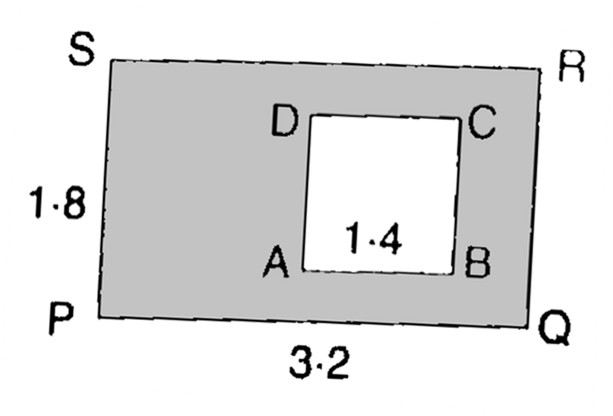
Step 1: From the figure:
PQRS is a rectangle with:
\[
PQ = 3.2,\quad PS = 1.8
\]Area of rectangle PQRS:
\[
= 3.2 \times 1.8 = 5.76
\]Step 2: ABCD is a square with side:
\[
AB = 1.4
\]Area of square ABCD:
\[
= 1.4^2 = 1.96
\]Step 3: Area of shaded portion:
\[
= \text{Area of rectangle} – \text{Area of square} \\
= 5.76 – 1.96 \\
= 3.80
\]Answer: Area of shaded portion = 3.8 m²
Case (ii)
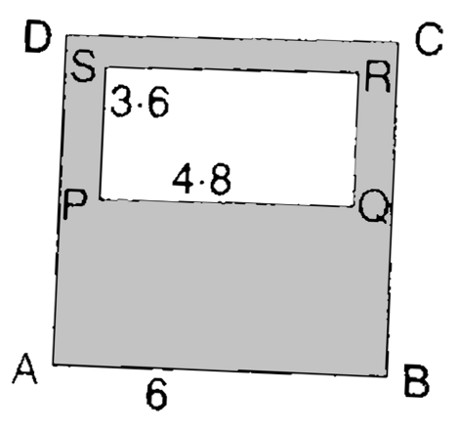
Step 1: From the figure:
ABCD is a square with side:
\[
AB = 6
\]Area of square ABCD:
\[
= 6^2 = 36
\]Step 2: PQRS is a rectangle with:
\[
PQ = 4.8,\quad PS = 3.6
\]Area of rectangle PQRS:
\[
= 4.8 \times 3.6 \\
= 17.28
\]Step 3: Area of shaded portion:
\[
= \text{Area of square} – \text{Area of rectangle} \\
= 36 – 17.28 \\
= 18.72
\]Answer: Area of shaded portion = 18.72 m²
Q11: A path of uniform width, 3 m, runs around the outside of a square field of side 21 m. Find the area of the path.
Step 1: Given side of square field \(s = 21\) m.
Width of path \(w = 3\) m.
Step 2: Calculate the side length of the larger square including the path:
\[
s_{\text{large}} = s + 2w = 21 + 2 \times 3 = 21 + 6 = 27 \text{ m}
\]Step 3: Calculate area of larger square:
\[
A_{\text{large}} = (s_{\text{large}})^2 = 27^2 = 729 \text{ m}^2
\]Step 4: Calculate area of the field:
\[
A_{\text{field}} = s^2 = 21^2 = 441 \text{ m}^2
\]Step 5: Area of the path = Area of larger square – Area of field:
\[
A_{\text{path}} = A_{\text{large}} – A_{\text{field}} = 729 – 441 = 288 \text{ m}^2
\]Answer: Area of the path = 288 m²
Q12: A path of uniform width, 2.5 m, runs around the inside of a rectangular field 30 m by 27 m. Find the area of the path.
Step 1: Given dimensions of rectangular field:
Length \(L = 30\) m, Breadth \(B = 27\) m.
Width of path \(w = 2.5\) m.
Step 2: Calculate the dimensions of the inner rectangle (field excluding path):
\[
L_{\text{inner}} = L – 2w = 30 – 2 \times 2.5 = 30 – 5 = 25 \text{ m} \\
B_{\text{inner}} = B – 2w = 27 – 2 \times 2.5 = 27 – 5 = 22 \text{ m}
\]Step 3: Calculate area of the outer rectangle (whole field):
\[
A_{\text{outer}} = L \times B = 30 \times 27 = 810 \text{ m}^2
\]Step 4: Calculate area of the inner rectangle (excluding path):
\[
A_{\text{inner}} = L_{\text{inner}} \times B_{\text{inner}} = 25 \times 22 = 550 \text{ m}^2
\]Step 5: Calculate area of the path:
\[
A_{\text{path}} = A_{\text{outer}} – A_{\text{inner}} = 810 – 550 = 260 \text{ m}^2
\]Answer: Area of the path = 260 m²
Q13: The length of a hall is 18 m and its width is 13.5 m. Find the least number of square tiles, each of side 25 cm, required to cover the floor of the hall. In each case, find thecost of the tiles required at the rate of ₹6 per tile.
Step 1: Convert the side of tile into metres. \[ 25 \text{ cm} = 0.25 \text{ m} \]Step 2: Area of one square tile. \[ \text{Area of tile} = 0.25 \times 0.25 \\ = 0.0625 \text{ m}^2 \]
i. Without leaving any margin
Step 3: Area of the hall.
\[
\text{Area} = 18 \times 13.5 \\
= 243 \text{ m}^2
\]Step 4: Number of tiles required.
\[
\text{Number of tiles} = \frac{\text{Area of hall}}{\text{Area of one tile}} \\
= \frac{243}{0.0625} \\
= 3888
\]Step 5: Cost of tiles.
\[
\text{Cost} = 3888 \times 6 \\
= 23328
\]Answer:Number of tiles required = 3888 and cost = ₹23328.
ii. Leaving a margin of width 1.5 m all around
Step 6: Reduce the dimensions of the hall.
Margin is on both sides.
\[
\text{New length} = 18 – 2(1.5) = 18 – 3 = 15 \text{ m} \\
\text{New width} = 13.5 – 2(1.5) = 13.5 – 3 = 10.5 \text{ m}
\]Step 7: Area of the remaining floor.
\[
\text{Area} = 15 \times 10.5 \\
= 157.5 \text{ m}^2
\]Step 8: Number of tiles required.
\[
\text{Number of tiles} = \frac{157.5}{0.0625} \\
= 2520
\]Step 9: Cost of tiles.
\[
\text{Cost} = 2520 \times 6 \\
= 15120
\]Answer:Number of tiles required = 2520 and cost = ₹15120.
Q14: A rectangular field is 30 m in length and 22 m in width. Two mutually perpendicular roads, each 2.5 m wide, are drawn inside the field so that one road is parallel to the length of the field and the other road is parallel to its width. Calculate the area of the crossroads.
Step 1: Given:
Length of field \(L = 30\) m, Width of field \(W = 22\) m.
Width of each road \(w = 2.5\) m.
Step 2: Calculate area of the road parallel to the length:
\[
A_{\text{road 1}} = \text{length} \times \text{width} = L \times w = 30 \times 2.5 = 75 \text{ m}^2
\]Step 3: Calculate area of the road parallel to the width:
\[
A_{\text{road 2}} = \text{width} \times \text{width} = W \times w = 22 \times 2.5 = 55 \text{ m}^2
\]Step 4: The intersection area (crossroads) is counted twice in above addition. Calculate area of intersection:
\[
A_{\text{intersection}} = w \times w = 2.5 \times 2.5 = 6.25 \text{ m}^2
\]Step 5: Area of crossroads:
\[
A_{\text{crossroads}} = A_{\text{road 1}} + A_{\text{road 2}} – A_{\text{intersection}} = 75 + 55 – 6.25 = 123.75 \text{ m}^2
\]Answer: Area of the crossroads = 123.75 m²
Q15: The length and the breadth of a rectangular field are in the ratio 5 : 4 and its area is 3380 m². Find the cost of fencing it at the rate of ₹75 per m.
Step 1: Let the length be \(5x\) m and breadth be \(4x\) m.
Step 2: Area of rectangle:
\[
\text{Area} = \text{length} \times \text{breadth} = 5x \times 4x = 20x^2
\]
Given area = 3380 m², so:
\[
20x^2 = 3380
\]Step 3: Solve for \(x\):
\[
x^2 = \frac{3380}{20} = 169 \\
\Rightarrow x = \sqrt{169} = 13
\]Step 4: Calculate length and breadth:
\[
\text{Length} = 5x = 5 \times 13 = 65 \text{ m} \\
\text{Breadth} = 4x = 4 \times 13 = 52 \text{ m}
\]Step 5: Calculate perimeter:
\[
P = 2(\text{length} + \text{breadth}) = 2(65 + 52) = 2 \times 117 = 234 \text{ m}
\]Step 6: Cost of fencing at ₹75 per meter:
\[
\text{Cost} = 234 \times 75 = ₹17,550
\]Answer: Cost of fencing = ₹17,550
Q16: The length and the breadth of a conference hall are in the ratio 7 : 4 and its perimeter is 110 m. Find:
i. Area of the floor of the hall.
Step 1: Let length = \(7x\) m and breadth = \(4x\) m.
Given perimeter \(P = 110\) m.
Step 2: Perimeter formula:
\[
P = 2(l + b) \\
\Rightarrow 110 = 2(7x + 4x) = 2 \times 11x = 22x
\]Step 3: Solve for \(x\):
\[
22x = 110 \\
\Rightarrow x = \frac{110}{22} = 5
\]Step 4: Calculate length and breadth:
\[
l = 7x = 7 \times 5 = 35 \text{ m}, \quad b = 4x = 4 \times 5 = 20 \text{ m}
\]Step 5: Calculate area:
\[
\text{Area} = l \times b = 35 \times 20 = 700 \text{ m}^2
\]Answer: Area = 700 m²
ii. Number of tiles, each a rectangle of size 25 cm × 20 cm, required for flooring of the hall.
Step 1: Convert area of hall to cm²:
\[
700 \text{ m}^2 = 700 \times 10,000 = 7,000,000 \text{ cm}^2
\]Step 2: Area of one tile:
\[
25 \text{ cm} \times 20 \text{ cm} = 500 \text{ cm}^2
\]Step 3: Number of tiles required:
\[
\frac{7,000,000}{500} = 14,000
\]Answer: Number of tiles = 14,000
iii. The cost of the tiles at the rate ₹1,400 per hundred tiles.
Step 1: Number of hundreds of tiles:
\[
\frac{14,000}{100} = 140
\]Step 2: Cost of tiles:
\[
140 \times 1400 = ₹196,000
\]Answer: Cost = ₹196,000
Leave a Comment